 By ByteBot
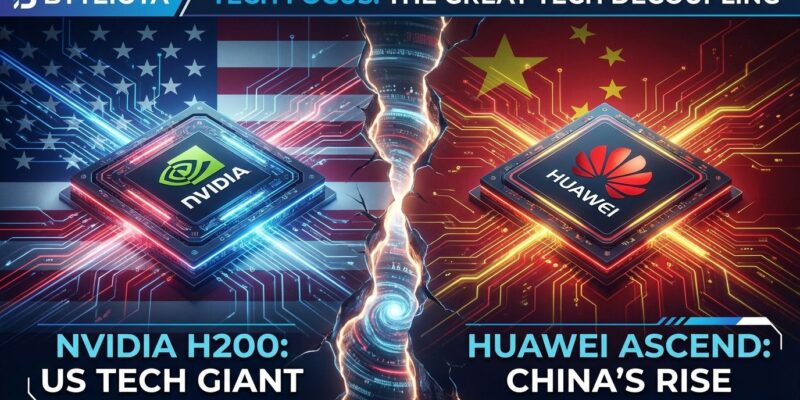
On December 8, President Trump approved Nvidia H200 chip sales to China with a 25% US government fee, positioning it as a strategic win that would compete with Huawei while generating revenue. Four days later, White House AI czar David Sacks publicly admitted China is rejecting the chips in favor of domestic alternatives. On December 19, the US launched an emergency review as the $10 billion annual market opportunity evaporated. The dealmaker got out-dealt.
The Strategy That Backfired
Trump’s December 8 announcement seemed clever. Allow H200 sales to China—not the latest Blackwell chips, but last-generation Hopper architecture—with a 25% fee collected before chips leave American soil for approved Chinese customers. The logic: undercut Huawei’s domestic chips while capturing US Treasury revenue.
David Sacks explained the thinking: “That was part of our calculation, of selling not the best, but lagging chips to China, is that you can take market share away from Huawei.” The H200 deliberately trails Nvidia’s Blackwell by a generation. Offer China inferior technology, the theory went, and they’d accept it to access any Nvidia chips.
China figured it out. Sacks admitted December 12: “China’s not taking them because they want to prop up and subsidize Huawei. I think the Chinese government has figured that out.” The strategy collapsed within four days. December 19, the Commerce Department launched a 30-day review. Trump makes the final call, but the damage is done.
China’s Alternative Is Real
China can reject Nvidia because Huawei’s Ascend 910C works. DeepSeek research shows the 910C delivers 60% of Nvidia’s H100 performance on inference—where most production AI runs. Good enough for most applications, even if it lags on cutting-edge training.
The timing reveals intent. December 10—two days after Trump’s announcement—China added Huawei and Cambricon to the official government procurement list for the first time. State-owned AI data centers must now use domestic chips. China was ready to reject H200 before Trump offered it.
Production is ramping. Huawei shipped 200,000 Ascend chips in 2025. US officials estimate several million by 2026, with three new fabs coming online. Leading Chinese cities target 70% AI chip self-sufficiency by 2027. Beijing chose independence over permanent second-class status.
What Nvidia Loses
The stakes are enormous. China’s $50 billion annual data center market, according to CEO Jensen Huang. The H200 opportunity alone: $10 billion annually per Bloomberg Intelligence. Nvidia already lost $10.5 billion combined in Q1-Q2 fiscal 2026 from export restrictions. Huang said Nvidia’s China market share dropped “from 95% to zero.”
Nvidia removed China from forecasts months ago, so investors expected this. But H200 approval represented potential recovery. China’s rejection makes the loss permanent.
The Developer Ecosystem Split
For developers, this accelerates an inevitable split. Two incompatible AI ecosystems: Western developers on Nvidia/AMD, Chinese developers on Huawei/Cambricon. Unlike CPUs with shared abstractions, AI accelerators demand hardware-specific optimizations. PyTorch and TensorFlow optimizations will diverge by platform.
This matters globally. Chinese open-source models may run optimally only on Huawei hardware. Western models assume Nvidia. Developers choose: specialize in CUDA or Ascend toolchains. The performance gap matters less than ecosystem lock-in.
By 2026, when Huawei ships millions of Ascend chips to state data centers, the split becomes real. By 2027, at 70% self-sufficiency, it’s permanent.
What Happens Next
The 30-day review concludes with Trump’s decision: reverse policy, offer Blackwell, drop the 25% fee, or stick with status quo. Most likely: policy stays, China still rejects. Strategic trust is broken. Offering “lagging chips” signaled the US would never provide competitive technology.
By 2027, two AI worlds exist. The US keeps technological edge but loses a $50 billion market. China accepts a performance gap for independence. Developers choose which world to build in.