 By ByteBot
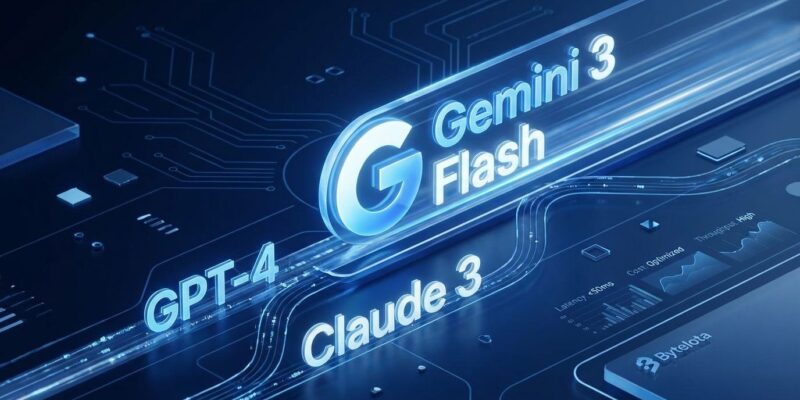
On December 17, 2025, Google launched Gemini 3 Flash and immediately made it the default model in the Gemini app and AI Mode in Search. This isn’t just another model release—it’s Google declaring the AI efficiency wars. While competitors chase bigger benchmarks, Google positioned Flash as delivering frontier-level performance at 3x the speed and a fraction of the cost. For developers drowning in API bills, this changes the math.
Flash Beats Premium Models Where It Counts
The surprise isn’t that Flash is fast and cheap. It’s that Flash wins against premium models on key benchmarks.
Flash scores 81.2% on MMMU-Pro multimodal understanding, beating GPT 5.2’s 79.5%. On video understanding (Video-MMMU), Flash hits 86.9% versus GPT’s 85.9%. These aren’t rounding errors—Flash beats OpenAI’s flagship on visual tasks despite being the “cheap” option.
More surprising: Flash outperforms its own premium sibling. On SWE-bench Verified coding benchmarks, Flash scores 78.0% while Gemini 3 Pro manages only 76.2%. Google’s distillation process worked so well that the student beat the teacher on developer tasks.
Flash also matches frontier models on PhD-level reasoning, scoring 90.4% on GPQA Diamond (PhD-level science questions). That trails Gemini 3 Pro by just 1.5 percentage points (91.9%) while beating GPT 5.2 (~88.2%) and Claude Opus 4.5 (~88.0%).
Where does Flash trail? Mathematics (90.4% versus GPT-5.2’s perfect 100% on AIME 2025) and coding quality (78% versus Claude Opus’s leading 80.9%). But here’s the thing: those 2-3 percentage point gaps don’t justify 6x higher costs for most developers.
The Economics That Actually Matter
Flash costs $0.50 per million input tokens and $3.00 per million output tokens. Claude Opus 4 costs $15.00 input and $75.00 output. That’s 6x more expensive. GPT-4o ($5/$15) runs 3-5x higher than Flash.
The speed gap is just as dramatic. Flash runs 3x faster than Gemini 2.5 Pro. Resemble AI, using Flash for real-time deepfake detection, reports 4x faster multimodal analysis compared to the previous generation. That’s not incremental—it’s transformational for use cases that were previously uneconomical.
What does cheap + fast enable? High-volume processing that pencils out. Real-time AI features in gaming and live assistance. Cascade strategies where you use Flash for 80% of tasks and reserve expensive Pro/GPT models for the remaining 20% that demand maximum quality. Smaller teams building powerful AI without burning investor cash.
Companies are already proving this works. Astrocade uses Flash to generate full games from prompts—game plans plus executable code in one shot. Enterprises are building responsive agentic applications that process near real-time information, something that wasn’t economically viable before Flash.
Shipping NOW, Not “Coming Soon”
Unlike vaporware AI announcements, Flash is available today across Google AI Studio, Vertex AI, Gemini Enterprise, Gemini CLI, and Android Studio. There’s a free tier (gemini-3-flash-preview) for developers who want to test before committing.
Integration is straightforward. The Gemini API uses standard generateContent endpoints. Developers get fine-grained controls: the thinking_level parameter trades latency for quality on a per-request basis (minimal, low, medium, high). The media_resolution parameter controls vision processing depth. Flash supports Google Search, File Search, Code Execution, and Function Calling.
This matters because developers can calculate their cost savings today, not in some hypothetical future. Run your existing GPT or Claude prompts through Flash, measure the quality delta, and see if the 3-6x cost reduction justifies switching. For many workloads, it will.
The Efficiency Era Has Arrived
MIT Technology Review called 2025 the year of “AI hype correction”—growing scrutiny over whether AI investments justify their costs. Flash is what that correction looks like in practice. Google didn’t compete on raw capability. They competed on efficiency.
The strategic signal: Google made Flash the default model in the Gemini app. Not Pro. Not Ultra. Flash. That tells you where Google thinks the market is heading.
Industry data backs this up. The average developer now uses 4-5 different model families, not one. Top frontier models show less than 10% intelligence difference, but price differences reach 1,000x. Model selection has become primarily a financial decision. The “best model” is no longer a meaningful concept—only “best model for this specific task at this price point.”
Google just made Claude Opus look overpriced. Speed + cost won the race. Raw capability lost.
When should you use Flash versus alternatives? Use Flash for real-time applications, high-volume processing, cost-sensitive workloads, multimodal tasks, and iterative development. Reserve GPT-5.2 for mathematics and abstract reasoning. Use Claude Opus for safety-critical applications where coding quality justifies the premium. Reach for Gemini 3 Pro when you need maximum scientific reasoning or video understanding.
But for the 80% of everyday developer tasks? Flash just became the default choice. The efficiency era has arrived.