 By ByteBot
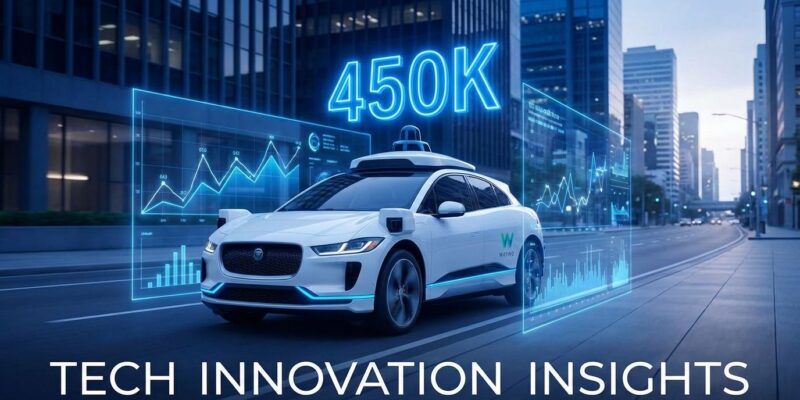
Waymo reached 450,000 weekly robotaxi rides in December 2025, according to investor Tiger Global Management—nearly double the 250,000 rides it reported in April. The milestone proves autonomous vehicles aren’t vaporware anymore. They’re real, scaling fast, and pulling away from competitors. Cruise shut down. Tesla operates with safety monitors. Waymo is the only company running truly driverless rides at scale in the U.S.
Exponential Growth Proves AV Viability
The numbers tell the story. Waymo hit 250,000 weekly rides in April 2025. Six months later, it’s at 450,000. That’s 64,000 rides per day across five cities: Atlanta, Austin, Los Angeles, Phoenix, and San Francisco. The company completed 14 million trips in 2025, tripling last year’s volume.
This isn’t incremental progress. It’s exponential scaling. Waymo targets 1 million rides per week by the end of 2026. If it maintains this growth rate, that’s achievable. The trajectory suggests autonomous vehicles won’t be “10 years away” forever. They’re here now, and the gap between Waymo and everyone else is widening.
Why Waymo Won While Competitors Failed
General Motors killed Cruise in December 2024 after burning through $10 billion. The company couldn’t recover from an October 2023 safety incident where a driverless Cruise vehicle dragged a pedestrian, causing serious injuries. California revoked its testing permit. The CEO resigned. GM pivoted to personal vehicle driver assistance instead.
Tesla launched its robotaxi service in Austin in June 2025, but it still requires safety monitors in the passenger seat. That’s not autonomous. That’s supervised driving. Elon Musk claimed in early December that safety monitors would be removed “in about three weeks.” It hasn’t happened. Meanwhile, Musk’s promises to launch robotaxis in Nevada, Florida, and Arizona by year-end fell through. Tesla operates 31 to 135 vehicles in one city. Waymo operates hundreds across five cities without human oversight.
Waymo succeeded where others failed because it chose safety over speed. The company uses multi-sensor fusion—LIDAR, radar, and cameras working together—while Tesla relies on cameras alone. A Swiss Re study analyzing 25.3 million autonomous miles found Waymo achieved an 88% reduction in property damage claims and a 92% reduction in bodily injury claims compared to human drivers. Tiger Global called Waymo “10x safer than human drivers” in its investor letter.
The technology stack matters. Waymo’s 6th-generation Driver uses 13 cameras, 4 LIDAR sensors, and 6 radar units to create a 360-degree view that detects objects up to 500 meters away, even in darkness or poor weather. The Waymo Foundation Model—a transformer-based AI trained on over 100 million driverless miles—handles perception, prediction, and decision-making in real time.
But the real differentiator was patience. Waymo didn’t rush to IPO. It didn’t scale before the technology was ready. Alphabet’s deep pockets allowed long development cycles without quarterly earnings pressure. Cruise scaled too fast and collapsed. Tesla announced features before they worked. Waymo expanded only after proving safety in each city. Slow and steady won the race.
The Infrastructure Behind Half a Million Weekly Rides
Operating 450,000 rides per week requires more than good sensors and AI. It requires fleet management software, HD mapping updated in real time, automated charging and maintenance scheduling, ride-matching algorithms, and remote operations centers. The infrastructure powering Waymo is as impressive as the autonomous driving itself.
For developers, this represents a massive opportunity. Waymo is hiring ML engineers, robotics specialists, computer vision experts, and infrastructure software engineers. The adjacent markets—mapping services, simulation tools, fleet management platforms, AV insurance tech—are expanding. The autonomous vehicle ecosystem creates jobs, not just disrupts them.
What’s Next: 1 Million Rides, 12 New Cities, London Launch
Waymo plans to expand to 12 new U.S. cities in 2026: Dallas, Denver, Detroit, Houston, Las Vegas, Miami, Nashville, Orlando, San Antonio, San Diego, and Washington, D.C. It’s testing in New York but hasn’t announced a launch date.
The international expansion begins in 2026. Waymo will launch in London, marking its first market outside the U.S. It’s also testing in Tokyo, though no launch timeline exists yet. The company is raising $15 billion at a $100 billion valuation to fund this growth.
The target is 1 million rides per week by the end of 2026 and 20-plus cities by 2027. If Waymo hits those numbers, autonomous vehicles transition from novelty to mainstream transportation option. The race is over. Waymo won. Now it’s about execution at scale.