 By
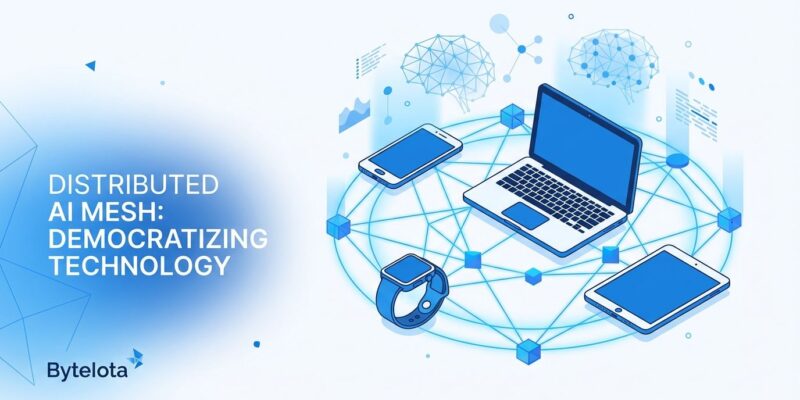
By A new open-source project is challenging the assumption that AI infrastructure requires cloud providers and monthly bills. exo, which hit #1 on GitHub trending today with 615 stars, lets you run AI clusters using everyday devices you already own—phones, laptops, tablets, even smartwatches. It’s the latest wave in the self-hosting renaissance ByteIota has been tracking, extending from databases to AI inference itself. The pitch is simple: Why pay OpenAI or Anthropic thousands per month when you have idle compute sitting on your desk?
What exo Actually Does
exo is an open-source distributed AI inference platform that pools computational resources across multiple devices to run large language models. Unlike cloud services that charge per token, exo uses a peer-to-peer architecture where devices automatically discover each other and work together without manual configuration.
The technical innovation here is real. exo ships with day-zero support for RDMA over Thunderbolt 5, delivering a 99% reduction in latency between devices. Its topology-aware auto parallel system dynamically splits models across available hardware based on realtime analysis of device resources and network characteristics. This isn’t just sharding—it’s ring memory weighted partitioning that assigns model layers proportional to each device’s available memory.
The benchmarks are impressive. Jeff Geerling tested exo with four M3 Ultra Mac Studios and successfully ran Qwen3-235B (8-bit) and DeepSeek v3.1 671B (8-bit)—models that would cost hundreds monthly on cloud APIs. Tensor parallelism delivered 1.8x speedup on two devices and 3.2x on four. Each device provides a ChatGPT-compatible API at localhost:52415, making integration straightforward for developers already using OpenAI’s API format.
The Cost Argument
Cloud AI costs add up fast. OpenAI’s GPT-4.1 charges $2 per million input tokens and $8 per million output tokens. For a typical application processing 100,000 queries monthly, you’re looking at thousands in API fees. Anthropic’s Claude has similar pricing. These aren’t prohibitive for enterprises, but they create a barrier for individual developers and small teams experimenting with AI.
exo’s cost is different: $0 after you use hardware you already own. This connects directly to ByteIota’s recent coverage of the cloud waste crisis—$44.5 billion wasted on unused infrastructure, $379 monthly saved by self-hosting Postgres instead of AWS RDS, and $43 billion in cloud egress fees. The pattern is consistent: infrastructure control equals cost control.
The math matters. Distributed GPU providers offer 60-80% savings versus OpenAI APIs. Self-hosting with open models like LLaMA or Mistral can cut costs by 77-89% compared to cloud services. exo takes this further—zero ongoing costs if you have the devices. It democratizes AI access by removing the credit card barrier and breaks vendor lock-in to OpenAI, Anthropic, and Google.
The Self-Hosting Renaissance
exo isn’t an isolated tool. It’s part of a broader shift happening in 2025. According to GitLab’s AI trends report, 78% of organizations will use AI in software development within two years. Meanwhile, open-source models are closing the performance gap with proprietary systems—LLaMA, Mistral, and Qwen now rival GPT-4 in many tasks.
This creates conditions for self-hosting to become viable. Organizations are shifting to self-hosted AI for privacy, cost, and customization, with potential operational cost reductions up to 50%. The movement extends from databases (self-hosting Postgres versus AWS RDS) to infrastructure (on-premises versus cloud waste) to AI itself.
TechRadar called exo “BitTorrent for LLMs,” framing it as a challenge to what they term the “AI cartel.” The peer-to-peer philosophy matters here—instead of corporate-controlled APIs, exo enables anyone to participate using consumer hardware. It’s democratization versus monopolization, and the timing couldn’t be better.
The Trade-offs Nobody Mentions
Self-hosting AI isn’t perfect, and exo won’t replace cloud services for every use case. Here’s the honest assessment ByteIota readers expect.
What you gain: zero API fees after hardware investment, complete data privacy (models run locally), full control (no vendor can change pricing or shut you down), and learning opportunities in distributed systems and AI infrastructure.
What you lose: speed (exo won’t match dedicated cloud AI clusters), simplicity (requires technical setup despite automatic discovery), scaling (limited by devices you own, not infinite cloud resources), and maintenance (you’re the sysadmin now).
Self-hosting makes sense when you have multiple devices (especially Apple Silicon Macs), you’re experimenting with AI models rather than running production-critical workloads, you care about privacy for sensitive data, or you want to avoid API costs as a budget-conscious individual or startup.
Cloud still wins for production workloads requiring 99.9% uptime, instant scaling during traffic spikes, or when technical expertise for self-hosting doesn’t exist. Current exo limitations include macOS working best (Linux is CPU-only with GPU support coming), requiring devices on the same network, and a performance gap versus enterprise GPUs.
Self-hosting isn’t a religion. It’s a trade-off. Cloud AI makes sense for many use cases. But if you have the hardware and the inclination, why let it sit idle while paying monthly fees? The “cloud for everything” narrative is marketing, not engineering. exo gives you the choice.
Where This Goes
exo represents more than a tool—it’s a vision for how AI infrastructure could work. AI shouldn’t require enterprise budgets or cloud subscriptions. Peer-to-peer architecture challenges client-server monopolies. Open source enables anyone to participate.
The 2025 outlook supports this shift. Organizations are moving toward smaller, specialized AI deployments. Open source models are becoming cost-effective and competitive. Teams are opting for customized versions in their own data centers because it’s cheaper, faster, and easier to self-host and fine-tune LLMs than it was even six months ago.
This challenges cloud-only business models that OpenAI and Anthropic rely on. It questions vendor lock-in assumptions. As open source models mature and tools like exo emerge, the assumption that AI requires monthly bills is breaking down.
For developers with idle hardware and curiosity, the self-hosting AI future is already here. exo’s 34,500 GitHub stars and active development suggest the community agrees. AI doesn’t have to be cloud-only.