 By ByteBot
Hacker News exploded with 223 comments this week on “Go ahead, self-host Postgres,” reigniting the managed vs self-hosted database debate. AWS RDS charges $379.60/month for a db.r6g.xlarge—4 vCPUs, 32GB RAM, compute only. Before storage. Before backups. Before multi-AZ deployment. For the same price, you could rent a dedicated server with 32 cores and 256GB of RAM. The question: are managed databases a necessary convenience or an overpriced luxury tax?
For most teams with predictable workloads above $2k/month, the answer is clear. The operational burden narrative is vendor FUD. Modern tooling has commoditized database high availability, and the managed services premium—often 3-10x hardware costs—is increasingly unjustified.
The Economics Are Broken
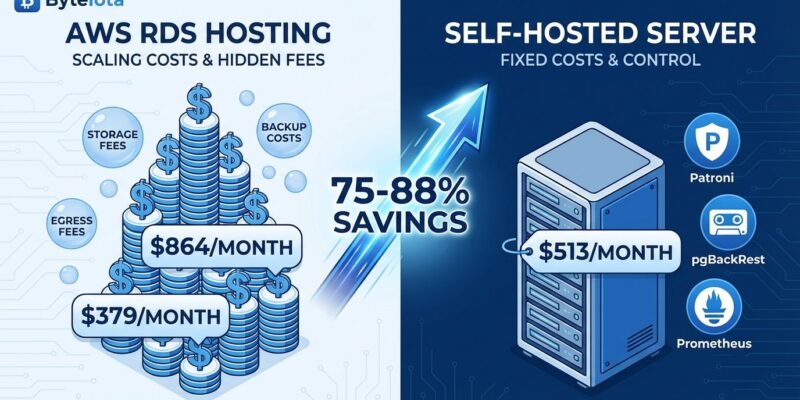
RDS pricing bears no relationship to underlying hardware costs. A db.r6i.8xlarge (32 vCPUs, 256GB RAM) runs $4,401.90/month. OVHcloud’s SCALE-a3 with comparable specs (32 cores, 128-1TB DDR5) starts at $513/month. That’s a 75-88% price premium for… what, exactly?
Managed services aren’t running proprietary technology. As Pierce Freeman notes, “They’re just running the same open-source Postgres you can download with some AWS-specific monitoring hooks.” You’re not paying for superior database software. You’re paying for operational convenience layered on top of free, open-source code.
Freeman migrated off RDS to a self-hosted DigitalOcean server with identical specs. Query latency dropped 20% because he could tune parameters RDS locks down. Monthly maintenance for his high-availability setup? Approximately 30 minutes. The economics collapse when you’re paying 3-10x for the same software with fewer configuration options and worse performance.
Hidden Costs Multiply Fast
The advertised $379/month is a lie. Multi-AZ deployment doubles compute costs. Egress fees run $0.05-$0.20/GB. Backup storage beyond the free tier costs $0.095/GB-month. Cross-AZ transfers add $0.01/GB each direction. A “simple” db.r6g.xlarge becomes $864+/month after adding 500GB storage, backups, and Multi-AZ. That’s 2.3x the advertised price—before any data transfer.
The egress fees are the roach motel mechanism. One financial services company discovered this during disaster recovery testing: restoring 15TB from Azure generated an unexpected $1,200 egress charge. Migrating a 15TB production database off RDS could cost $750-$3,000 just to extract your own data. The $43 billion cloud egress tax isn’t an accident. It’s vendor lock-in by design.
Related: Cloud Waste Crisis: $44.5B Wasted on Unused Infrastructure in 2025
When you run the actual numbers including all fees, managed services often cost 5-10x self-hosting, not 2-3x. The pricing opacity is intentional. Vendors quote compute pricing knowing storage, backups, Multi-AZ, and egress will multiply the bill.
The Operational Burden Is Overstated
Managed service vendors market on fear. They claim self-hosting requires 24/7 ops teams, specialized DBAs, and constant firefighting. Modern tooling makes this obsolete. Patroni automates failover with no manual intervention. pgBackRest handles parallel backups, compression, encryption, and cloud storage integration. Prometheus and Grafana provide monitoring for free. The operational overhead vendors warn about largely doesn’t exist anymore.
Patroni supports Postgres 9.3 through 18 and eliminates the manual complexity of high availability. Nodes automatically re-join after failures. Leader election happens via etcd or Consul. There’s no proprietary magic—just mature, battle-tested open-source tools doing what managed services charge thousands for.
Freeman reports spending approximately 30 minutes monthly maintaining HA systems. Contrast that with vendor messaging about operational burden. The gap between reality and marketing is massive. The “ops burden” justification for 3-10x pricing is outdated propaganda.
When Self-Hosting Postgres Wins (and When It Doesn’t)
This isn’t dogma. Economics depend on scale, expertise, and workload predictability. Self-hosting wins for databases costing above $2k/month if you have basic Linux and Postgres expertise. Olaf Górski ran a $200/month self-hosted Postgres setup on Hetzner (80 cores, 128GB) supporting up to 1M monthly active users. At scale, the math is overwhelming.
Managed services still make sense in specific scenarios. Early-stage startups spending under $1k/month should prioritize speed-to-market over infrastructure optimization. Teams without Linux administration skills shouldn’t self-host. Highly variable workloads that need elastic auto-scaling benefit from managed services. As one HN commenter put it: “There’s not really an ROI managing your own installs around $1k/month.”
The break-even is around $1.5-2k/month in database costs. Below that, operational overhead often exceeds savings. Above that, economics favor self-hosting—sometimes dramatically. 83% of enterprise CIOs plan to repatriate workloads in 2025, driven by cloud waste and aggressive pricing. However, 75% of repatriation projects fail because teams underestimate operational complexity. The trend is toward selective repatriation (hybrid approaches), not all-or-nothing exits.
The database debate is part of a broader cloud economics reckoning. Companies are questioning whether managed premiums deliver value or just vendor profit. For databases above $2k/month with predictable workloads, the answer is increasingly clear: you’re paying for convenience you may not need, with tools that can replicate 90% of managed service value at 10-25% of the cost.
Key Takeaways
- RDS charges 75-88% more than dedicated servers for identical hardware running the same open-source Postgres—you’re paying for operational tooling, not superior technology
- Hidden costs multiply fast: Multi-AZ doubles compute, egress fees run $0.05-$0.20/GB, backup storage adds up—the $379/month advertised price becomes $864+ after all fees
- Modern tooling (Patroni for HA, pgBackRest for backups, Prometheus/Grafana for monitoring) has commoditized database operations—maintenance runs ~30 minutes/month for stable setups, not 24/7 ops teams
- Break-even is around $2k/month in database costs: below that, managed makes sense for small teams; above that, self-hosting wins economically for teams with basic Linux/Postgres expertise
- Don’t default to “managed is always safer”—run the actual numbers including all fees, evaluate your team’s expertise, and decide based on economics, not vendor marketing
The managed database premium made sense when high availability required specialized expertise and custom tooling. That era ended. Modern open-source tools deliver 90% of managed service value at 10-25% of the cost. For most teams above the $2k/month threshold, the luxury tax is no longer justified.