 By ByteBot
Enterprises will burn $44.5 billion on cloud infrastructure they don’t use in 2025—21% of all cloud spending wasted on idle servers, orphaned storage, and over-provisioned resources. The problem isn’t ignorance. According to Harness’s “FinOps in Focus” report, 52% of engineering leaders point to a specific culprit: the disconnect between FinOps teams and developers. One group manages costs without engineering context. The other builds infrastructure without cost visibility. Neither can fix what they can’t see.
Here’s the irony: the FinOps market grew to $5.5 billion in 2025, yet cloud waste increased from 30% of budgets in 2023 to 32% today. Tools aren’t the problem. Organizational silos are.
Developers Can’t Optimize What They Can’t See
62% of developers want more control over cloud costs. Fewer than half have access to the data they need to act on it.
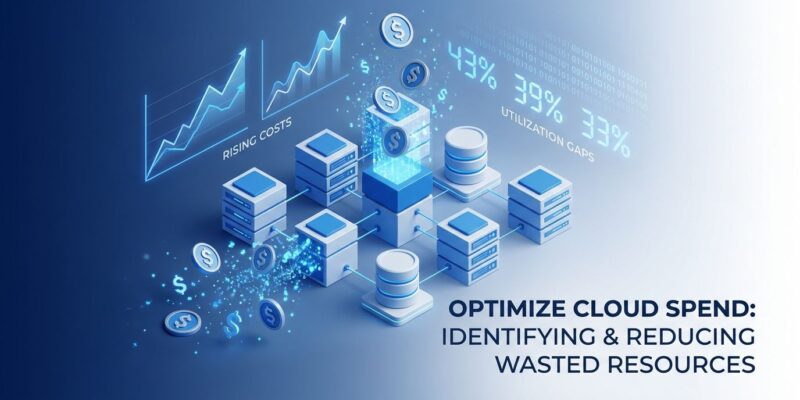
Only 43% of developers have real-time visibility into idle resources. Only 39% can see orphaned resources—old snapshots, forgotten databases, storage volumes from deleted instances. Only 33% can see over or under-provisioned workloads. This isn’t a skills problem. It’s an access problem.
The consequences show up in Kubernetes deployments. 82% of Kubernetes workloads are overprovisioned, with 65% using less than half their requested CPU and memory. One financial services company discovered their job workloads averaged 1.2 CPU cores and 4GB RAM—an 85% overprovisioning rate costing $180,000 annually. They didn’t know because they couldn’t see actual utilization versus requested resources.
The average Kubernetes cluster runs at 10% CPU utilization and 23% memory utilization. Developers aren’t careless. They’re blind. Without visibility into real usage, they default to “more is safer” because the cost of overprovisioning feels less risky than the cost of an outage.
Three Types of Cloud Waste
Cloud waste breaks down into three categories, all stemming from the same problem: accountability without visibility.
Idle resources: Dev and test environments running 24/7 when they should only run during business hours. Databases spun up for experiments and forgotten. Unused load balancers from old projects. Business 2 Community estimates $14.5 billion wasted on idle resources in 2025, typically representing 15-25% of all provisioned resources.
Orphaned resources continue accruing costs indefinitely. Storage volumes from deleted instances, old snapshots retained beyond retention policies, redundant backups from decommissioned applications. Only 39% of developers have visibility to find them.
Over-provisioning represents 30-40% of cloud costs. The gap between provisioned and requested capacity is 40% for CPUs and 57% for memory. In Kubernetes environments specifically, 82% of workloads are overprovisioned.
All three waste types trace back to the same dysfunction: developers are increasingly held accountable for cloud costs but lack real-time visibility into what they’re spending. They can’t see what’s idle, what’s orphaned, or what’s overprovisioned. So they keep paying for it.
The FinOps-Developer Disconnect
52% of engineering leaders cite the disconnect between FinOps and development teams as the primary driver of wasted spend. The problem compounds with every deployment.
FinOps teams can’t optimize without engineering context. Why does this resource exist? Can we shut it down safely? What will break if we change this configuration? Without answers, FinOps makes conservative decisions—don’t touch production, maybe that idle database is important, better to waste money than cause an outage.
Developers can’t optimize without cost data. How much does this instance type cost? What’s the budget impact of this deployment? Should I rightsize this workload? Without visibility, developers make expensive decisions—default to larger instances for safety, leave test environments running overnight, request generous resource limits to avoid throttling.
Only 32% of organizations have automated cost efficiency practices in place. Only 35% of developers consider cloud cost efficiency a key measure of success. Cost optimization exists outside the development process, making it an afterthought rather than a design principle. The waste compounds with each deployment.
Meanwhile, organizations overshoot cloud budgets by 13% on average, and 84% cite managing cloud spend as their top challenge. The tools exist. The $5.5 billion FinOps market proves that. But tools can’t fix organizational problems. When FinOps and Engineering operate in silos, neither group has both the context and the authority to optimize effectively.
How to Fix Cloud Infrastructure Waste
Fixing cloud waste requires both organizational changes and technical tools. The organizational shifts matter more.
Embed FinOps in engineering teams. Make cost a shared responsibility. Skyscanner implemented decentralized cost accountability and empowered engineers to identify savings opportunities. They found a year’s worth of savings within two weeks. When developers have both visibility and ownership, they optimize faster than centralized FinOps teams ever could.
Make cost a performance metric. Only 35% of developers currently consider cost efficiency a key measure of success. That needs to become standard. Measure cost per feature, waste percentage, and budget variance. Tie cost efficiency to performance reviews and promotions. Engineers optimize what gets measured.
Shift cost visibility left. Integrate cost data directly into development workflows. Tools like Infracost show cost impact in pull requests before deployment. Pre-deployment cost estimates in CI/CD pipelines create immediate feedback loops instead of waiting for monthly reports. Developers make better decisions when they see the financial impact in real time.
Automate tagging and cleanup. Enforce tagging policies: every resource must have project, environment, owner, cost center, and expiration tags. Automate cleanup based on expiration dates. Prevent creation of untagged resources. Visibility starts with knowing what exists and who owns it.
Implement rightsizing automation. AI-driven cost optimization tools report savings up to 30%. Automated shutdown of dev and test environments saves 70% on non-production workloads. Kubernetes resource request and limit optimization reduces overprovisioning. Real-time recommendations with automated implementation—not just dashboards showing waste after the fact.
Cloud Waste Keeps Growing Despite FinOps Investment
Cloud waste is getting worse, not better. From 30% of budgets in 2023 to 32% in 2025. Public cloud spending grew from $595.7 billion in 2024 to $723.4 billion in 2025. The FinOps market grew at 34.8% CAGR. Yet waste keeps increasing.
The bottleneck isn’t tooling. It’s culture and visibility. Organizations need to move from centralized FinOps departments to embedded cost ownership, from monthly cost reviews to real-time visibility, from FinOps tools isolated in finance departments to developer workflows with built-in cost feedback.
Developers need both visibility and control. Accountability without authority doesn’t work. Give engineers access to cost data, make cost efficiency a shared responsibility, and integrate financial feedback into development workflows. The tools exist. The organizational model is the hard part.
Fix the visibility gap, and the $44.5 billion problem becomes solvable.