 By ByteBot
The Real AI Money Isn’t Where You Think
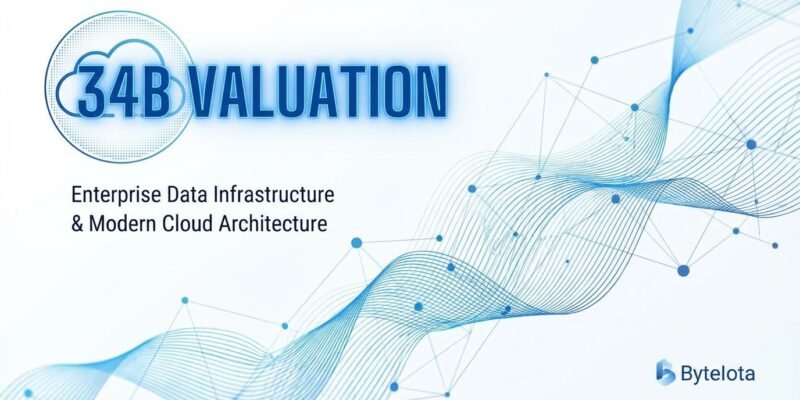
Databricks just raised $4 billion at a $134 billion valuation this week, making it one of the largest late-stage funding rounds in tech history. However, here’s what matters: while everyone watches the ChatGPT wars, enterprise investors just bet billions that the real AI money isn’t in flashy chatbots. Instead, it’s in the unglamorous infrastructure that makes AI actually work at scale.
The data infrastructure company announced the Series L round on December 16, marking a 34% valuation jump from $100 billion just four months ago. More telling than the funding itself: Databricks hit a $4.8 billion revenue run-rate in Q3, growing 55% year-over-year while maintaining positive free cash flow.
The Numbers That Prove Infrastructure Beats Hype
Databricks pulled in over $1 billion from AI products alone. Furthermore, that’s not a pilot program or proof-of-concept revenue. That’s enterprises paying serious money to deploy AI at scale, with data governance, security, and integration that actually works in production.
Additionally, add another $1 billion from traditional data warehousing, and the company serves over 700 customers paying $1 million or more annually. Net retention rate sits above 140%, meaning existing customers keep spending more. This isn’t consumer AI’s $20/month subscription math. This is enterprise infrastructure economics.
The timing aligns with broader market signals. Enterprise AI infrastructure spending jumped 166% year-over-year in Q2 2025, hitting $82 billion. Moreover, the global AI infrastructure market is projected to grow from $87.6 billion this year to $197.6 billion by 2030. Enterprises spent over $19 billion on AI applications in 2025 alone—more than half of all generative AI spending.
Why Infrastructure Outlasts Models
Databricks is making a strategic bet that might prove smarter than the foundation model race: they don’t care which AI model wins. Their platform works with OpenAI, Anthropic, Google, open-source models—whoever. Consequently, the company positioned itself as the infrastructure layer that enterprises need regardless of which chatbot ends up on top.
Think about the economics. ChatGPT charges $20 per month for consumer subscriptions. Meanwhile, Databricks customers pay $1 million or more annually for infrastructure that runs their AI applications on proprietary data. Model providers compete on price and capabilities. In contrast, infrastructure providers compete on lock-in, data gravity, and switching costs.
It’s the difference between selling pickaxes versus digging for gold. Databricks sells the pickaxes, and they’re making significantly better margins doing it.
The Data Wars Are Heating Up
Databricks’ main competitor, Snowflake, hit a $3.8 billion revenue run-rate growing at 27% year-over-year. Both companies command similar revenue scale, but Databricks is growing twice as fast. The difference: Databricks’ data lakehouse architecture combines data warehousing with machine learning capabilities, while Snowflake focused primarily on warehousing.
That $1 billion in AI product revenue represents Databricks’ competitive edge. Market share numbers show Snowflake leading at 20.21% versus Databricks’ 15.18%, but growth rates suggest that gap is closing fast. Enterprises choosing data platforms today are prioritizing AI capabilities, not just analytics.
The Trillion-Dollar Vision
CEO Ali Ghodsi outlined an ambitious path to a $1 trillion valuation at Fortune’s Brainstorm AI conference on December 9. His three-pronged strategy: Lakebase (operational databases for AI agents), AI-powered coding, and Agent Bricks (their multi-agent platform).
The most striking claim: “Over 80% of the databases that are being launched on Databricks are not being launched by humans, but by AI agents.” If true, it suggests AI isn’t just a product category for Databricks—it’s fundamentally changing how their platform gets used.
Reaching $1 trillion from a $134 billion valuation requires roughly 7x growth. That’s aggressive, especially with an expected 2026 IPO on the horizon. However, 55% growth at nearly $5 billion in revenue is rare. Most companies this size grow at 20-30% if they’re lucky.
What This Signals for 2026
The funding round attracted serious institutional investors: Insight Partners, Fidelity, JP Morgan Asset Management, BlackRock, Blackstone, and T. Rowe Price. These aren’t venture funds chasing moonshots. They’re traditional asset managers making calculated bets on profitable, growing businesses.
If Databricks IPOs near its current valuation in early 2026, it validates the enterprise AI infrastructure thesis at public market scale. It could open the door for other infrastructure companies and test whether public investors will pay premium multiples for AI-adjacent businesses with actual revenue and margins.
The IPO market has been selective since 2022. Nevertheless, a successful Databricks debut could signal that the window is opening for the right companies—those with strong fundamentals, not just AI hype.
Where Value Actually Accrues
The Databricks funding round clarifies where AI value is accumulating. It’s not primarily in consumer applications or even foundation models. Instead, it’s in the infrastructure that makes AI deployable, governable, and economically viable for enterprises.
Model providers race to improve capabilities and cut prices. In contrast, infrastructure providers build moats through data gravity, workflow integration, and enterprise relationships. One creates commodity risk. The other creates compounding returns.
Smart money is betting on the pickaxes.