 By ByteBot
Microsoft Research just eliminated the biggest barrier to AI agent reinforcement learning. Agent Lightning, a new open-source framework, adds RL capabilities to any existing agent with virtually zero code changes. No rewrites. No framework lock-in. Just three code additions.
The framework works with LangChain, AutoGen, OpenAI Agents SDK, and custom implementations. It’s available now under MIT license: pip install agentlightning.
The Code Rewrite Tax Is Dead
AI agents generate valuable training data through execution. Reinforcement learning can use that data to massively improve performance. But production teams don’t use RL because it requires painful code rewrites and specialized expertise.
Agent Lightning removes that barrier entirely. The framework decouples agent execution from model training through a three-component architecture that keeps your existing code untouched.
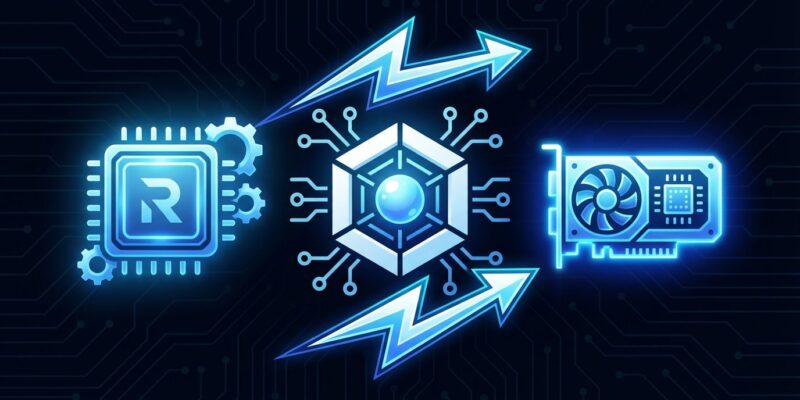
Agent Runner runs your agent on CPU. LightningStore collects execution data through standardized interfaces. Algorithm Layer trains models on GPU using the LightningRL algorithm. Your agent logic? Unchanged.
To integrate, add three elements: agl.PromptTemplate for prompt definition, agl.emit() for step tracking, and agl.Trainer for training orchestration. That’s it.
Framework Compatibility Without Compromise
Agent Lightning is framework-agnostic by design. It uses Markov Decision Process (MDP) formulation to convert any agent execution into standardized state-action sequences, regardless of complexity. Multi-agent systems, dynamic tool usage, complex reasoning chains—all work.
Supported frameworks include LangChain/LangGraph (80,000+ GitHub stars), AutoGen (Microsoft’s multi-agent framework), OpenAI Agents SDK (minimalist and production-ready), CrewAI, and custom Python implementations. Use your existing stack. No migration required.
The architecture uses shared protocols and OpenAI-compatible endpoints. Client-server separation means your tech stack stays intact while RL training happens independently.
Proven in Production Scenarios
Microsoft tested Agent Lightning across three real-world domains. All showed stable performance improvements across training and test phases.
Text-to-SQL generation using a three-agent LangChain pipeline improved SQL execution accuracy. Multi-hop question answering on the MuSiQue dataset (OpenAI SDK) produced better search queries and reasoning. Mathematical problem solving with AutoGen enhanced tool selection and result integration.
The consistent pattern: agents got better at their tasks through RL training, without touching their core logic.
The Credit Assignment Edge
The LightningRL algorithm solves a hard problem: when an agent executes a 20-step task and succeeds, which steps deserve credit?
The Credit Assignment Module breaks trajectories into independent transitions, determines each LLM call’s contribution to outcomes, and decomposes rewards to the token level. This hierarchical approach works with existing RL algorithms like PPO and GRPO, keeping training sequences short while maintaining efficiency.
You don’t need to rewrite your RL training code either.
What This Means for AI Agents
Production teams have been stuck with static agents because improving them required extensive rewrites. Agent Lightning changes that equation. RL training becomes an enhancement layer, not an architecture overhaul.
The framework makes RL accessible without specialized expertise. Teams can iterate on agent performance without technical debt. Independent scaling of CPU-based execution and GPU-based training means resource efficiency at any scale.
Agent Lightning is open source on GitHub, with full documentation and examples. The Microsoft Research blog covers technical architecture, and the arXiv paper details experimental results.
Framework-agnostic RL training for AI agents is no longer theoretical. It’s three code additions away.