 By
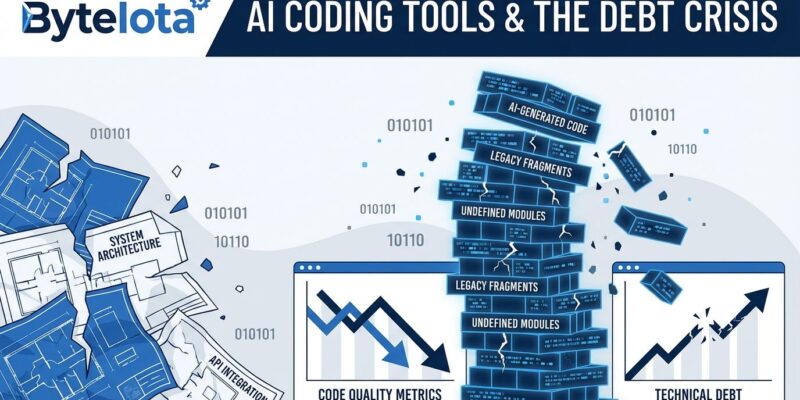
By AI coding tools promised 10x developers. Instead, they delivered an “army of juniors”—code that’s fast and functional but architecturally flawed. OX Security’s October 2025 analysis of 300+ repositories found systematic anti-patterns in AI-generated code, while GitClear’s study of 211 million lines revealed a 4x surge in code cloning and an 8x spike in duplicate code blocks. 2024 marked the first year copy/pasted code exceeded code reuse, signaling a fundamental quality collapse. Forrester predicts 50% of tech leaders will face moderate-to-high technical debt in 2025, escalating to 75% by 2026—a crisis fueled by AI code generation at unprecedented velocity.
The Quality Collapse Is Measurable
GitClear analyzed 211 million changed lines of code from 2020 to 2024. The findings are unambiguous: code quality is eroding and accelerating. Code churn—changes revised within two weeks of commit—surged from 3.1% to 5.7%, an 84% increase. Copy/pasted code rose from 8.3% to 12.3%, while refactoring collapsed from 25% to below 10%, a 60% decline in healthy code reuse.
2024’s milestone: the first year copy/pasted lines exceeded moved lines. Developers are duplicating code instead of reusing it. During 2024, code blocks with five or more duplicated lines spiked 8x. Google’s 2024 DORA report documented a 7.2% decrease in delivery stability for every 25% increase in AI adoption. The data doesn’t lie—AI tools generate code faster than teams can maintain quality.
The “Army of Juniors” Problem
OX Security’s “Army of Juniors” report analyzed 300+ open-source repositories and identified 10 critical anti-patterns. The core insight: AI writes like a talented junior developer—fast, follows conventions, but lacks architectural judgment and security awareness. The problem isn’t “more vulnerable” code per line; it’s “insecure by dumbness.” Non-technical users deploy AI-built applications at unprecedented velocity without security or architectural expertise.
The top anti-patterns reveal AI’s limitations:
- Avoidance of Refactors (80-90%): AI generates functional code but never architecturally improves it
- By-The-Book Fixation (80-90%): Rigidly follows rules, missing context-specific solutions
- Over-Specification (80-90%): Creates single-use solutions instead of reusable components
- Bugs Déjà-Vu (70-80%): Violates code reuse, causing identical bugs to recur
- Fake Test Coverage (40-50%): Inflates metrics with meaningless tests
Eyal Paz, VP of Research at OX Security: “The problem isn’t that AI writes worse code, it’s that vulnerable systems now reach production at unprecedented speed, and proper code review simply cannot scale to match the new output velocity.” AI can write code as fast as developers can prompt it. Human architectural review can’t keep pace.
The Perception Gap: Slower But Feeling Faster
A METR randomized trial in July 2025 exposed a stunning gap. 16 experienced developers completing 246 tasks were objectively 19% slower with AI tools. Those same developers believed they were 20% faster. That’s a 39-percentage-point gap between perception and reality—automation bias at work.
The “almost right” problem drives the slowdown. 45% of developers cite “almost right but not quite” AI code as their number-one frustration. 66% spend more time fixing AI code than writing from scratch. The process compounds: read AI-generated code, debug subtle issues, rewrite problematic sections. Total time exceeds starting fresh. Meanwhile, 13% of dev time goes to managing AI tools instead of building features.
Automation bias creates false confidence. Developers using AI assistance not only wrote less secure code than those working unaided, but believed their insecure code was safe. 75% still ask other people for help when distrusting AI answers—humans remain more reliable than algorithms.
Why AI Debt Compounds Faster
Traditional technical debt accumulates linearly. AI technical debt compounds exponentially. Three vectors drive the compounding:
Model versioning chaos: AI products evolve rapidly. Code from GPT-4 in January differs from Claude Opus 4.5 in December. Organizations lack governance to track which model generated which production code, making debugging nearly impossible.
Code generation bloat: AI systematically produces bloated output—verbose, over-commented, hyper-specific. OX Security found 90-100% of AI code suffers from “Comments Everywhere,” reducing readability.
Organization fragmentation: Teams lack unified standards. Some use Copilot, others Claude, others ChatGPT. No central governance, no consistent review, no architectural oversight.
Code review can’t scale to AI velocity. Copilot-heavy pull requests take 26% longer to review. 67% of developers spend more time debugging AI code. 68% spend more time resolving AI-introduced security vulnerabilities. Time “saved” during generation is lost during review, debugging, and remediation.
The Financial and Organizational Cost
Forrester’s prediction: 50% of tech leaders will face moderate-to-high debt severity in 2025, jumping to 75% by 2026. That’s 25 percentage points in one year. The Consortium for Information and Software Quality pegged annual US technical debt cost at $2.41 trillion in 2022—a baseline growing with AI adoption.
A mid-sized fintech found engineers spent 35% of time addressing technical debt. From a $4.2 million engineering budget, $1.47 million went to debt interest. 69% of IT leaders report debt limits innovation. 61% say it impacts organizational performance. You can’t build new features when your team drowns in cleanup from AI code that seemed fine three months ago.
Real-World Consequences Are Here
One AI assistant wiped out a company database. A payments service threw 503 errors for hours because an AI-generated “temporary” cache was never replaced—it “worked,” so it shipped.
Security vulnerabilities hit production at unprecedented rates. 36% of developers using AI introduced SQL injection vulnerabilities, compared to 7% of the control group—a 5x increase. Nearly 50% of AI-generated snippets contain exploitable bugs. 33% of Python snippets and 25% of JavaScript snippets have security vulnerabilities.
AI hallucinations enable new attack vectors. AI recommends outdated libraries with known CVEs or nonexistent packages. Attackers register malicious packages with those names—”slopsquatting.” Google’s DORA report documented a 10% climb in software delivery instability tied to AI adoption.
76% of developers must rewrite or refactor at least half of AI-generated code before production. Senior developers—those who should gain most from AI—experience 10-15% productivity decreases. Junior developers see 30-40% increases because AI handles boilerplate. But juniors can’t provide the architectural oversight AI needs.
What Happens Next
Forrester predicts tech leaders will triple AIOps adoption in 2025 to stem the debt tsunami. AIOps platforms promise contextually aware data, automated incident remediation, and self-healing systems. The bet: AI created the problem, so better AI can manage it. Whether automated systems can scale fast enough to match AI code generation velocity remains open.
Governance frameworks are emerging slowly. Organizations implement mandatory senior review for all AI code, automated quality gates, and stricter testing. Some track which AI model versions generated which production code. The pragmatic middle: use AI for boilerplate and documentation, but require human architectural oversight for core systems.
The speed-quality debate intensifies. Can organizations slow code generation for proper review? Or accept compounding debt as the cost of AI velocity? The next 12 months will answer. If Forrester’s 75% prediction holds, the industry hits a crisis point where debt service consumes more engineering time than feature development.
Key Takeaways
- AI coding tools create 4x code cloning surge and 8x duplicate block spike—2024 was first year copy/paste exceeded code reuse
- Developers are objectively 19% slower with AI but believe they’re 20% faster—a 39-point perception gap from automation bias
- OX Security’s “Army of Juniors” study found 10 critical anti-patterns in 300+ repos—AI writes like talented juniors lacking architectural judgment
- Forrester predicts 50% of tech leaders face moderate-high debt in 2025, escalating to 75% by 2026—a 25-point jump in one year
- Real consequences include 5x SQL injection rate (36% vs 7%), database wipeouts, and service outages from AI-generated “temporary” solutions that shipped to production