 By
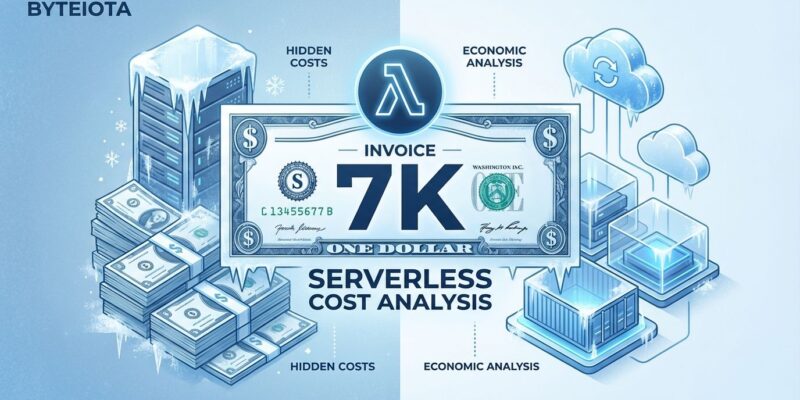
By The $47K Wake-Up Call
A CTO woke up to a $47,000 AWS bill. Not from a crypto mining hack or a forgotten test environment—from cold starts. During a routine traffic spike, 60% of their fraud detection API requests hit cold start delays, adding 3-8 seconds of latency to critical transactions. Customers couldn’t complete purchases. The team scrambled to fix it with standard solutions: increase memory, add provisioned concurrency, deploy warming functions. The bill tripled.
This isn’t an edge case. It’s serverless economics working exactly as designed.
The Mitigation Trap
Here’s the counterintuitive part: fixing cold starts often costs more than tolerating them.
The team in our case study did everything “right.” They added provisioned concurrency to keep functions warm. AWS charges $0.015 per GB-hour for this—whether you use the capacity or not. For a modest setup (1 GB function with 10 concurrent instances), that’s $108 per month before handling a single request. The break-even point sits at 60% utilization, which most teams never reach.
Then they deployed warming functions—Lambda invocations that periodically ping the main function to prevent cold starts. You pay for the warming invocations. You pay for the main function invocations (even though they do nothing). You pay for the architectural complexity. One team documented their experience: implementing warming functions alongside provisioned concurrency tripled their AWS bill while performance barely improved.
As one developer put it: “Serverless pricing is optimized for vendor margins.” You’re not just paying for compute—you’re paying for the convenience of not managing servers, and that convenience compounds exponentially with every mitigation layer you add.
When Serverless Costs More Than Containers
The “pay only for what you use” promise works—until it doesn’t. Break-even analysis reveals where serverless stops being economical:
At 50 requests per second, serverless costs about $370.65 while EC2 containers cost more. At 66 requests per second, serverless becomes the more expensive option. For traffic at or below 15 RPS, serverless beats AWS App Runner. But push beyond that sweet spot, and you’re better off with containers.
Real-world example: A video transcoding microservice running 24/7 at 65% CPU utilization. On EKS with ARM-based spot instances, it costs $0.012 per vCPU-hour. Move it to Lambda (3,008 MB, 90 seconds per transcode, 60 transcodes per hour), and serverless costs four times as much.
The trade-off isn’t compute power—it’s operational complexity versus cost. Serverless wins for sporadic workloads because you don’t pay for idle time. Containers win for steady traffic because costs amortize across many requests. Cold starts hit hardest in the middle: enough traffic to trigger frequent cold starts, not enough to justify provisioned concurrency.
What Actually Drives the Costs
Understanding where cold start latency comes from helps you avoid the expensive fixes.
A 2025 ACM systematic review analyzed over 100 papers on serverless cold starts and studied production data from five data centers. The finding: scheduling delays are either the first or second most significant component in cold start times. Not runtime initialization. Not package downloads. Scheduling—the platform deciding where to run your function.
Most serverless platforms run multi-layered stacks on top of Kubernetes, Ray, Firecracker, KVM, or combinations. Each layer adds latency. A simple Node.js function might cold-start in 100 milliseconds. A Java application with dependencies can take seven seconds or more, dominated by dependency deployment and scheduling overhead.
At scale, even a 1% cold start rate creates problems. With millions of invocations, that’s potentially 10,000 unhappy customers hitting multi-second delays in synchronous flows like checkout or fraud detection.
Fargate suffers worse: cold starts range from 10 to 90 seconds due to infrastructure provisioning, image pulls, and networking setup. One fintech company reported 35-second average startup delays for fraud detection services. Another engineering team measured P99 cold starts at 38 seconds before architectural changes brought it under four seconds.
Real Business Impact Beyond the Bill
Cold starts don’t just increase your AWS spend—they tank revenue and create security risks.
In the e-commerce case, a recommendation engine cold-started during checkout. Customers waited 25 seconds for product suggestions. Cart abandonment spiked. Each abandoned cart represented a lost $180 average order value.
A payment webhook processor cold-started while handling a callback. The payment gateway timed out after 10 seconds. Transactions failed. Customers retried. Duplicate charges hit their accounts. Trust eroded faster than the cold start times.
The fraud detection API forced an impossible choice: block all transactions (anger customers who can’t buy) or approve everything blindly (risk chargebacks and fraud losses). Neither option recovers the $47,000 already spent trying to solve the problem.
What Actually Works in 2025
AWS Lambda SnapStart shows promise—if you’re running Java.
Performance benchmarks show a 4.3× improvement over functions without SnapStart. For SpringBoot applications, cold starts improve by 10× or more. Real production data: P99.9 latency dropped from 6.99 seconds to 0.52 seconds with SnapStart enabled. Cost reduction reaches up to 30% in billable function duration by eliminating initialization time.
Best part: no additional cost, unlike provisioned concurrency.
Catch: It’s Java-focused. AWS is gradually expanding to .NET 8 with Native AOT and select custom runtimes throughout 2025, but if you’re running Python or Node.js, you’re waiting.
For everyone else, the strategy shifts to architecture:
Schedule provisioned concurrency only during peak hours (8am-1pm) rather than 24/7. Use dynamic auto-scaling instead of fixed provisioning (fixed high wastes money on idle capacity; fixed low triggers more cold starts). Consider containers for steady workloads above 66 RPS. Keep serverless for truly sporadic, event-driven traffic.
As the 2025 ACM review notes: “Performance-cost trade-offs of serverless control plane designs remain poorly understood.” The research exists, but the platforms haven’t solved it. You’re making architectural bets on incomplete information.
The Economic Reality
Serverless isn’t cheaper by default. It’s a trade-off: operational simplicity (no servers to patch, no load balancers to configure) versus compute costs and cold start taxes. When you add mitigation strategies, you’re often paying more than you would for containers—while still dealing with occasional cold starts.
Calculate your break-even point. Measure actual utilization, not projected traffic. Factor in cold start frequency, mitigation costs, and operational overhead. The math might surprise you.
The $47,000 bill wasn’t a failure of serverless. It was a failure to understand serverless economics. Don’t let vendor marketing decide your architecture. Let the numbers decide.