 By ByteBot
Trump Media announced yesterday a $6 billion merger with fusion power company TAE Technologies to build a utility-scale power plant by 2031. The same week, PJM Interconnection—which serves 65 million customers across 13 eastern U.S. states—moved to block new data centers indefinitely because the grid can’t provide reliable power. The AI energy crisis just forced fusion power from “30 years away” to commercial necessity.
Energy has become the primary bottleneck for AI development. Data centers will consume 10% of U.S. electricity by 2030, but grids can’t expand fast enough. For developers and cloud users, this means rising costs, geographic limitations on AI infrastructure, and genuine uncertainty about future compute availability. Fusion power—if it delivers on aggressive 2028-2031 timelines—could eliminate the energy constraint entirely. Or it might be another false promise.
The Grid Can’t Keep Up With AI
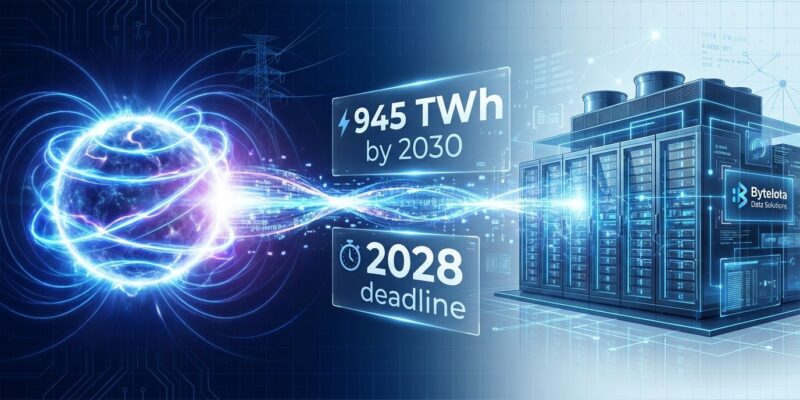
Data centers will consume 945 terawatt-hours by 2030, equivalent to Japan’s total electricity consumption. In the U.S. alone, data center growth will account for half of all electricity demand increases through 2030. AI-optimized facilities are driving this spike—demand is projected to quadruple by decade’s end.
The PJM grid crisis shows how acute the problem has become. The operator fell 6,625 megawatts short of its 20% reserve margin target in the latest capacity auction, with data centers driving a 5,250 MW demand spike. Capacity prices hit the $333.44/MW-day ceiling. On November 25, 2025, PJM’s market monitor filed a complaint with FERC to block all new data centers unless they can prove reliable power supply. Industry projections warn that 40% of AI centers will be operationally constrained by power availability by 2027.
Developers are feeling this directly. Cloud storage costs are rising—94% of IT leaders report increases, with 59% seeing significant billing jumps. “Time to power” now trumps location, taxes, and traditional data center site considerations. Alphabet raised its 2025 capital expenditure outlook to $91-93 billion, largely for AI infrastructure energy. The power shortage isn’t theoretical—it’s actively limiting where and how fast AI workloads can scale.
Fusion Went From Research to Commercial Deals in 5 Years
Fusion funding exploded from $1.7 billion in 2020 to $15 billion in 2025. This isn’t speculative research money—these are commercial contracts with delivery dates and financial penalties.
Microsoft signed a power purchase agreement with Helion Energy for 50 megawatts by 2028. Helion CEO David Kirtley admitted they’ve “put our skin in the game” by accepting financial penalties if they miss the deadline. Google committed to buying 200 MW from Commonwealth Fusion Systems’ ARC plant, targeted for the early 2030s. CFS’s SPARC reactor already achieved net fusion energy (Q>1)—producing more energy than it consumes. TAE Technologies’ Norman reactor hit 75 million degrees Celsius with stable plasma control.
The Trump Media merger injects another $6 billion into TAE, targeting first power by late 2031. These deals share a pattern: Big Tech companies betting billions on specific timelines because no other clean energy source can scale fast enough to meet AI demand. The shift from “someday” to “2028-2031” isn’t hype—it’s desperation. Without unlimited clean power, the AI boom hits a physical ceiling.
The geographic split is telling. The U.S. leads with $8.05 billion across 42 companies (94.5% private capital). China follows with $4.4 billion across 8 companies (71.2% state-led). This is becoming a strategic technology race, like semiconductors.
Why Data Centers Need Fusion Power (Not Just Any Power)
Fusion solves problems renewable energy can’t. Solar and wind are intermittent—data centers need 24/7 baseload power. Battery storage at data center scale (hundreds of megawatts) remains prohibitively expensive. Natural gas is fast to build but conflicts with climate commitments and exposes companies to volatile fuel prices.
Fusion produces no long-lived radioactive waste, only helium. The reaction can’t meltdown—any disruption halts it immediately. Unlike traditional nuclear fission with its chain reactions and million-year waste storage, fusion fuel is abundant deuterium extracted from seawater. Reactor components become mildly radioactive but are recyclable within 100 years.
For data centers, fusion’s key advantage is deployability. Plants can be built on-site, eliminating the 5-10 year wait for grid transmission expansion. Helion, CFS, and TAE are all designing modular 50-400 MW units—perfect for large AI facilities. If fusion works, “time to power” becomes a non-issue. Energy costs stabilize (abundant fuel), and AI development becomes unconstrained by physical power limits.
Ironically, AI is also enabling fusion breakthroughs. Machine learning controls plasma stability in TAE’s reactors. Princeton’s AI predicted plasma disruptions 300 milliseconds ahead, giving time for intervention. AI optimization increased laser fusion yield threefold. The technology creating the energy crisis is also helping solve it.
The 2028 Test Everyone’s Watching
Helion’s 2028 Microsoft deadline is the litmus test. If Helion delivers even 20-30 megawatts by 2029, fusion credibility soars and investment floods in. If they miss by three years or fail to achieve commercial operation, fusion skepticism gets validated for another decade.
Skeptics have legitimate concerns. Fusion has been “30 years away” since the 1950s. TAE has “struggled to make designs work” over decades of research. Most scientists predict the mid-2030s as realistic for commercial deployment—not 2028-2031. The gap between research reactors hitting technical milestones and commercial power plants delivering reliable electricity is enormous.
The Trump Media involvement adds complexity. Economist Peter Schiff argues “the real value DJT offers is political leverage—access to power and favorable treatment from the Trump administration.” Trump Media generated $2.7 million in revenue against $107 million in losses during the first three quarters of 2025. Fusion industry insiders have voiced concerns about potential conflicts of interest with the Department of Energy. Is this a serious energy investment or financial maneuvering?
Yet TAE has credible backers. Ernest Moniz, Obama’s Energy Secretary, sits on their board. They’ve raised $1.3 billion from Chevron, Google, and other serious investors. If any fusion company can deliver by 2031, why not TAE with a $6 billion capital injection?
What Developers Should Actually Do
Plan for both scenarios. The conservative approach: assume fusion doesn’t deliver and optimize for energy efficiency now. Don’t bet infrastructure strategies on unproven technology, regardless of how aggressive the marketing.
But watch 2028 closely. Helion’s construction in Chelan County, Washington is underway. If they hit even 80% of their target by 2029, fusion is real. That’s your signal to pivot. CFS’s ARC plant (400 MW, enough for 150,000 homes) and TAE’s 2031 timeline provide confirmation points.
If fusion succeeds, the benefits are transformative: unconstrained energy for AI, stable cloud costs, and geographic flexibility for data center placement. Energy stops being the bottleneck. If fusion fails, energy constraints persist through the 2030s. Efficiency improvements and alternative energy sources (likely more natural gas, despite climate implications) become critical.
The hedge: invest in efficiency regardless, monitor 2028 as the inflection point, and maintain flexibility to pivot strategy if fusion actually delivers. The industry bet on massive compute growth without securing the power supply. Fusion is the Hail Mary.