 By ByteBot
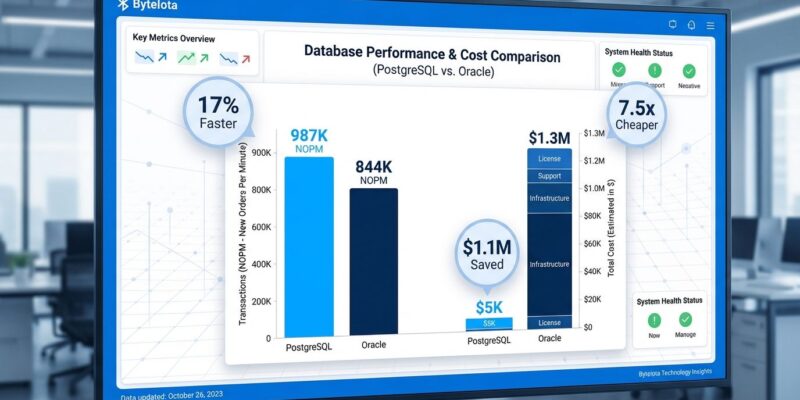
In February 2025, an independent benchmark study by McKnight Consulting Group revealed that EDB Postgres AI outperformed Oracle Database Enterprise Edition by 17% in transaction processing—achieving 987,000 new orders per minute compared to Oracle’s 844,000. The cost differential is even more dramatic: $0.21 per unit for EDB versus $1.58 for Oracle, translating to a three-year total cost of ownership of $205,605 versus $1,333,765. That’s $1.1 million in savings for comparable performance that actually exceeds Oracle’s.
This isn’t a marginal improvement or a marketing spin on selective benchmarks. It’s an independent study using industry-standard methodologies (TPC-C via HammerDB on AWS EC2 instances) that directly challenges the narrative Oracle has maintained for decades: that premium pricing buys you superior performance for mission-critical workloads. The data suggests otherwise.
PostgreSQL Outperforms Oracle: The Benchmark Results
The McKnight study tested transactional performance across EDB Postgres AI, Oracle Database Enterprise Edition, and Microsoft SQL Server using a TPC-C-like workload via HammerDB. EDB topped the charts at 987,472 NOPM (new orders per minute), ahead of Oracle’s 844,479 and SQL Server’s 758,682. This represents a 17% performance advantage over Oracle and a 30% lead over SQL Server.
Beyond relational workloads, EDB also dominated NoSQL/JSON operations. On INSERT operations, EDB was 150 times faster than MongoDB and 4 times faster than MySQL. For bulk loads, it clocked 34% faster than MongoDB and 63% faster than MySQL. The study positions PostgreSQL not just as an Oracle alternative for traditional OLTP, but as a unified platform that handles relational, analytical, and document workloads without the operational overhead of managing multiple databases.
The $1.1 Million Question: Where Does the 7x Cost Gap Come From?
The cost-per-unit breakdown reveals why the TCO difference is so stark:
ORACLE (3-year TCO): $1,333,765
- Software licensing: $47,500/processor × 4 cores = $190,000
- Annual support (22%): $41,800 × 3 years = $125,400
- Deployment + training: ~$80,000

EDB POSTGRES AI (3-year TCO): $205,605
- Software licensing: $2,780/unit × 4 cores = $11,120
- Annual support: $0 (included)
- Deployment + training: ~$50,000

SAVINGS: $1,128,160 (85% cost reduction)
The primary driver is Oracle’s processor-based licensing model at $47,500 per processor versus EDB’s per-core model at $2,780. Add Oracle’s 22% annual support fees ($10,450 per unit) versus EDB’s included support, and you get a 7.5x multiplier. This isn’t a rounding error that negotiated discounts can fix—it’s a fundamental difference in pricing philosophy. Oracle extracts maximum revenue from license fees; EDB competes on value.
For enterprises, this represents more than budget savings. $1.1 million over three years funds significant infrastructure improvements, additional engineering headcount, or innovation initiatives. The question shifts from “can we afford to leave Oracle?” to “can we justify staying?”
When Oracle’s Premium Is Justified
The benchmark results don’t make Oracle obsolete. Specific scenarios still favor staying with Oracle: deep integration with Oracle-specific features like Real Application Clusters (RAC), Exadata appliances, or GoldenGate replication; applications with extremely complex PL/SQL codebases where refactoring would take years; and environments with negotiated Oracle pricing that narrows the TCO gap significantly.
Oracle licensing expert Craig Guarente from Palisade Compliance warns: “Just because you use less Oracle doesn’t mean you will spend less on Oracle.” Oracle’s licensing complexity means partial migrations don’t guarantee cost reductions—you often need full decommissioning to realize savings. If your stack is tightly coupled to Oracle’s ecosystem and you’ve negotiated favorable pricing, the migration ROI calculus changes considerably.
The Migration Path: From 20 Days to 18 Months
EDB’s migration tools promise impressive automation—the Migration Portal has analyzed over 52 million DDL constructs and claims 95% reduced application rewrites, with some migrations completing in as little as 20 days. Those numbers apply to simple schemas with minimal PL/SQL dependencies. Real-world enterprise migrations typically span 3 to 18 months depending on application complexity.
Common challenges include PL/SQL to PL/pgSQL conversion (different execution models require manual adjustments), data type mapping differences (Oracle’s BLOB, CLOB, and DATE types lack direct PostgreSQL equivalents), and subtle behavioral changes like timestamp timezone handling and NULL sorting order. Success stories exist—the FBI, USDA, and Ericsson have migrated successfully, with one customer reporting $1 million in annual savings and support for 3x revenue growth. But these wins came from realistic planning, pilot programs, and proper team training, not blind faith in automated tools.
What This Means for Database Decisions
For new projects, the decision calculus has shifted dramatically. If you’re not locked into Oracle already, EDB Postgres AI delivers superior performance at a fraction of the cost, with the added benefit of cloud-native flexibility (Kubernetes support, multi-cloud deployments) and no vendor lock-in. The “you need Oracle for performance” argument is empirically false.
For existing Oracle shops, the path depends on your integration depth and complexity. Greenfield applications should default to PostgreSQL unless you have specific Oracle-dependent requirements. Legacy migrations require honest assessment: Can 95% of your code migrate cleanly? Do you have Oracle-specific features (RAC clustering, specific replication patterns) that lack PostgreSQL equivalents? Is your team willing to invest in PostgreSQL expertise?
The broader trend is clear: open-source databases have matured to enterprise readiness. PostgreSQL’s ecosystem—extensions like pgvector for AI/ML, PostGIS for geospatial, TimescaleDB for time-series—combined with proven performance and dramatic cost advantages makes it a serious contender for workloads that once required commercial databases by default. Oracle’s lock-in is no longer inevitable; it’s a choice you can challenge with data.