 By ByteBot
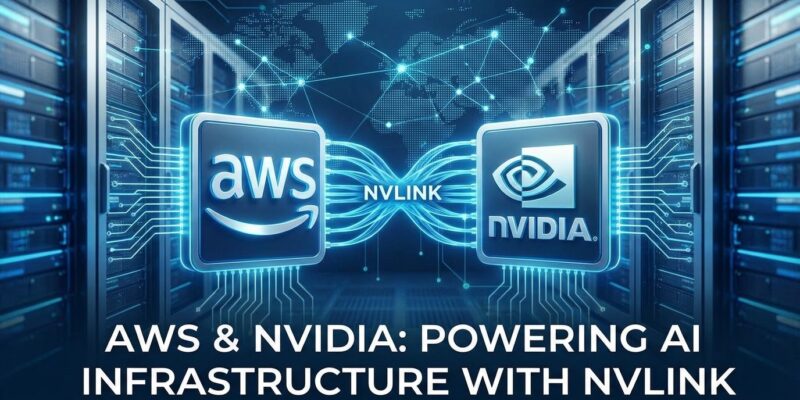
AWS just made a strategic U-turn in the AI chip wars. At re:Invent on December 2, Amazon announced its next-gen Trainium4 chip will integrate with Nvidia’s NVLink 6 technology—a stark departure from the “replace Nvidia” strategy AWS has pursued for years. The move signals something the entire cloud industry has been reluctant to admit: Nvidia’s ecosystem dominance is too strong to compete against head-on.
The Strategic Shift: From Competition to Collaboration
For years, AWS positioned its Trainium chips as a direct Nvidia alternative. The pitch was simple: train and run AI models at 30-50% lower cost by ditching expensive H100 GPUs. However, Trainium4 tells a different story.
Instead of building its own interconnect technology to compete with Nvidia’s NVLink, AWS is adopting it. According to Nvidia’s technical blog, Trainium4 will use NVLink Fusion to connect up to 72 custom ASICs with Nvidia’s sixth-generation NVLink Switch. The result? Developers can mix low-cost Trainium chips with high-performance Nvidia GPUs in the same cluster, unified under Nvidia’s networking infrastructure.
As The Register put it: “AWS decided it was better to build on NVIDIA NVLink instead of building its own communications protocol, switches, and rack infrastructure.” That’s not capitulation—it’s pragmatism.
Why Nvidia’s Ecosystem Is Unbeatable
Here’s the uncomfortable truth: even AWS, with unlimited resources and top-tier engineering talent, can’t replicate Nvidia’s ecosystem. The problem isn’t hardware performance—AWS’s chips can compete on raw compute. The problem is software.
A typical 1,000-GPU cluster contains roughly 200,000 lines of CUDA-optimized code. Migrating to alternative chips like Trainium or Google’s TPUs requires rewriting 60-80% of that codebase—an effort costing $2-5 million in engineering time per major model. After 15+ years of CUDA development, Nvidia’s software moat is deeper than its silicon advantage.
Moreover, Nvidia controls the entire stack: chips (H100, H200, B200), networking (NVLink), systems (DGX), and software (CUDA). That vertical integration creates a $250 billion revenue flywheel that’s nearly impossible to disrupt.
AWS CEO Matt Garman acknowledged this reality: “Nvidia is an incredibly important partner. I think the press wants to make it us vs. them but it’s just not true.” Translation: We tried head-to-head competition and realized the ecosystem lock-in is unbreakable.
What Trainium4 with NVLink Actually Delivers
NVLink Fusion enables AWS to offer something new: flexible AI infrastructure that combines cost efficiency with Nvidia compatibility. According to Next Platform’s analysis, Trainium4 will deliver 3x the FP8 performance and 4x the memory bandwidth of Trainium3, powered by eight stacks of HBM4 memory. It can scale beyond single racks to 144+ coherent domains via cross-rack connections.
For developers, this means workload optimization. Run cost-sensitive training jobs on Trainium (50% cheaper than Nvidia), then deploy latency-critical inference on Nvidia GPUs—all within the same infrastructure. No code rewrites. No migration headaches.
Nvidia CEO Jensen Huang framed the collaboration as mutual benefit: “We’re unifying our scale-up architecture with AWS’s custom silicon to build a new generation of accelerated platforms.” In other words, Nvidia gets to extend its NVLink ecosystem while AWS gets the compatibility it needs to compete on price.
Real-World Proof: Anthropic’s 500,000-Chip Deployment
This isn’t theoretical. Anthropic’s Project Rainier connected over 500,000 Trainium2 chips into the world’s largest AI compute cluster—five times bigger than the infrastructure that trained previous Claude models. All Claude 3.5 traffic running through Amazon Bedrock now runs exclusively on Trainium, delivering 60% faster inference compared to alternatives.
Anthropic’s strategy is telling: they’re using AWS Trainium, Google TPUs, and Nvidia GPUs simultaneously. Multi-cloud, multi-accelerator deployments are rare, but they make sense. Anthropic engineers write low-level kernels directly for Trainium silicon, optimizing for their specific workloads while maintaining Nvidia compatibility for tasks where CUDA tooling is irreplaceable.
Furthermore, the cost savings are real. Anthropic and other early adopters report up to 50% reductions in training costs compared to Nvidia-only infrastructure. Companies like Karakuri, Metagenomi, and Ricoh are seeing similar benefits.
The Broader AI Chip Wars Context
AWS isn’t the only hyperscaler trying to escape Nvidia’s gravity. Google’s TPU has emerged as the only credible technical alternative, with Anthropic committing to a million TPUs for future models and Meta exploring billions in TPU investment for 2027. According to CNBC’s analysis, TPU v6e costs just $0.39 per chip-hour—cheaper than spot H100 pricing—and runs at 300W TDP compared to H100’s 700W.
Nevertheless, Google’s TPUs come with their own lock-in: they only run on Google Cloud. One TPU customer explained the concern: “With TPUs, once you rely on them and Google says, ‘Now you have to pay 10X more,’ then we would be screwed.” Nvidia’s cross-cloud flexibility remains a major advantage.
Microsoft’s Maia chips, meanwhile, are struggling. Designed before the generative AI era for image processing rather than large language models, Maia 100 reportedly powers no production services and faces 18-24 month wait times compared to 2-3 months for TPUs.
The pattern is clear: every hyperscaler is building custom ASICs because nobody believes Nvidia’s pricing is sustainable long-term. But only Google has a decade of production hardening and a commercial offering that lets third parties use the same infrastructure. AWS’s answer? Don’t try to replace Nvidia. Interoperate with it.
Smart Pragmatism, Not Surrender
AWS’s Trainium4 strategy isn’t an admission of defeat—it’s a recognition of reality. Nvidia’s ecosystem lock-in is too strong to overcome with hardware alone. By adopting NVLink instead of fighting it, AWS can offer developers real choice: optimize for cost with Trainium or maximize performance with Nvidia, all in the same infrastructure.
Does this cement Nvidia’s dominance? Possibly. NVLink compatibility extends Nvidia’s reach into custom silicon territories it might not otherwise access. But it also opens doors for meaningful cost competition. Developers win when they can mix and match based on workload requirements rather than being locked into a single vendor’s chips.
The AI chip wars aren’t over. They’re just entering a new phase—one where interoperability trumps pure competition. AWS tried to build a Nvidia replacement and realized the software moat was impenetrable. Now it’s building a Nvidia complement instead. That might be the smartest move AWS could make.