 By ByteBot
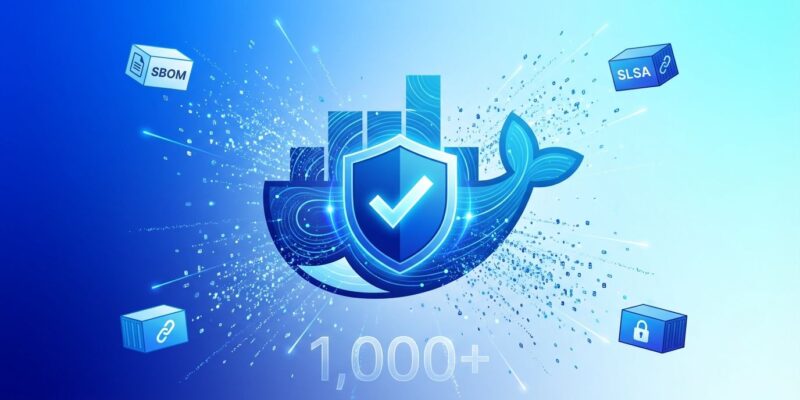
Docker Inc. announced today (December 17, 2025) that it’s making its entire catalog of 1,000+ Docker Hardened Images completely free and open source under the Apache 2.0 license. The hardened images, which slash container vulnerabilities by 95% compared to traditional community images, were previously a paid premium feature since their May 2025 launch. This isn’t freemium bait—the free tier delivers the full security foundation, including SBOM transparency, SLSA Level 3 provenance, and distroless architecture.
Moreover, the move eliminates a major cost barrier to enterprise-grade container security. Major companies including Adobe, Crypto.com, Attentive, and Qualcomm had already standardized on Docker Hardened Images when they required payment. Now every developer gets the same security foundation—whether you’re a hobbyist or a Fortune 500 company.
95% Fewer Vulnerabilities Through Distroless Architecture
Docker Hardened Images follow a “distroless” philosophy: strip away everything that isn’t absolutely necessary to run your application. That means no shells (bash, sh), no package managers (apt, apk), and no debugging tools that commonly introduce security vulnerabilities. Consequently, only essential runtime dependencies make it into the final image.
The results speak for themselves. Typical container images harbor 600+ known vulnerabilities. In contrast, Docker’s hardened images reduce that attack surface by up to 95%. Every image includes a complete Software Bill of Materials (SBOM), SLSA Build Level 3 provenance for cryptographic build verification, and transparent CVE data for vulnerability tracking.
Furthermore, these aren’t exotic custom distributions. Docker builds hardened images on Alpine Linux (musl-based) and Debian (glibc-based)—two widely adopted foundations developers already know. That compatibility means teams can adopt hardened images with minimal workflow changes. Just swap your base image in your Dockerfile.
Adobe, Crypto.com Already Bet on This in Production
Enterprise adoption accelerated fast after the May 2025 launch—even when Docker charged for access. Adobe evaluated multiple hardened image vendors and chose Docker. Vikram Sethi, Principal Scientist at Adobe, explained their criteria: “We evaluated multiple options for hardened base images and chose Docker Hardened Images for its alignment with our supply chain security posture, developer tooling compatibility, Docker’s maturity in this space, and integration with our existing infrastructure.”
Crypto.com and Attentive—companies in regulated industries with strict security requirements—have standardized on Docker Hardened Images organization-wide. Similarly, Qualcomm uses them across their entire enterprise infrastructure. These aren’t pilot programs. They’re production deployments at scale.
Mark Cavage, Docker’s President and COO, frames this as more than a product release: “This is a foundational shift that strengthens every part of the software supply chain and the Internet.” When enterprises with billions at stake make this bet, the technology has proven itself beyond marketing claims.
Free Foundation, Paid Compliance Features
Docker now offers three tiers. The free tier—Apache 2.0 licensed, no restrictions—provides the same 95% vulnerability reduction and security features as paid plans. You get SBOM, SLSA, and transparent CVE data at zero cost. Nevertheless, most developers and many enterprises won’t need anything more.
The Enterprise tier targets regulated industries like finance, healthcare, and government. It includes FIPS-enabled and STIG-ready images that meet federal security standards, plus SLA-backed CVE remediation under 7 days for critical vulnerabilities. If you need to prove compliance, this tier delivers.
Extended Lifecycle Support (ELS) adds 5 years of security coverage beyond upstream end-of-life. Legacy systems that can’t easily migrate get continued CVE patches, SBOM updates, and provenance attestations. That’s the tier enterprises pay for when they’re stuck supporting old infrastructure.
Competing Against Chainguard, Google, Canonical
Docker isn’t alone in the hardened container image market. Chainguard offers Wolfi-based images claiming 97.6% CVE reduction. Google pioneered the distroless concept but gets criticized for making images hard to debug and extend. Additionally, Canonical released Chiselled Images for Ubuntu-based workflows. BellSoft just announced Java-focused hardened images at KubeCon 2025, claiming 95% vulnerability reduction plus 30% lower resource consumption.
RedMonk analyst James Governor sees Docker’s free tier as industry-shaping: “Making Docker Hardened Images free and pervasive should underpin faster, more secure software delivery across the industry by making the right thing the easy thing for developers.” That last part matters. Container security has been a premium feature for too long.
Moreover, Docker’s Apache 2.0 licensing and Alpine/Debian compatibility may provide easier migration paths than alternatives requiring Wolfi or Ubuntu. The free tier strategy could commoditize competitors’ paid-only models—forcing the whole market to make security accessible instead of premium.
Getting Started Requires Docker Hub Login
While the images are free, they aren’t anonymous public pulls. You need to authenticate to Docker Hub with your credentials before pulling hardened images from the docker.io/hardened/ namespace.
Docker’s AI assistant can scan your existing containers and recommend equivalent hardened replacements, automating the migration path. That addresses what Docker calls the “perfectly hardened image that only 20% of teams can use” problem—making security accessible beats making it perfect but unusable.
The 1,000+ catalog includes not just standalone images but Hardened Helm Charts for Kubernetes deployments and Hardened MCP Servers (MongoDB, Grafana, GitHub). If you’re running containers in production, there’s probably a hardened version ready.
The Takeaway
Docker made enterprise-grade container security free. Not “free tier with crippled features” but Apache 2.0 licensed, 95% vulnerability reduction, full SBOM and provenance transparency. Adobe and Crypto.com are already running this in production. The AI-assisted migration path lowers adoption friction.
If you’re still pulling community images with 600+ vulnerabilities, you’re choosing insecurity when secure alternatives cost nothing. Container security just became a commodity—and that’s exactly what the industry needs.