 By ByteBot
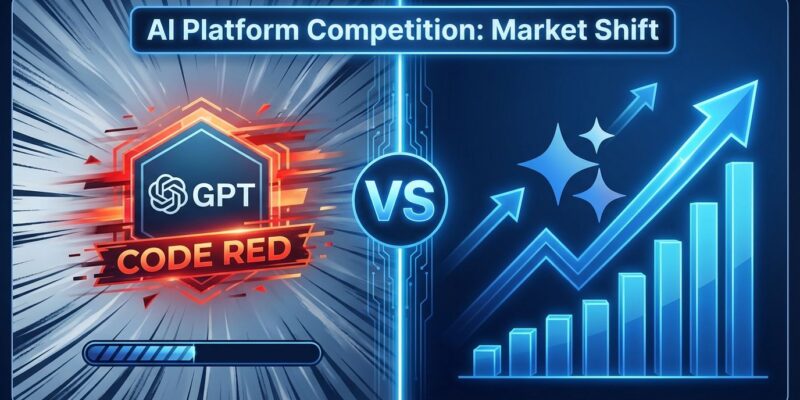
OpenAI launched GPT Image 1.5 on December 16, 2025, promising 4x faster generation and 20% lower API pricing. However, the features sound great—until you realize the accelerated timeline. This release was originally scheduled for January but got rushed to December. Why the hurry? Because OpenAI is scrambling. Sam Altman’s leaked “code red” memo admits what the stock market already figured out: Google Gemini 3 is winning. For the first time since 2016, investors value Alphabet as the AI leader, not OpenAI. This isn’t innovation—it’s desperation.
The “Code Red” Context: Losing Ground to Google
Google’s Gemini 3 model dropped on November 18, 2025, and matched or beat ChatGPT in industry benchmarks. That flipped the market’s perception overnight. The stock market now prices Alphabet as the AI winner, ending OpenAI’s nine-year dominance. Moreover, Sam Altman’s internal memo declared “code red” to improve ChatGPT quality—a tacit admission that OpenAI lost the technical edge.
The accelerated GPT Image 1.5 timeline reveals the panic. Moving a major release forward from January to December isn’t confidence—it’s a defensive scramble. Furthermore, OpenAI needed something, anything, to show momentum and counter Google’s surge. Speed and pricing improvements check that box, but rushed releases carry risk. Developers building on OpenAI’s platform should watch for reliability issues.
What Actually Improved: Speed, Price, and Precision
Strip away the competitive drama and GPT Image 1.5 delivers real improvements. Generation speed jumped 4x compared to GPT Image 1, dropping from roughly 6-8 seconds to under 2 seconds. Consequently, that’s a tangible developer experience win—faster iteration cycles mean shorter feedback loops during prototyping.
API pricing dropped 20% below GPT Image 1 rates, making high-volume image generation more economical. Additionally, Microsoft Foundry integration arrived the same day—December 17, just hours after OpenAI’s blog post. Enterprise customers get security features and governance tools out of the box. That’s strategic timing, locking in enterprise accounts before they evaluate Google Imagen alternatives.
Editing precision also stepped up. The model now follows instructions more accurately, changing only what you specify while preserving lighting, composition, and facial features across iterations. Developers complained about GPT Image 1 rewriting entire scenes when asked for minor tweaks. Version 1.5 addresses that—non-destructive edits without full regeneration save time and API costs.
The Competitive Battlefield: Users vs. Investor Confidence
OpenAI still dominates users. ChatGPT has 800 million weekly active users compared to Google Gemini’s 650 million monthly active users. However, investor perception tells a different story. The stock market flipped in late November 2025, valuing Alphabet as the AI leader for the first time since 2016.
That disconnect—user dominance versus investor doubt—reveals deeper concerns. Investors see Google’s technical benchmarks and infrastructure advantages. Users see ChatGPT’s first-mover network effects. For developers, the takeaway isn’t “pick the winner.” Instead, it’s “don’t lock in.” Platform wars create opportunity (features, pricing) and risk (instability, migration costs). Build abstraction layers and keep vendor switching costs low.
Microsoft’s Strategic Move: Enterprise Lock-In
The Microsoft Foundry integration timing exposes the strategy. Same-day availability means enterprises evaluating image generation get a turnkey solution: GPT Image 1.5 with Azure security, governance, and billing already integrated. That’s OpenAI and Microsoft leveraging their partnership to box out Google.
Compare that to standing up Google Vertex AI if you’re not already in Google Cloud. The switching costs favor Microsoft-OpenAI. That’s the partnership value—distribution and enterprise credibility. Nevertheless, it also reveals OpenAI’s dependency. Without Microsoft’s enterprise channel, OpenAI would struggle to compete with Google’s integrated ecosystem.
Key Takeaways
- Competitive pressure works: OpenAI’s “code red” panic delivered 4x speed and 20% lower pricing—tangible developer benefits from platform wars.
- Rushed releases carry risk: Moving launches forward (January to December) suggests OpenAI prioritizing optics over reliability. Watch for bugs.
- Microsoft Foundry is strategic: Same-day enterprise integration locks customers into Azure-OpenAI before they evaluate Google Imagen alternatives.
- Market perception shifted: Stock market now values Google as AI leader (first time since 2016) despite ChatGPT’s user dominance—signals long-term concerns.
- Don’t lock into one vendor: Platform wars create instability. Build abstraction layers and keep switching costs low across OpenAI, Google, and open-source options.
OpenAI’s GPT Image 1.5 proves competition drives innovation. Faster features, lower prices, and better capabilities all stem from Google’s Gemini 3 threat. But the “code red” context reveals vulnerability. This isn’t OpenAI confidently innovating from a position of strength. It’s a company scrambling to defend market share after losing technical leadership. For developers, that’s both opportunity (better tools, lower costs) and risk (platform instability, rushed quality). Navigate accordingly.