 By ByteBot
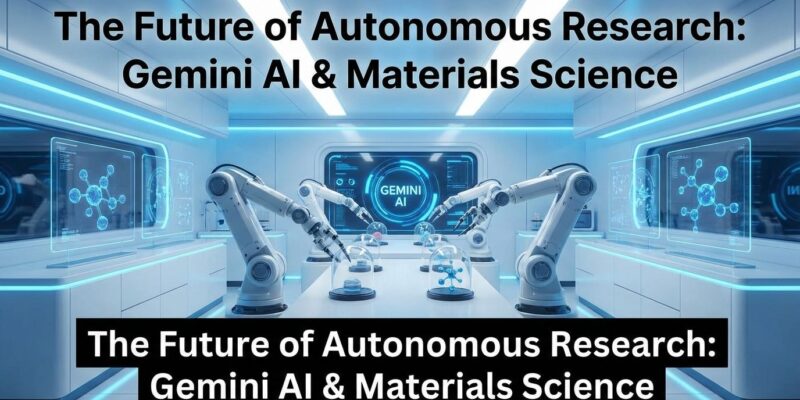
Google DeepMind announced on December 11, 2025, the UK’s first fully automated AI research laboratory. Moreover, this facility represents a paradigm shift—AI won’t assist scientists but will conduct science autonomously. The lab will be fully integrated with Gemini, directing robotics to synthesize and characterize hundreds of materials daily. Furthermore, it targets superconductors for medical imaging and fusion energy. A multidisciplinary team provides strategic oversight. However, AI makes tactical research decisions without human approval for each experiment.
Berkeley’s A-Lab already proved the concept. Consequently, autonomous labs can discover 41 new materials in 17 days. Additionally, DeepMind is scaling this with Gemini integration, raising fundamental questions: Can AI produce Nobel Prize-worthy breakthroughs, or only incremental improvements? What happens to research scientists when AI conducts experiments 50-100 times faster?
Autonomous AI Research at Industrial Scale
The lab will be “built from the ground up to be fully integrated with Gemini.” As a result, it will direct robotics to synthesize and characterize 100-300 materials per day. In fact, that’s 50 to 100 times faster than human researchers. Moreover, unlike traditional labs where humans design experiments and AI analyzes results, Gemini makes research decisions autonomously in a “closed-loop” cycle. Specifically, AI generates hypotheses, designs experiments, interprets results, and refines approaches without human approval between iterations.
This isn’t speculative. Berkeley National Lab’s A-Lab has operated since 2023, processing 50-100 samples daily compared to 1-2 for human researchers. Furthermore, the lab discovered 41 new materials in 17 days with a 95%+ success rate. Additionally, Argonne’s Polybot demonstrated 10x acceleration in polymer discovery. Meanwhile, University of Liverpool’s autonomous robot conducted 688 experiments in 8 days, identifying catalysts 6 times better than the baseline.
DeepMind’s advantage lies in Gemini integration from inception rather than retrofitted AI. Consequently, Gemini’s multimodal capabilities allow it to read scientific literature, analyze visual characterization data, and optimize across 10+ variables simultaneously. Therefore, this is the first AI research facility designed for autonomy from the ground up.
If successful, expect rapid global replication. For example, pharmaceutical autonomous labs for drug discovery. Battery research facilities for EVs and grid storage. Catalyst labs for green chemistry and carbon capture. As a result, the bottleneck in materials science shifts from discovery—AI handles this 100x faster—to validation, where humans remain essential for peer review and manufacturing scale-up.
Medical Imaging, Fusion Energy, and Computing Performance
The lab targets superconductors operating at ambient temperature and pressure, advanced batteries, solar cells, and semiconductor materials. Moreover, room-temperature superconductivity is physics’ holy grail—materials that conduct electricity with zero resistance without expensive cooling. Consequently, the applications are transformative.
MRI machines currently require liquid helium cooling at $30-50 per liter amid global shortages. However, room-temperature superconductors could reduce MRI costs by 20-40%, making advanced medical imaging accessible to developing nations. In fact, MRI installations using high-temperature superconductors increased 15% by 2025, already reducing helium consumption by 20%.
Fusion reactors require 10,000-20,000 kilometers of high-temperature superconductor tape per reactor, currently costing $200-300 per meter. Furthermore, AI-discovered materials could cut costs 50% while improving performance, making fusion commercially viable by the 2030s instead of the 2040s. Additionally, the fusion industry projects needing 300,000 kilometers of HTS materials by 2035, with 71% of fusion companies expecting to deliver grid power before 2035.
Semiconductor materials extending Moore’s Law represent the third target. Currently, silicon approaches physical limits. However, new materials—graphene alternatives, topological insulators—could deliver 30-50% performance gains or 40-60% power reduction. Therefore, this could extend computing performance another decade.
The global superconductors market is projected at $16 billion by 2030, growing 11.2% annually. Moreover, high-temperature superconductors—DeepMind’s primary focus—are growing 28% annually to $6.4 billion. In February 2025, SLAC National Accelerator Lab stabilized room-pressure superconductors. Consequently, DeepMind’s lab targets commercializing exactly these breakthroughs.
Related: AI Agents Eat SaaS: 320X Growth Kills Traditional Software
UK Positioning for AI-Driven Research Dominance
The automated lab is part of a £5 billion Google investment in UK AI infrastructure. Furthermore, it’s part of a broader UK-DeepMind partnership announced December 10-11, 2025. As a result, UK scientists receive priority access to DeepMind’s AI models including AlphaFold, which predicted protein structures from DNA sequences and won the 2024 Nobel Prize in Chemistry. Additionally, they gain access to AlphaGenome for DNA sequencing and Gemini research tools.
Prime Minister Keir Starmer stated: “This partnership will make sure we harness developments in AI for public good so that everyone feels the benefits.” Moreover, Technology Secretary Liz Kendall added: “DeepMind serves as the perfect example of what UK-US tech collaboration can deliver.”
The partnership includes the UK government’s £137 million AI for Science Strategy and expanded collaboration with the UK AI Security Institute for safe AI development. Consequently, this is geopolitical AI competition—the UK securing strategic partnership with DeepMind to compete with the US and China in AI-driven scientific research.
Priority access to AlphaFold, which already revolutionized biology, and Gemini gives UK scientists a technological advantage. Furthermore, national competitiveness increasingly depends on AI research infrastructure, not just human talent. Following November 2025’s £24.25 billion private investment commitment to UK tech, this positions Britain as a global hub for AI-accelerated scientific discovery.
AI Replacing Scientists, Not Assisting Them
This lab doesn’t augment human researchers—it replaces bench scientists. Specifically, AI conducts experiments, analyzes results, and makes research decisions autonomously. Humans set strategic objectives and validate breakthroughs. However, tactical research execution belongs to AI.
The World Economic Forum reports 41% of employers plan AI-driven workforce reductions by 2030. Furthermore, sociologists, political scientists, chemical engineers, and astronomers are identified as susceptible to AI automation. However, materials science represents knowledge work at the highest level—PhD-level expertise in experimental design, synthesis techniques, and property characterization.
Can AI produce paradigm-shifting discoveries like room-temperature superconductors that merit Nobel Prizes, or only optimize within existing approaches? Berkeley A-Lab researchers noted: “AI excels at systematic exploration but humans still identify ‘interesting’ anomalies AI dismisses as noise.” Moreover, the innovation paradox: AI trained on historical data may reinforce existing assumptions, missing paradigm shifts that contradict training data.
Consider serendipitous discoveries—X-rays, penicillin, graphene—that came from accidents or random exploration in “useless” areas. Does AI explore randomly? Or does it optimize predictably, missing breakthrough opportunities hiding in unexpected places?
The validation crisis looms large. AI discovers 36,000 materials annually at 100-300 experiments per day. However, humans validate 365 materials annually at 1-2 per day. Who reviews the other 35,635? Peer review, manufacturing scale-up, and long-term stability testing don’t accelerate with AI. Therefore, this creates a bottleneck.
What happens to PhD students and research scientists? The job transitions from “bench scientist” executing experiments to “AI curator” providing strategic oversight and “discovery validator” conducting independent verification. However, do we need as many curators as we currently employ researchers?
Developers and tech professionals face the same automation threat. If AI can conduct scientific research—one of humanity’s most intellectually demanding tasks—what knowledge work remains safe? This isn’t assembly line automation. It’s AI replacing PhD-level expertise. Therefore, the precedent matters far beyond materials science.
Timeline, Validation Challenges, and the Breakthrough Test
The lab opens in 2026 at an unspecified UK location. Furthermore, first results are expected within months rather than years. Consequently, the next 3-5 years determine whether AI autonomously conducting research represents a genuine breakthrough or overhyped optimization.
If DeepMind’s lab discovers room-temperature superconductors, fusion-enabling materials, or semiconductor breakthroughs, autonomous research becomes standard across all sciences. For example, pharmaceutical labs autonomously discovering drugs. Climate science labs identifying carbon capture materials. Therefore, every field where systematic exploration accelerates discovery.
If the lab only produces incremental improvements—10% better existing materials rather than paradigm shifts—we learn AI’s limits. Optimization is valuable. However, breakthrough innovation requires something AI may lack: the ability to question fundamental assumptions and explore radically different approaches.
Critical validation challenges remain. AI-designed materials optimized for lab conditions may be impossible to manufacture at scale. For instance, rare isotopes, extreme conditions, or impractical processes limit commercialization. Consequently, AI doesn’t automatically solve the gap between “works in the lab” and “works in a factory.”
Scientific community skepticism persists. Journals may resist papers authored primarily by AI without human explanation. How do we evaluate AI-generated findings when traditional peer review assumes human reasoning? The entire scientific methodology—hypothesis, experiment, peer review, replication—was designed for human researchers.
DeepMind’s credibility helps. AlphaFold won the 2024 Nobel Prize in Chemistry for revolutionizing protein structure prediction. Moreover, this proves DeepMind can produce breakthrough science, not just incremental improvements. However, predicting protein structures from sequences differs from discovering entirely new materials. One optimizes within known physics; the other explores unknown chemical spaces.
Key Takeaways
- DeepMind announced the UK’s first fully automated AI research lab on December 11, 2025, opening in 2026. Gemini-powered AI will autonomously conduct 100-300 materials science experiments daily—50-100x faster than human researchers—targeting superconductors, batteries, and semiconductors.
- Berkeley’s A-Lab precedent proves autonomous labs work: 41 new materials discovered in 17 days with 95%+ success rate. DeepMind scales this with Gemini integration, potentially revolutionizing materials discovery across medical imaging ($16B market), fusion energy (300,000 km HTS demand), and computing performance.
- This lab doesn’t assist scientists—it replaces them. AI makes tactical research decisions autonomously. Humans provide strategic oversight and validation, but bench scientists transition to AI curators. The validation bottleneck looms: AI discovers 36,000 materials yearly; humans validate 365.
- Can AI produce Nobel Prize-worthy breakthroughs or only optimize existing approaches? The next 3-5 years answer definitively. AlphaFold won the 2024 Nobel, proving DeepMind can deliver breakthrough science. However, autonomous experimental research differs from computational prediction.
- Developers and tech professionals should watch closely. If AI can conduct PhD-level research autonomously, what knowledge work remains safe? This precedent extends beyond materials science to any field where systematic exploration drives discovery—pharmaceuticals, climate science, engineering.
The uncomfortable truth: autonomous labs prove AI can execute complex intellectual tasks at 100x human speed. Whether AI can innovate or merely optimize remains the billion-dollar question. Consequently, DeepMind’s lab will answer it.