 By ByteBot
OpenAI declared an internal “code red” in early December after Google’s Gemini 3 beat ChatGPT on benchmark tests. CEO Sam Altman delayed advertising, shopping agents, health AI, and a personal assistant called Pulse to redirect all resources toward improving ChatGPT. One week later, OpenAI fired back with GPT-5.2 on December 11, hitting 100% on AIME 2025 math and 55.6% on SWE-Bench Pro coding challenges. But the real story isn’t technical specs – it’s the panic that forced OpenAI into defensive mode and the revenue-generating features they delayed to stay competitive.
The Crisis That Triggered the Code Red
Google launched Gemini 3 on November 18, 2025, and the impact was immediate. Gemini topped the LMArena leaderboard – the gold standard for AI model comparisons – across text generation, image editing, and multimodal tasks. Within two weeks, OpenAI traffic dropped approximately 6% as developers experimented with Google’s model. Former Googler Deedy Das noted that OpenAI’s rapid GPT-5.2 release “seems like a direct response to that pressure.”
Altman’s “code red” memo – the highest alert level in OpenAI’s three-tier system – leaked in early December. The directive was clear: enhance ChatGPT’s day-to-day experience, including wider question range, speed, reliability, and personalization. Everything else got shelved. Pulse, OpenAI’s anticipated personal assistant, was indefinitely delayed. Advertising features that leaked in the Android app beta went on hold. Shopping and health AI agents disappeared from the roadmap. The message: defend the core product or lose the market.
GPT-5.2’s Benchmark Wins (and Losses)
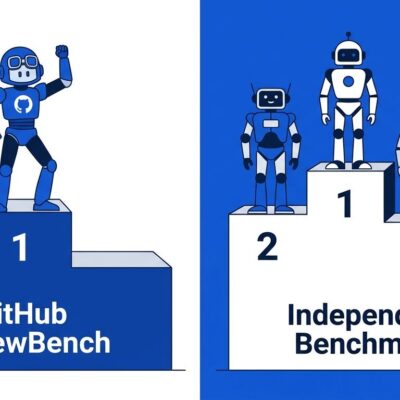
GPT-5.2 launched with three variants: Instant (speed-optimized for routine queries), Thinking (better at coding and structured work), and Pro (maximum accuracy for difficult questions). The Thinking variant reclaimed some competitive ground, achieving perfect scores on AIME 2025 math competition without tools – something Gemini 3 Pro only matched with code execution enabled. On SWE-Bench Pro, a rigorous real-world coding benchmark testing four languages, GPT-5.2 Thinking hit 55.6%, setting a new state of the art.
Hallucination rates dropped 38% compared to GPT-5.1, falling to 10.9% on factual questions. OpenAI also claims a 400,000-token context window and 128,000-token max output, allowing developers to ingest entire code repositories at once.
But Gemini 3 didn’t lose. It still dominates most LMArena categories, including multimodal tasks. On Humanity’s Last Exam, Gemini scored 37.5% versus GPT-5.1’s 21.8%. Google’s user base surged from 450 million to 650 million monthly active users since Gemini 3 launched, while ChatGPT’s growth stalled around 810 million. The verdict from developers? “Too close to call.” The most intelligent choice, they say, is empirical – test on actual data and workflows, because benchmarks don’t reflect real-world performance.
The Cost of Moving This Fast
OpenAI shipped three major model versions in four months: GPT-5 in August, GPT-5.1 in November, and GPT-5.2 in December. That pace is unsustainable. Developers are scrambling to monitor release notes, test behavior changes, and update prompts faster than they can deploy stable applications. One developer noted that GPT-5.2 is “tuned to avoid drift in extended reasoning sessions,” but rapid iteration means constant recalibration.
The strategic trade-offs are visible. Delayed advertising means delayed revenue. Shelved shopping and health agents mean missed opportunities to expand beyond chat. Pulse’s indefinite postponement removes a potential competitor to Google Assistant and Siri. Altman bet that sacrificing short-term revenue growth to defend ChatGPT would pay off long-term – but only if GPT-5.2 actually reclaims the lead. So far, it hasn’t. It’s matched Gemini 3 in some areas and fallen behind in others.
What Happens When the Market Leader Blinks
The code red reveals something the AI industry hasn’t seen from OpenAI before: vulnerability. Even the company that sparked the generative AI revolution can be forced into reactive mode by a competitor with deeper pockets and ecosystem integration. Google deployed Gemini 3 into Search “faster than ever,” leveraging distribution advantages OpenAI can’t match. OpenAI responded with technical performance, but Google controls the platform.
Altman told CNBC he expects to “exit code red by January,” meaning crisis mode continues through the end of 2025. That phrasing matters. Exiting code red doesn’t mean winning – it means stabilizing. If OpenAI can stop the traffic drop and maintain developer mindshare, delayed products like Pulse and advertising can resurface. If they can’t, the code red becomes permanent, and the delayed features become canceled.
The Developer Takeaway
For developers, this changes nothing and everything. GPT-5.2 is a strong model with impressive coding performance and lower hallucination rates. Gemini 3 excels at multimodal tasks and integrates seamlessly with Google services. Claude Opus 4.5 still leads on web development work. There is no single “best” model, and the gap between them is narrowing.
What changed is the realization that competitive dynamics now move faster than product roadmaps. The code red forced OpenAI to delay revenue-generating features and accelerate releases beyond sustainable cadence. That instability affects every developer using these APIs. The practical advice remains consistent: test on real workloads, measure error budgets and latency, and let total cost of ownership – not benchmarks – determine tool selection.
OpenAI’s code red won’t be the last. When market leadership is this fragile, everyone operates in permanent crisis mode.