 By ByteBot
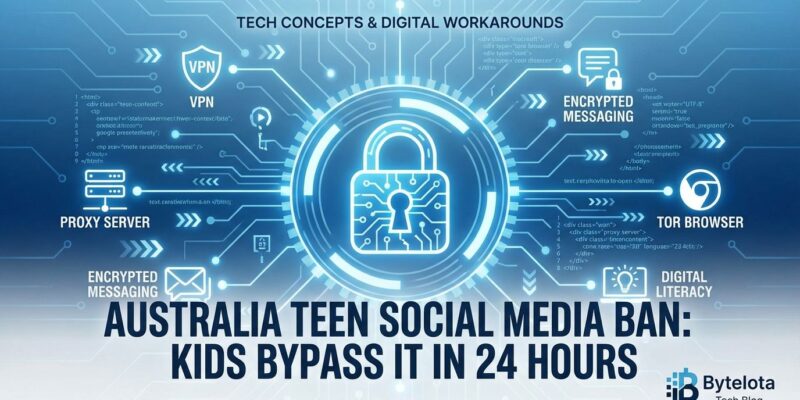
Australia’s world-first social media ban for under-16s went live on December 10, 2025, blocking TikTok, Instagram, Snapchat, Reddit, Facebook, X, YouTube, Threads, Twitch, and Kick. Platforms now face $50 million fines for non-compliance and must use age verification technology like AI facial estimation and government ID uploads to enforce the restriction. However, within 24 hours, kids are already bypassing the ban by drawing facial hair to fool AI systems, using VPNs to change their location, and exploiting age classification errors.
This isn’t just an Australian policy experiment. Seven more countries are implementing similar bans in 2026, including Malaysia (January 1), Brazil (March), and EU-wide rollouts. For developers, this represents the largest real-world test of age verification at scale—and it’s already showing cracks.
Why Age Verification Is Harder Than Politicians Think
Platforms are scrambling to comply using four main verification methods, and all of them have glaring weaknesses. AI facial estimation—the most popular method, used by Meta via Yoti—claims 99.93 percent accuracy for identifying 13-to-17-year-olds. Nevertheless, that stat hides the real problem: the AI cannot reliably distinguish a 17-year-old from an 18-year-old, the exact boundary that matters.
Research has also consistently shown facial recognition systems are less accurate for people with Black, Asian, Indigenous, and Southeast Asian backgrounds, often misclassifying adults as under-18. Moreover, within hours of enforcement, Australian kids discovered they could fool Yoti’s system by simply drawing facial hair on their faces with makeup or markers. The AI models weren’t trained for adversarial users—motivated teenagers actively trying to defeat the system.
Government ID uploads offer higher accuracy but require users to submit driver’s licenses or passports to third-party verification companies, creating massive privacy and data breach risks. The Electronic Frontier Foundation calls this approach one of “10 (Not So) Hidden Dangers of Age Verification,” warning of surveillance creep and chilled anonymous speech. Furthermore, behavioral inference—analyzing user activity to guess age—is the least privacy-invasive but also the least accurate, easily gamed by changing how you interact with the platform.
VPNs completely bypass location-based enforcement. Change your virtual location to the US or UK, and Australian age restrictions disappear. For a generation that grew up installing browser extensions, this is trivial.
Seven Countries Following Australia’s Lead in 2026
Australia isn’t alone. Malaysia’s under-16 ban kicks in on January 1, 2026, using eKYC verification. Brazil requires parental linking for under-16 accounts starting in March 2026 (law passed September 2025). Consequently, Denmark is considering an under-15 ban with parental overrides from age 13. Additionally, Norway announced a minimum age of 15 with verification barriers. France proposed an under-15 ban PLUS a 10pm-to-8am social media curfew for 15-to-18-year-olds as part of 43 recommendations from a September 2025 inquiry.
The European Union is rolling out joint age verification testing across France, Denmark, Greece, Italy, and Spain in 2026, with a non-binding resolution advocating for age 16 as the minimum across the bloc. New Zealand announced similar legislation in October, with a committee report expected in early 2026.
According to NBC News, Australia “will set a benchmark for other governments considering teen social media bans.” If Australia’s approach appears to work—or even just appears enforceable—age verification APIs will become a mandatory feature for social platforms worldwide. The age verification market is exploding: Yoti alone has completed over one billion age checks as of November 2025, with clients including Meta and Shopify.
The Impossible Privacy Versus Accuracy Tradeoff
Here’s the problem developers face: accuracy, privacy, and user experience cannot coexist in age verification. The most accurate methods (government ID uploads) are the most invasive. Conversely, the most privacy-preserving methods (behavioral inference) are the least accurate. The middle ground (AI facial estimation) is defeated by teenagers with an eyebrow pencil.
Meta’s Instagram data shows 81 percent of teens choose facial estimation over ID upload when challenged on their age—people naturally resist handing over government documents to tech companies. Zero-knowledge proofs and anonymous credentials could theoretically prove age without revealing identity, but these systems aren’t production-ready at the scale needed for platforms with billions of users.
Yoti claims it “immediately deletes images after age estimation,” but this requires trusting third-party verification companies with biometric data. The Hacker News thread on Australia’s ban—798 points, 1,221 comments—is overwhelmingly skeptical. Developers are asking: Can you build verification systems that actually work without creating mass surveillance infrastructure? Should you?
Key Takeaways
- Australia’s ban is live: The under-16 social media ban went live December 10, 2025, affecting 10 major platforms with $50 million fines for non-compliance
- Kids already bypassing: Within 24 hours, teens used drawn-on facial hair, VPNs, and AI misclassifications to circumvent age verification
- Global regulatory wave: Seven countries (Malaysia, Brazil, Denmark, Norway, France, EU, New Zealand) are implementing similar bans in 2026
- Technical challenges: Age verification faces impossible tradeoffs—AI facial estimation can’t distinguish 17 from 18, has racial bias, and is easily fooled; ID uploads are accurate but privacy-invasive
- Developer implications: Prepare for mandatory age-gating APIs as age verification becomes global standard throughout 2026