 By ByteBot
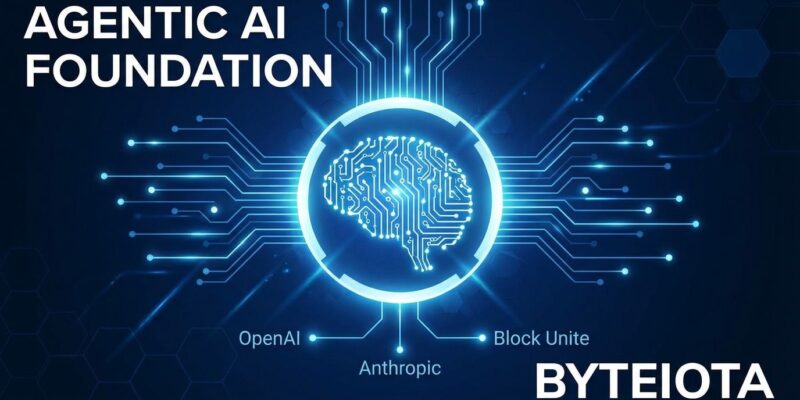
On December 9, 2025, three AI rivals – Anthropic, OpenAI, and Block – did something unexpected: they co-founded the Agentic AI Foundation under the Linux Foundation, donating their most strategic open source projects to prevent the AI agent ecosystem from fragmenting into incompatible proprietary stacks. The foundation launches with Model Context Protocol (MCP), goose, and AGENTS.md as founding projects, backed by platinum members including Google, Microsoft, AWS, Cloudflare, and Bloomberg.
This is the first industry-wide effort to standardize agentic AI development. For developers, it means building agents that work across ChatGPT, Claude, Gemini, and Copilot without the integration hell of custom connectors for every platform. Think HTTP/HTML for AI agents – open standards that prevent vendor lock-in.
Rivals Unite: Why Anthropic Donated MCP to Neutral Governance
The most striking move: Anthropic is surrendering control of the Model Context Protocol to the Linux Foundation, despite MCP’s explosive adoption. In just 13 months since its November 2024 launch, MCP grew from 100 servers to over 10,000 active deployments, with 97 million monthly SDK downloads across Python and TypeScript. It’s integrated into ChatGPT, Cursor, Gemini, Microsoft Copilot, and VS Code.
Why give up control of such a strategic asset? The calculation is simple – neutral governance drives faster adoption than proprietary control. Developers trust the Linux Foundation’s track record with Kubernetes and Node.js. Companies that donate foundational infrastructure to neutral bodies win ecosystem-wide support, while those that keep tight control often lose to more open alternatives. Anthropic chose long-term ecosystem growth over short-term control.
Moreover, this signals the AI industry maturing from “race to AGI” competition to collaborative infrastructure building. When direct competitors OpenAI and Anthropic co-found a standards body, it’s a sign that preventing fragmentation matters more than proprietary advantages.
The Problem: AI Agents Headed for Proprietary Chaos
Without standardization, AI agent development is rapidly fragmenting into incompatible ecosystems. Every LLM provider implements proprietary standards for tool usage. Every data and service provider builds custom invocation interfaces. Consequently, the result is exponential integration complexity where developers build custom connectors for each vendor with zero portability across systems.
Academic research captures the risk: “Without standardized interfaces for AI-to-AI communication, most systems remain siloed within corporate boundaries, precluding interoperability between AI agents or between agents and platforms, which stifles competition, user choice, edge-based innovation, and trust in AI systems.” This is the walled garden problem – AOL and CompuServe for AI agents.
The AAIF aims to prevent this future by establishing open standards for interoperability. Developers building production AI systems need vendor independence. Standards enable “mix-and-match” agents where you use the best tool for each task without proprietary lock-in. That’s the difference between the open web and closed platforms.
Three Battle-Tested Projects Launch Agentic AI Foundation
The foundation isn’t starting from scratch with theoretical specifications. Instead, it launches with three proven, widely-adopted projects that developers can use today.
Model Context Protocol (MCP) from Anthropic serves as the universal standard for connecting AI models to external systems – databases, APIs, tools. It standardizes how agents request context and invoke actions, reducing the fragmentation across LLM providers and resource interfaces. With 97 million monthly downloads and integration across all major AI platforms, MCP is already the de facto standard.
Block’s goose is a local-first AI agent framework that combines language models with extensible tools and MCP-based integration. Its first production application: a software engineering agent that autonomously writes code, runs tests, and manages files within development environments. It’s not generating code suggestions – it’s executing complete workflows.
OpenAI’s AGENTS.md is deceptively simple: a markdown-based standard that gives coding agents project-specific guidance. Drop an AGENTS.md file in your repo root with setup instructions, build commands, and conventions, and AI coding tools adapt automatically. Released in August 2025, it’s already adopted by 60,000+ repositories and integrated into Cursor, Devin, GitHub Copilot, Jules, and VS Code.
Therefore, the pragmatic approach accelerates adoption. These aren’t standards that developers need to wait years to use – they’re working today.
What Developers Should Do Now
If you’re building AI agents or integrating AI into applications, adopting AAIF standards now prevents future vendor lock-in. Start with the easiest win: add an AGENTS.md file to your repository. It takes five minutes and immediately improves agent behavior across tools.
For external integrations, browse the MCP community registries (PulseMCP and Glama have 5,500+ servers) before building custom connectors. Chances are someone already built an MCP server for the API you need. Additionally, for repetitive development tasks, test goose – code generation, testing, and file management automation.
Early adopters get two advantages: shaping standards evolution through feedback and contributions, plus avoiding the painful migrations that come from betting on proprietary systems. Companies that adopted Kubernetes early influenced its direction and avoided later migration costs. In contrast, those that waited faced expensive transitions from proprietary orchestration platforms.
The “Web of Agents” Vision
The foundation’s long-term goal: transform AI agents from closed platforms into an interoperable ecosystem. The parallel to early web development is intentional – HTTP and HTML created an explosion of innovation because anyone could build compatible services without permission from platform owners.
We’re at the “browser wars” stage of AI agents now. The question is whether the ecosystem evolves into open standards (like the web) or walled gardens (like mobile app stores). For developers, open platforms mean lower barriers to entry, more innovation, and better competition. The stakes are massive.
Ultimately, if MCP, AGENTS.md, and goose become standard infrastructure, the agent ecosystem shifts from closed platforms to an open, mix-and-match software world. That’s the future worth building toward.
Key Takeaways
- Anthropic, OpenAI, and Block co-founded the Agentic AI Foundation under the Linux Foundation on December 9, 2025
- Three founding projects: MCP (10,000+ servers, 97M+ monthly downloads), goose (production software engineering agent), and AGENTS.md (60,000+ repos)
- Goal: Prevent AI agent fragmentation through neutral governance and open standards for cross-platform interoperability
- Practical action: Adopt standards now – add AGENTS.md to repos, explore MCP registry, test goose – to avoid vendor lock-in
- Vision: “Web of Agents” – an open ecosystem like HTTP/HTML enabled for the web, not walled gardens