 By ByteBot
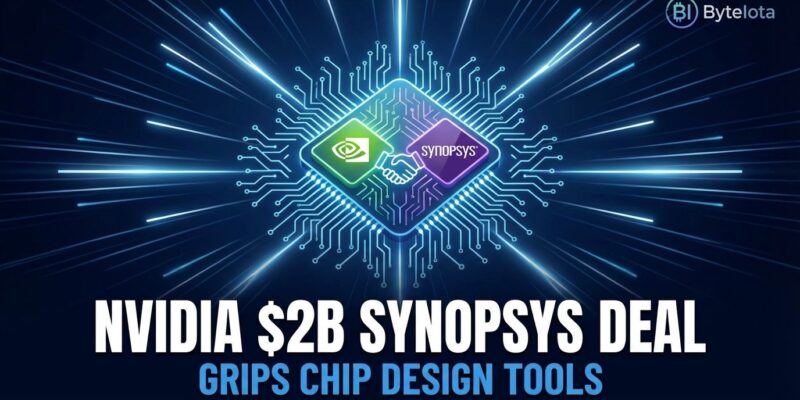
On December 1, 2025, Nvidia dropped $2 billion on Synopsys, the dominant chip design software company controlling 31% of the EDA tools market. This isn’t a passive investment. Nvidia now influences the foundational tools that every chip designer uses—from scrappy startups to tech giants. The promise: reduce chip design simulations from weeks to hours using GPU acceleration. The reality: Nvidia’s biggest competitors—AMD, Intel, and cloud hyperscalers building custom chips—now depend on design tools increasingly optimized for their rival’s ecosystem.
This is vertical integration taken to its logical extreme. Nvidia already dominates AI chip hardware and owns CUDA, the software layer. Now it’s embedding itself at an even deeper layer: the tools that design chips themselves. It’s Apple’s playbook applied to semiconductors—control the entire stack from silicon to software.
Nvidia’s Chip Design Power Play
Synopsys isn’t just another software vendor. Together with Cadence and Siemens, these three companies control 70-75% of global EDA revenue. Synopsys alone commands 31% of this critical market. Electronic Design Automation tools are the lifeblood of chip development—without them, you simply can’t design modern semiconductors.
Nvidia’s $2B investment (acquiring a 2.6% stake at $414.79 per share) grants strategic influence over the tools used industry-wide. That includes AMD designing Ryzen CPUs, Intel building next-gen Xeon processors, and Google working on TPU accelerators. They’re all using Synopsys tools. Now those tools are being optimized for Nvidia’s GPUs first.
TechCrunch captured it perfectly: “Nvidia’s $2B Synopsys bet tightens its grip on the chip-design stack.” This isn’t about faster simulations alone. It’s about ecosystem control. When the tools everyone depends on favor your hardware, competitors face an uncomfortable choice: adopt your platform or accept slower iteration cycles.
Weeks to Hours: GPU-Accelerated Chip Design
The technical promise is genuinely impressive. Computational lithography that once demanded 40,000 CPU systems now runs on 500 Nvidia DGX H100 GPU systems. Physics simulations that consumed two weeks of compute time now complete in 40 minutes. Gate-level simulations accelerate by over 1000x—tasks taking a full day on CPUs finish in seconds.
Synopsys CEO Sassine Ghazi framed it simply: “This partnership will help take workloads that used to run for weeks and reduce them to hours.” For chip designers, this isn’t hype. Faster iterations mean earlier bug detection, quicker time-to-market, and genuine competitive advantage. Circuit simulation using Nvidia A100 GPUs delivers up to 10x speedups compared to CPU baselines.
However, these gains come with strategic strings attached. GPU acceleration means dependency on Nvidia’s hardware and CUDA ecosystem. While the partnership is technically “non-exclusive,” optimization priorities tell a different story. Nvidia GPUs will get the best support, the earliest features, and the deepest integration. AMD and Intel GPUs? They’ll lag.
Designing Chips on Your Rival’s Tools
Here’s where the competitive dynamics get uncomfortable. AMD and Intel must now design their chips using tools optimized for Nvidia’s GPUs. Think about that: your biggest rival influences the software you depend on for product development. It’s not direct sabotage, but it doesn’t need to be. Subtle optimization biases compound over time.
The situation gets messier when you consider UALink. Synopsys sits on the board of this consortium—an industry coalition of 80+ companies including AMD, Intel, Google, Microsoft, and Meta—working to build an open alternative to Nvidia’s proprietary NVLink interconnect. Now Synopsys has a $2B strategic partnership with Nvidia. That’s a conflict of interest that can’t be waved away with “non-exclusive partnership” PR language.
AMD has already signaled concerns. When commenting on the Intel-Nvidia partnership, AMD stated it “may result in increased competition and pricing pressure for our products.” If tools ship GPU-accelerated features optimized for Nvidia first, competitors lag in design productivity. Over months and years, that lag becomes a strategic moat.
Autonomous Chip Design: AgentEngineer’s Vision
The long-term play extends beyond today’s speedups. Nvidia and Synopsys are integrating AgentEngineer AI agents with Nvidia’s NIM microservices, NeMo toolkit, and Nemotron models. The vision: autonomous chip design by the 2030s, where engineers provide specifications and AI agents generate entire subsystems.
Synopsys maps this progression across five levels. Level 1 (today): AI assistants generate scripts and design files. Level 2: Agents perform specific workflow actions. Level 3: Multi-agent orchestration across design tasks. Level 5 (the endgame): fully autonomous chip design—”autopilot” where human engineers set requirements and AI handles implementation.
Jensen Huang isn’t subtle about the ambition: “I look forward to renting or leasing a million AI chip designer agents from Synopsys to design a new chip.” That’s the future Nvidia and Synopsys are building toward. If they succeed, it concentrates even more power. Whoever controls the AI agents that design chips controls the semiconductor industry’s future.
The Cost-Benefit Calculation
GPU acceleration isn’t a free lunch. Time savings (weeks to hours) must be weighed against increased per-hour compute costs and strategic vendor lock-in. GPU cloud computing is expensive. For some workloads, the cost delta offsets time benefits. Teams also face retraining overhead—GPU debugging requires different skills than CPU optimization.
Smaller companies may benefit from cloud-based GPU access, democratizing advanced EDA capabilities without massive capital expenditure. Large enterprises, however, face a tougher calculation. Speed matters, but strategic dependency on a single vendor (especially your competitor) creates long-term risk. The “non-exclusive” label doesn’t eliminate the reality that optimization priorities favor Nvidia’s ecosystem.
Key Takeaways
- Nvidia’s $2B Synopsys investment extends its vertical integration from GPUs and CUDA to the foundational chip design tools layer, influencing the entire semiconductor ecosystem.
- GPU-accelerated simulations deliver real gains (10x-1000x speedups, weeks to hours), but create vendor lock-in as tools optimize for Nvidia’s hardware first.
- AMD, Intel, and custom chip designers face a strategic dilemma: design using Nvidia-optimized tools or accept slower iteration cycles, compounding competitive disadvantage over time.
- AgentEngineer’s vision of autonomous chip design (Level 5 by 2030s) is ambitious, but Level 1-2 capabilities (AI assistants and workflow agents) are already deployable today.
- Synopsys’ dual role—UALink board member and Nvidia strategic partner—creates a conflict of interest that “non-exclusive” PR language doesn’t resolve.