 By ByteBot
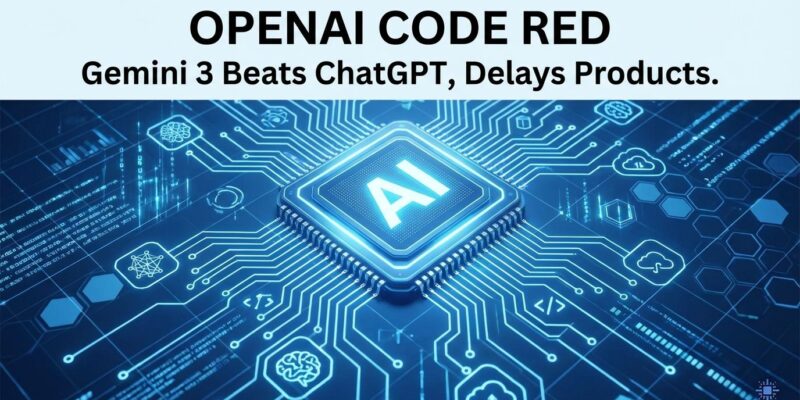
Sam Altman declared an internal “code red” at OpenAI this week, putting nearly all company projects on hold to improve ChatGPT after Google’s Gemini 3 outperformed it in industry benchmarks. The December 2 memo delays advertising integration, shopping AI agents, and health AI agents indefinitely as OpenAI scrambles to catch up. Moreover, it’s an ironic reversal: three years ago, Google panicked over ChatGPT’s launch with the exact same “code red” language.
For the first time since ChatGPT’s viral debut, OpenAI is on the defensive. Consequently, the company’s enterprise market share has collapsed from 50% in 2023 to just 25% today, while Anthropic leads at 32% and Google climbs to 20%. Developers building on ChatGPT APIs now face uncertainty about the roadmap, product delays, and whether OpenAI can actually close the performance gap.
Gemini 3 Wins the Benchmark Battle
Google’s Gemini 3, launched in November, outperformed ChatGPT across multiple industry benchmarks. On “Humanity’s Last Exam,” a challenging reasoning test, Gemini 3 scored 37.5% compared to ChatGPT’s 31.6%—a six-point gap. In coding tests (SWE-bench Verified), Gemini 3 Pro achieved 76.2% versus GPT 5.1’s 73%. Furthermore, Gemini 3 Pro now sits at the top of the LMArena leaderboard, displacing ChatGPT from the crown.
These aren’t marginal differences. Gemini 3 excels at multimodal tasks (analyzing images, diagrams, and videos), long document reasoning with its 1-million-token context window, and raw speed. Meanwhile, ChatGPT maintains an edge only in conversational quality and specific coding scenarios requiring strict correctness.
The shift is real enough that high-profile users are switching. Salesforce CEO Marc Benioff posted on November 23: “I’ve used ChatGPT every day for three years. Just spent two hours on Gemini 3. I’m not going back. The leap is insane—reasoning, speed, images, video…everything is sharper and faster.” That’s a brutal endorsement of Google over OpenAI from a CEO who’s built AI into his company’s products.
What Gets Delayed: Real Consequences
Altman’s memo didn’t just promise vague improvements—it killed active projects. Additionally, OpenAI is delaying advertising integration (which had been in beta testing), AI shopping agents for product research, health AI agents, and a personal assistant called “Pulse” that would have competed with Google Assistant and Siri. These aren’t future plans; they’re live initiatives with timelines now on indefinite hold.
For a company pursuing profitability, pausing advertising is costly. OpenAI had been testing shopping-related ad experiences in the ChatGPT app, and users had already complained about “app suggestions that looked like ads.” Now all of that work stops. Therefore, for developers waiting for OpenAI’s promised agent capabilities, it signals the roadmap is unpredictable. Strategic bets are being abandoned to fight an existential threat.
The Irony of “Code Red”
In December 2022, Google CEO Sundar Pichai declared a companywide “code red” after ChatGPT went viral, calling it an “existential threat to Google Search.” He reassigned teams across research and Trust & Safety to build AI prototypes by May 2023. However, Pichai later admitted Google had the technology but delayed launch over quality concerns: “We knew in a different world, we would’ve probably launched our chatbot maybe a few months down the line.”
Now, three years later, Sam Altman is using the exact same language to respond to Google’s Gemini 3. The roles have completely reversed. Fortune’s headline captured it perfectly: “Sam Altman declares Code Red as Google’s Gemini surges—three years after ChatGPT caused Google CEO Sundar Pichai to do the same.”
This isn’t just a fun historical parallel—it reveals the AI race dynamics. Market leaders get disrupted by challengers, forcing reactive pivots. Consequently, Google’s distribution advantage (billions of users across Search, Gmail, Docs) now threatens OpenAI the same way ChatGPT’s quality threatened Google Search in 2022. The innovator becomes the incumbent, scrambling to defend territory instead of breaking new ground.
The Market Share Collapse
OpenAI’s enterprise market share has been cut in half in just two years. In 2023, OpenAI owned 50% of the enterprise AI market. Nevertheless, by July 2025, according to Menlo Ventures data, that share had dropped to 25%. Anthropic now leads with 32%, while Google holds 20%. That’s a massive redistribution in a market growing rapidly—OpenAI isn’t just losing ground, it’s being displaced.
Anthropic’s rise is backed by serious money: Microsoft invested up to $5 billion and Nvidia up to $10 billion, valuing the company at $350 billion. Claude Opus 4.5, launched November 24, competes directly with ChatGPT on quality while undercutting on price ($5/$25 per million tokens) and emphasizing safety and alignment features enterprises want.
Meanwhile, Google’s ecosystem integration gives it a distribution advantage OpenAI can’t match. Gemini 3 launched with day-one integration across Search, Gmail, Docs, and other Google services—instantly reaching billions of users. As a result, enterprise customers are diversifying away from OpenAI because competitors offer better features (Anthropic’s safety focus) or better distribution (Google’s ecosystem). The “code red” is as much about market share as it is about technology.
Can OpenAI Catch Up?
Altman’s memo promises a new reasoning model next week (week of December 9) that will beat Gemini 3 in internal evaluations. However, the pattern is concerning: OpenAI has released multiple models throughout 2025—o3 in January, o3 and o4-mini in April, o3-pro in June—and still trails in public benchmarks. Constant releases, marginal improvements, but not closing the gap.
The memo focuses on personalization features, response speed, reliability, and ability to answer a wider range of questions. Those are important, but they’re also vague quality improvements, not the breakthrough performance needed to retake the lead. Furthermore, Google has distribution and resources, Anthropic has enterprise trust, and both are moving fast.
Developers need to make a choice: stay loyal to ChatGPT APIs, diversify across multiple providers, or switch entirely? Smart developers are building provider-agnostic applications with abstraction layers, not betting everything on OpenAI catching up. Therefore, the “code red” creates uncertainty, and uncertainty drives customers to hedge their bets. That’s the real danger for OpenAI—not falling behind on benchmarks, but losing the trust that keeps developers locked in.
Key Takeaways
- Google’s Gemini 3 leads ChatGPT in industry benchmarks, including a 6-point gap on “Humanity’s Last Exam”
- OpenAI has delayed all non-ChatGPT projects: ads, shopping agents, health agents, and the Pulse assistant
- The December 2025 “code red” mirrors Google’s December 2022 panic over ChatGPT—roles completely reversed
- OpenAI’s enterprise market share dropped from 50% (2023) to 25% (2025), while Anthropic leads at 32%
- Developers should build provider-agnostic apps instead of betting on one AI platform