 By ByteBot
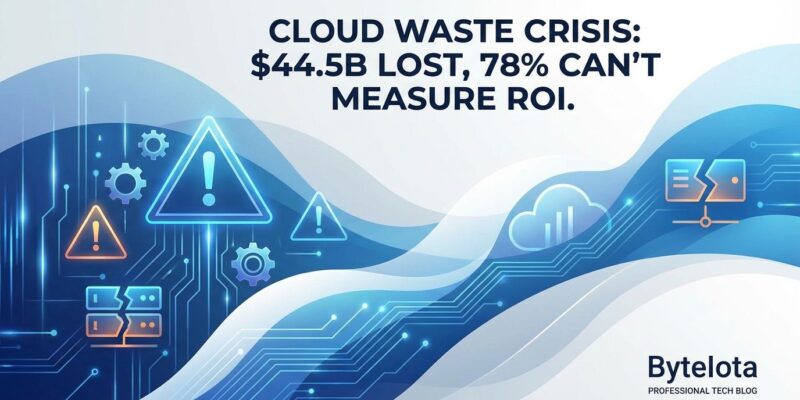
Organizations will waste $44.5 billion on cloud infrastructure in 2025—21% of total enterprise spend burned on underutilized resources, according to Harness’s November-December 2024 survey of 700 developers and engineering leaders. The deeper crisis? 78% of IT leaders can’t consistently demonstrate cloud ROI, despite 66% claiming automated waste management. This isn’t a technical problem. It’s organizational dysfunction between FinOps teams managing budgets and developers building systems.
While FinOps teams optimize spreadsheets, 62% of developers want cost control but only 43% can see idle resources in real-time. The result: an average 31 days to identify waste, purchasing commitments “based on guesswork” (55% of developers), and billions vanishing into a blame cycle that fixes nothing.
The $44.5 Billion Question: Where’s the Money Going?
The waste isn’t mysterious. Only 43% have visibility into idle resources, 39% can see orphaned resources, and 33% can identify over-provisioned workloads. When teams can’t see costs, they can’t optimize them. Flexera’s 2025 State of the Cloud Report independently confirms 32% waste rates, showing minimal improvement from 35% in 2023. The optimization gap is staggering: 71% don’t use spot orchestration (missing 70-90% discounts), 61% don’t rightsize instances, 58% don’t use reserved instances or savings plans, and 48% don’t even track and shut down idle resources.
Real-world case studies prove the opportunity exists. A U.S. e-commerce company cut AWS bills 35% just by shutting down non-production environments outside business hours and rightsizing instances. A global financial services firm reduced multi-cloud spending 30% through workload optimization. These aren’t outliers—they’re what happens when teams actually implement basic FinOps practices. The fact that 71% aren’t using spot orchestration when 70-90% discounts exist reveals the gap isn’t technical knowledge. It’s organizational execution.
Cloud spending compounds the problem. Global public cloud spend hit $679 billion in 2025, up from $563 billion in 2023—a 28% year-over-year increase. Organizations are exceeding budgets by 17% on average. The waste isn’t slowing down. It’s accelerating alongside growth.
The FinOps Theater Problem: Claiming Automation, Delivering Spreadsheets
Here’s the irony: 66% claim mostly-to-fully automated waste management environments, yet 58% admit it takes weeks or months to detect and remediate cost waste. CloudBolt’s 2025 survey of 350 senior IT leaders exposes this “FinOps theater”—the gap between automation claims and detection reality. Organizations take an average 31 days to identify and eliminate waste, and 25 days just to detect overprovisioned resources. That’s a month of daily burn before action starts.
The ROI measurement crisis runs deeper. Organizations can’t even agree on what ROI means: 43% define it as revenue growth, 36% as operational efficiency, and 35% as cost savings. Meanwhile, 55% can’t link cloud spend directly to business outcomes, 48% blame organizational silos, and 44% cite poor tagging and inconsistent accountability. The result: 48% of CFOs lack confidence in measuring cloud ROI. You can’t justify investments you can’t measure.
The Kubernetes blind spot epitomizes the dysfunction. 98% agree Kubernetes drives major cloud cost increases, yet 91% can’t effectively optimize their clusters. That’s not a knowledge gap—it’s a systematic failure to connect infrastructure complexity with cost accountability. Tools exist. Adoption lags.
Related: AI Developer Productivity Paradox: 19% Slower, Feel Faster
The Real Culprit: When FinOps and Developers Don’t Talk
The root cause is quantified: 52% of engineering leaders cite the disconnect between FinOps and development teams as the primary driver of wasted cloud spending. The dysfunction flows both ways. FinOps teams optimize budgets without understanding engineering workflows. Developers make architectural decisions without cost visibility. The result: 55% of developers say purchasing commitments are “ultimately based on guesswork,” yet 62% want more control and responsibility for managing cloud costs.
Visibility gaps prevent developer accountability. Fewer than half have real-time access to idle resources (43%), orphaned resources (39%), or over/under-provisioned workloads (33%). The 2025 FinOps Framework emphasizes “accountability pushed to the edge” with engineers owning costs from design through operations. Theory looks good. Practice lags years behind.
Developer frustration from community discussions paints the reality: “Finance says we’re overspending, but won’t give us cost dashboards.” “We’re asked to commit to reserved instances based on vibes, not data.” “I have no idea how much my Kubernetes deployment costs.” This isn’t ignorance. It’s developers being blamed for costs they can’t control with tools they don’t have access to. The blame cycle wastes billions while fixing nothing.
Related: Technical Debt Crisis 2025: 33% Time Wasted, $1.5M Cost
What Actually Works: Five Fixes That Break the Cycle
Solutions exist with proven ROI. FinOps teams grew from 51% to 59% of organizations year-over-year, showing momentum. Yet only 32% have achieved fully automated cost-saving practices. The gap between tools (growing FinOps adoption) and outcomes (still 32% waste, 31-day detection) reveals implementation challenges. Here’s what organizations getting results actually do differently:
Tag everything ruthlessly. 44% cite poor tagging as an ROI measurement blocker. Enforce tagging policies at provisioning time—prevent untagged resources from launching. Tag owner, team, project, environment, cost center, and expiration date. If you can’t attribute costs, you can’t optimize them.
Shift cost awareness left into design. Architectural decisions made during design have 10x cost impact compared to operational tuning. Add cost estimates to pull requests. Include cloud cost impact in architecture reviews. “This new microservice will cost ~$1,200/month at expected load” changes conversations before resources deploy.
Give developers budgets and visibility, not just blame. 62% of developers want cost control, but only 43% have visibility. Implement team-level budgets. Deploy real-time cost dashboards. Send alerts to engineering teams, not just finance. Accountability requires visibility. If developers can see costs as they build, they’ll optimize. If they only see blame in monthly reports, nothing changes.
Automate the boring stuff. Only 32% have automated cost-saving practices—huge opportunity. Start with low-hanging fruit: auto-shutdown dev/test environments outside business hours (proven 35% savings), auto-scaling based on actual load, spot instance orchestration for fault-tolerant workloads. Manual monthly audits can’t keep pace with cloud’s dynamic nature.
Measure business outcomes, not just costs. 78% can’t demonstrate ROI partly because they’re measuring wrong things. Link cloud spend to business metrics: revenue per dollar spent, infrastructure cost per user, cost per transaction, feature velocity per team budget. “$150K/month infrastructure supports 2M users = $0.075 per user” tells a story finance understands.
The future priorities are clear: 40% have funded FinOps for AI over the next 6-12 months (addressing the inference cost explosion), and 42% prioritize hybrid multi-cloud management. 86% believe AI will enhance cost optimization within a year. The window to get ahead is narrow. Organizations not investing in Kubernetes cost visibility now will hit walls as workloads grow. AI inference costs (which dwarf training costs 15x for models like GPT-4) will surprise teams without proactive FinOps.
Key Takeaways
- $44.5B waste in 2025 isn’t a tech problem—it’s organizational dysfunction. 52% cite FinOps-developer disconnect as the root cause. Fix the communication, fix the waste.
- FinOps theater is expensive. 66% claim automation while taking 31 days to find waste. Measure time-to-remediation, not just “do we have a FinOps team.”
- Visibility enables accountability. 62% of developers want cost control, but only 43% can see idle resources. Give teams real-time dashboards or stop blaming them for costs.
- Low-hanging fruit still unpicked. 71% not using spot orchestration (70-90% discounts available), 61% not rightsizing instances. Start with basics before building complex FinOps programs.
- ROI measurement matters. 78% can’t demonstrate cloud ROI. Link spend to business outcomes (revenue, users, features) instead of just tracking costs.