 By ByteBot
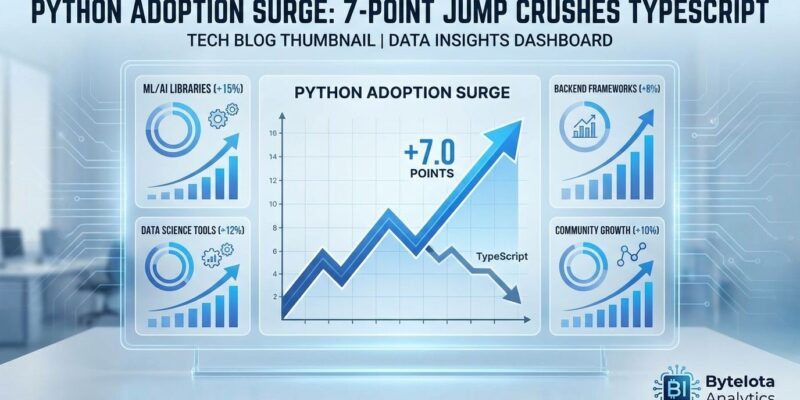
Python experienced a 7 percentage point increase in adoption from 2024 to 2025, reaching 57.9% usage among developers according to the Stack Overflow Developer Survey released in July 2025. This represents the most substantial single-year jump for any programming language in over a decade – more than three times the growth rate of Rust and Go combined. The survey of 49,000+ developers from 177 countries attributes this surge to Python’s dominance in AI, data science, and backend development. While TypeScript and Rust generate buzz about their “growth potential,” Python is quietly delivering unprecedented actual adoption at scale.
The Job Market Doesn’t Lie
Python leads the US job market with over 64,000 open positions as of February 2025, more than double JavaScript’s 30,000+ openings and significantly ahead of Java’s 43,000+. Moreover, Python’s TIOBE Index rating hit 26.14% in 2025 – the highest any programming language has ever achieved in TIOBE’s history. These aren’t vanity metrics. They’re corporate budgets speaking louder than developer enthusiasm ever could.
The numbers reveal a stark reality: everyone talks about learning Rust or TypeScript, but employers are hiring Python developers at unprecedented scale. Python salary averages $125,740, competitive with Go’s $146,879 and well above JavaScript’s $117,002-$154,956 range. Furthermore, 70% of junior and mid-level job listings now require either Python or JavaScript skills, according to 2025 data from Turing and HackerRank.
This is the ultimate validation of Python’s real-world value – not just developer excitement, but where companies actually allocate hiring budgets. The gap between what developers say they want to learn and what the market actually demands has never been wider.
Perception vs Reality: The Buzz Gap
JetBrains’ State of Developer Ecosystem 2025 survey ranks TypeScript, Rust, and Go highest for “perceived growth potential” and future attractiveness. Yet Python’s actual adoption growth dwarfs all of them. Python delivered in one year what typically takes a decade – a 7 percentage point jump that more than triples Rust and Go’s 2 percentage point gains each.
TypeScript has seen a “dramatic rise” over the past five years, according to JetBrains. Meanwhile, Python quietly dominates actual usage: 54.8% among professional developers and 71.8% among learners – the leading position in the learning pipeline. JavaScript, PHP, and SQL have hit their “maturity plateau” with minimal growth, making Python’s surge even more remarkable.
This disconnect between promise and reality challenges the narrative that newer, “sexier” languages are taking over. Python wins on the metrics that actually matter: adoption rates, production usage, and job market demand. The hype belongs to Rust and TypeScript. The market share belongs to Python.
Related: TypeScript Overtakes Python as GitHub’s #1 Language
The AI Multiplier Effect
Python’s surge directly correlates with the AI boom, but dismissing this as “just AI hype” misses the fundamental dynamic at play. This is a self-reinforcing ecosystem: AI projects drive Python adoption, which creates more Python developers, which produces more Python AI tools, which enables more AI capabilities, which drives more Python adoption. The loop accelerates with each iteration.
The data backs this up. 41% of Python developers use the language specifically for machine learning, while 51% focus on data exploration and processing. Among Kaggle data scientists, 87% use Python regularly. SlashData research shows 65% of global data science projects rely on Python compared to just 21% for JavaScript. Industry giants like Google, Microsoft, Tesla, Amazon, and NVIDIA depend on Python for mission-critical AI applications.
However, this isn’t just about AI models. The ecosystem is maturing across the board. TensorFlow 3.x brings enterprise-grade serving and tooling. PyTorch 2.3 adds the TorchDynamo compiler for production optimization. AutoML platforms like Auto-sklearn, AutoGluon, and H2O democratize machine learning for non-experts. Emerging tools like Polars push data processing boundaries while LangChain enables new LLM application patterns.
This ecosystem momentum is self-sustaining, not just riding a hype cycle. Each new AI project creates more Python infrastructure, which lowers barriers for the next project, which trains more developers in Python. Network effects at scale.
Related: AI Developer Tools: 84% Adoption But Only 29% Trust
The Performance Paradox: Why Slow Wins
Python is objectively slow. Orders of magnitude slower than C, Java, or JavaScript for CPU-intensive work. The Global Interpreter Lock (GIL) limits parallelism. Dynamic typing adds runtime overhead. Multi-threading remains challenging. Yet Python is experiencing the fastest growth of any major language. This performance paradox challenges conventional developer wisdom that speed matters most.
The explanation reveals what developers actually value: ecosystem strength and “good enough” performance trump raw speed. Most Python code never actually runs in Python. NumPy, pandas, and TensorFlow execute at C speeds – Python just provides the interface. Consequently, developer productivity matters more than execution speed for the majority of real-world workloads.
Python has also gotten substantially faster. Python 3.12 doubled Python 2’s performance. Python 3.13 adds an optional JIT compiler. PyPy provides significant speedups through just-in-time compilation. For the remaining performance-critical paths, developers can replace hot spots with Rust or C modules without abandoning the Python ecosystem.
As one Hacker News commenter noted, Python “succeeds by being good enough to gain traction, with people choosing it for its great ecosystem and developer availability despite performance trade-offs.” Another veteran developer shared this was their “first year writing production-quality Python code after decades of using it for prototypes and scripts.” The language has crossed a maturity threshold where performance objections no longer override practical advantages.
Is This Python Growth Sustainable?
Python’s unprecedented surge raises the critical question: Is this sustainable growth or an AI-driven bubble? The answer determines whether investing in Python skills and infrastructure makes strategic sense or sets up future regret.
The bull case for sustainability is compelling. Python’s massive installed base creates ecosystem inertia that’s nearly impossible to overcome. Corporate investment in Python infrastructure continues accelerating. Educational institutions teach Python widely, creating a steady pipeline of new developers. Network effects strengthen daily – everyone uses Python because everyone uses Python. Most tellingly, Python leads among learners at 71.8%, ensuring the next generation of developers arrives Python-fluent.
However, the bear case deserves consideration. Python’s growth is explicitly tied to the AI boom, with 41% of developers using it specifically for machine learning. Performance ceilings exist – the GIL’s limitations may constrain applications requiring true parallelism at scale. Rust and Go could capture performance-sensitive workloads as their ecosystems mature. Some argue AI tooling will eventually abstract language choice away, making Python’s current advantage temporary.
Expert consensus leans toward sustainability. Most predict Python will dominate data science and AI for at least the next 5+ years due to ecosystem inertia and corporate lock-in. Yet contrarians warn that performance limitations will eventually force migrations to faster alternatives. The market is essentially betting that ecosystem effects outweigh performance concerns – a bet that’s paying off so far, but remains the biggest open question for developers choosing what to learn and companies selecting tech stacks.
Key Takeaways
- Python’s 7 percentage point year-over-year growth represents the largest single-year adoption jump for any major programming language in over a decade, more than tripling the combined growth of Rust and Go.
- Job market data validates Python’s dominance: 64,000+ open US positions versus JavaScript’s 30,000+, with Python achieving a record 26.14% TIOBE Index rating – the highest any language has ever reached.
- The “buzz vs reality” gap is stark – TypeScript, Rust, and Go generate excitement about growth potential, but Python delivers actual adoption at unprecedented scale through production usage and hiring.
- Python’s AI-driven growth isn’t just hype; it’s creating self-reinforcing network effects where AI projects generate more Python tools, which enable more AI capabilities, which drive more Python adoption in an accelerating loop.
- The performance paradox reveals what developers truly value: Python wins despite being objectively slow because ecosystem strength, developer productivity, and “good enough” performance with C libraries outweigh raw execution speed.
The data suggests Python’s surge represents a fundamental shift rather than temporary hype. However, sustainability depends on whether ecosystem effects continue outweighing performance limitations as applications scale. For now, the market has spoken – and it’s speaking Python.