By ByteBot
Docker just experienced the biggest single-year adoption surge of any technology in Stack Overflow’s survey history. The containerization platform jumped 17 percentage points to reach 71.1% adoption in the 2025 survey—the largest increase ever recorded for any tool, framework, or language. Moreover, this isn’t gradual growth. It’s a tipping point backed by compelling economics: Forrester’s Total Economic Impact study documents 66% infrastructure cost reduction and 43% productivity gains for enterprises adopting Docker Business.
71.1% Adoption: The Biggest Jump in Stack Overflow History
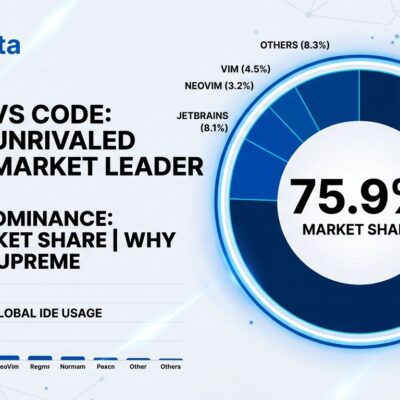
Stack Overflow’s 2025 Developer Survey, covering 49,000+ developers across 177 countries, revealed Docker reached 71.1% adoption—up from approximately 54% in 2024. The survey authors explicitly state this 17-point jump is “the largest single-year increase of any technology surveyed” in the platform’s history. Furthermore, Python’s recent 7-point surge and FastAPI’s 5-point gain pale in comparison.
The gap between IT professionals and other industries tells an important story. Among IT organizations, Docker adoption hit 92% in 2025, up from 80% in 2024. However, across all industries, adoption averages just 30%. This 62-point gap signals massive growth ahead as non-IT sectors catch up to infrastructure best practices.
When 7 out of 10 developers use a tool, it’s no longer optional—it’s industry infrastructure. Consequently, developers who haven’t adopted containers aren’t early skeptics anymore. They’re increasingly in the minority.
The Economics Are Irresistible: 66% Cost Reduction
Forrester’s Total Economic Impact study of Docker Business quantified what many suspected: containers deliver massive ROI. Independent research found enterprises reduced infrastructure costs by an average of 66% while increasing developer productivity by 43%. Additionally, organizations achieved 3 months faster time-to-market for revenue-generating applications.
These aren’t vendor marketing claims. Forrester conducted independent analysis of Docker Business customers and documented measurable business outcomes. The 66% cost reduction comes from higher density (more containers per host than VMs), lower resource overhead (containers share OS kernels), and reduced operational complexity. Meanwhile, the 43% productivity boost stems from consistent environments eliminating “works on my machine” problems and faster build-deploy cycles.
Real-world evidence backs the numbers. GE Appliances achieved “much greater application density than virtual machines” when migrating legacy data center applications to Docker. BBC’s news division solved “speed and volume” challenges by containerizing processing pipelines. In an era of budget constraints and efficiency mandates, 66% cost reduction isn’t a nice-to-have—it’s business-critical.
Why 2025 Was the Docker Adoption Tipping Point
Five converging forces made 2025 the year containers became default infrastructure:
AI/ML workflows demand reproducible environments. Tesla uses Dockerized deep learning models for autonomous driving. Netflix runs containerized AI for personalization. Hospitals deploy Docker-based medical imaging analysis. The problem containers solve—dependency hell with TensorFlow, PyTorch, NumPy, and CUDA versions—is critical for ML reproducibility. A model trained on one machine must run identically everywhere.
Microservices hit mainstream adoption. According to Docker’s 2025 State of App Dev report, 68% of IT organizations now use microservice architectures, versus just 31% of other industries. Docker’s lightweight, portable nature lowered the barriers to microservices adoption. When you’re deploying dozens of independent services, containers become essential infrastructure.
Economic pressure makes cost reduction compelling. That 66% infrastructure cost reduction from Forrester’s study hits different during budget constraint cycles. Cloud cost optimization shifted from nice-to-have to strategic priority. Containers deliver immediate, measurable savings.
Technology matured past early adoption concerns. Rootless containers are now mainstream—security by default rather than security add-on. GitOps tools like ArgoCD and Flux reached production maturity for declarative infrastructure. Docker Model Runner launched in 2025 to simplify AI model deployment. The rough edges got smoothed.
Speed-to-market became table stakes. Forrester’s finding of 3 months faster deployment for revenue-generating applications translates to competitive advantage. When competitors ship features quarterly instead of annually, deployment speed stops being optional.
Gartner’s 95% Projection: Containers as Default Infrastructure
Gartner projects that by the end of 2025, over 95% of new digital workloads will run on cloud-native (mostly containerized) platforms—up from just 30% in 2021. This represents a 3x increase in four years, positioning containers not as an alternative deployment option but as the default infrastructure for new applications.
The Docker monitoring and management market reflects this shift. Grand View Research pegs the market at $889.5 million in 2024, growing at 26.4% CAGR through 2030. Multi-billion dollar ecosystems don’t emerge around optional technologies—they emerge around infrastructure fundamentals.
Even Kubernetes dropping Docker as the default runtime (in v1.24) reinforces the broader point. Kubernetes still runs Docker images, just via containerd directly. The container format won. Consequently, the question isn’t “Do we containerize?” anymore—it’s “Which container runtime?”
What This Means for Developers
The Docker adoption surge signals containers have moved from early adopter technology to baseline expectation. Container literacy is becoming mandatory for developers—similar to how Git knowledge became non-negotiable over the past decade. Job requirements increasingly list container experience as required, not preferred.
Alternative tools are emerging for different use cases. Podman offers daemonless, rootless architecture for security-conscious environments. Containerd provides minimal footprint for Kubernetes workloads. However, all use the OCI standard container image format. A Docker image runs on Podman or containerd without modification.
Some skepticism remains valid. Hacker News threads still feature solo founders arguing “I don’t need Docker for a single VM deployment”—and they’re right for their specific use case. Static binary to one server doesn’t benefit from container overhead. Nevertheless, that’s increasingly the exception, not the rule.
For microservices, AI/ML workflows, or multi-environment deployments, the question flipped. Don’t justify container adoption—justify NOT using them. The default assumption changed.
Key Takeaways
- Docker adoption hit 71.1%—the biggest single-year surge of any technology in Stack Overflow survey history with a 17-point jump
- Forrester documents 66% infrastructure cost reduction and 43% developer productivity gains for enterprises adopting Docker Business
- Five drivers converged in 2025: AI/ML reproducibility needs, microservices mainstream adoption (68% IT), economic pressure, technology maturity, and speed-to-market imperatives
- Gartner projects 95% of new workloads cloud-native by end of 2025—up from 30% in 2021, signaling containers as default infrastructure
- Container literacy is becoming baseline expectation—justify NOT using containers rather than justifying adoption
The container surge isn’t hype. It’s infrastructure transformation backed by measurable economics and industry-wide adoption data.