 By ByteBot
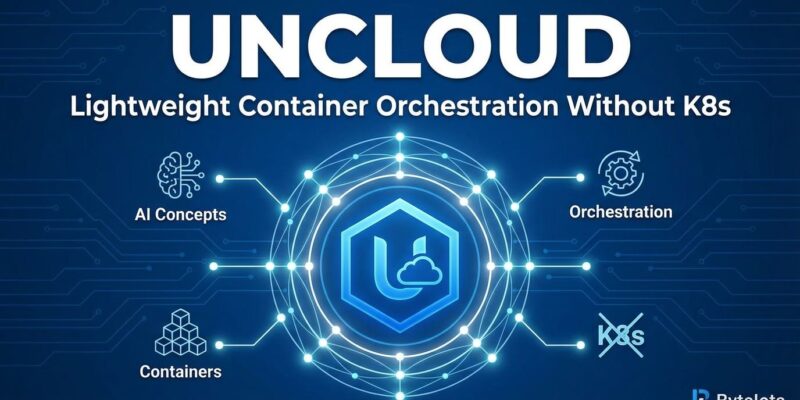
Uncloud hit 106 upvotes on Hacker News in three hours today. Developers are desperate for simpler container orchestration. The tool bridges the gap most teams actually face: Docker Compose doesn’t scale beyond one machine, but Kubernetes demands operational expertise startups don’t have. Uncloud offers multi-host container deployment with peer-to-peer architecture, automatic HTTPS, and zero-downtime updates—all without a control plane to manage.
The “Kubernetes overkill” problem is real. Teams adopt K8s because it’s the industry default, then spend more time managing infrastructure than building product. Uncloud challenges that assumption: What if you could get orchestration benefits without K8s complexity?
The Kubernetes Complexity Trap
Kubernetes solves real problems at scale, but most teams adopt it prematurely. The learning curve is steep—Helm charts, pod lifecycles, networking configs, secret management. This operational burden consumes “huge chunks of DevOps teams’ bandwidth,” as industry research shows. Developers report spending more time troubleshooting K8s than writing code.
The complexity has escalated beyond engineering teams. C-suite executives now see K8s as a drag on delivery cycles and innovation velocity. ByteIota’s own coverage reflects this: “Kubernetes Overkill: 90% of Teams Should Skip It” captured widespread sentiment. The 2025 “Kubernetes Exodus” trend shows companies publicly sharing migrations away from K8s. For teams without dedicated infrastructure expertise, K8s “runs on your time, your brain cells, and your team’s sanity.”
This establishes the problem: developers need container orchestration but are burned out on K8s complexity. Without this context, Uncloud looks like yet another alternative. With it, Uncloud becomes the answer to a painful question.
No Control Plane, No Problem
Uncloud’s breakthrough is architectural: no master nodes, no quorum management, no control plane at all. Each server maintains a synchronized copy of cluster state via distributed SQLite, and containers communicate directly through automatic WireGuard mesh networking. This peer-to-peer design eliminates single points of failure while dramatically reducing operational complexity.
As creator Pasha Sviderski puts it: “After several years of managing and extending Kubernetes at a unicorn, I wanted container orchestration to bring joy again.” That philosophy shows in the implementation. While Kubernetes demands etcd clusters, API servers, schedulers, and controllers, Uncloud needs nothing beyond SSH access between machines. The project takes inspiration from Talos Linux’s gRPC-over-SSH approach, wrapping operational simplicity in modern tooling.
The results speak for themselves: 3,000+ GitHub stars and 834 commits show active community interest. However, Sviderski is explicit—Uncloud is NOT production-ready yet. Features may change significantly between releases. This is alpha software for experimentation and learning, not mission-critical workloads.
From Zero to Deployed in 10 Minutes
Setting up an Uncloud cluster takes minutes, not hours. Install with one curl command, initialize your first machine, add additional servers, and deploy using familiar Docker Compose syntax. Zero-downtime rolling updates, automatic HTTPS via Caddy, and built-in service discovery work out of the box—no configuration files, no YAML engineering, no Helm charts.
# Install Uncloud
curl -fsS https://get.uncloud.run/install.sh | sh

# Initialize first machine
uc machine init root@192.168.1.10

# Add more machines to cluster
uc machine add root@192.168.1.11
uc machine add root@192.168.1.12

# Deploy service with automatic HTTPS
uc service run -p 80/http --replicas 2 nginxdemos/hello
Your existing Docker Compose files work as-is—no translation layer. Uncloud uses the Docker Compose format natively, eliminating the learning curve for teams already using Docker locally. Caddy handles TLS certificates from Let’s Encrypt automatically, and DNS-based service discovery resolves service names to container IPs without manual configuration.
The community is building a recipes repository with pre-built templates for popular services. Deploy databases, caching layers, and monitoring stacks using proven configurations rather than starting from scratch.
When to Use Uncloud (And When Not To)
Uncloud isn’t for everyone—it’s explicitly NOT production-ready yet, and won’t replace K8s for teams that genuinely need it. The sweet spot: 2-20 servers, teams of 1-5 engineers, startups prioritizing speed over scale, or development/staging environments even for K8s production apps.
Choose Kubernetes when you have >20 servers, complex policies and RBAC requirements, or need battle-tested stability. Choose Uncloud when operational simplicity matters more than feature completeness. The honest trade-offs matter: Uncloud lacks RBAC, advanced scheduling, and enterprise features K8s provides.
Alternative positioning helps clarify the landscape. Nomad offers workload flexibility beyond containers (VMs, binaries). K3s provides K8s compatibility with minimal resources. Docker Swarm feels deprecated despite ongoing maintenance.
Sviderski’s philosophy resonates: “Deployable applications shouldn’t require distributed systems expertise.” That mindset defines Uncloud’s target audience—teams that outgrew Docker Compose but don’t need K8s power (yet).
What This Means for Infrastructure Choices
Uncloud reflects a broader 2025 trend: developers questioning whether they’ve over-engineered infrastructure. The “match tool complexity to problem complexity” philosophy resonates in a burnout-heavy environment. Whether Uncloud becomes the dominant “simple orchestration” standard or influences other tools’ design, the shift is clear—teams want developer joy, not distributed systems PhDs.
The question isn’t “Will Uncloud replace Kubernetes?” but “Will the industry stop defaulting to K8s for problems that don’t need it?” Community reception signals appetite for change: 106 HN upvotes in three hours, multiple front-page discussions throughout 2025, and inclusion in Thoughtworks Technology Radar. Similar projects like Kamal demonstrate that simplified deployment tooling is gaining traction.
The self-hosting renaissance compounds this trend. Privacy concerns and cost optimization drive teams toward alternatives. Uncloud enables self-hosting without K8s operational burden, addressing both motivations simultaneously.
For infrastructure teams, this shift requires honest assessment: Does your scale justify Kubernetes complexity? Can you maintain operational simplicity while growing? The answer increasingly looks like “right-size your tools”—use Docker Compose until you outgrow it, try Uncloud or Nomad for medium scale, reserve Kubernetes for genuine complexity.
Key Takeaways
- The Gap is Real: Teams outgrow Docker Compose but find Kubernetes overwhelming
- Architectural Innovation: Peer-to-peer design with distributed SQLite eliminates control plane complexity
- Developer Experience: Docker Compose compatibility means zero learning curve
- Production Status: Alpha software—experiment and learn, but don’t bet production on it yet
- Decision Framework: <20 servers + <5 engineers = Uncloud’s sweet spot
- Industry Trend: 2025 sees developers rejecting unnecessary complexity at scale
Uncloud isn’t just a tool—it’s a symptom of larger industry correction. Whether it succeeds or not, the message is clear: infrastructure choices should match problem complexity, not resume-driven development trends.