 By ByteBot
JetBrains just released their annual Developer Ecosystem 2025 survey—24,534 developers across 194 countries—and it reveals the productivity paradox defining modern software development. Here’s the headline: 85% of developers now use AI tools regularly, with one in five saving a full workday per week (8+ hours). AI adoption is a resounding success. Yet 66% of those same developers say current productivity metrics don’t capture their real contributions.
We’ve cracked AI-augmented coding, but we’re still measuring productivity like it’s 2015. DORA metrics are failing, and human factors now matter more than technical benchmarks. Here’s what 24,534 developers told JetBrains about AI, productivity measurement, and the languages winning in 2025.
AI Adoption Is a Success Story (Not a Cautionary Tale)
Let’s start with the good news: AI tools work, and developers know it. The JetBrains survey found that 85% of developers use AI tools regularly, with 62% relying on at least one AI coding assistant. Even more striking: 90% of AI users report clear time savings, and one in five saves 8+ hours per week—a full workday.
This is a counter-narrative to recent skepticism about AI tools. Developers aren’t just experimenting with ChatGPT and GitHub Copilot—they’re integrating them into daily workflows. ChatGPT leads at 41% usage, GitHub Copilot at 30%, and Claude Sonnet models at 45% among professional developers. The numbers don’t lie: 74% report increased productivity, 73% complete repetitive tasks faster, and 72% spend less time searching for information.
Moreover, developers are strategic about how they use AI. They delegate repetitive work—boilerplate code, documentation, searching Stack Overflow—while keeping control of creative tasks like debugging and system design. The concerns? Sure, they exist: inconsistent code quality (“almost-right” code that needs fixing), limited understanding of complex logic, privacy worries, and skill degradation fears. However, 68% of developers say AI proficiency will become a job requirement. The 15% who haven’t adopted yet aren’t the norm—they’re the outliers.
Productivity Metrics Are Broken (66% Don’t Trust Them)
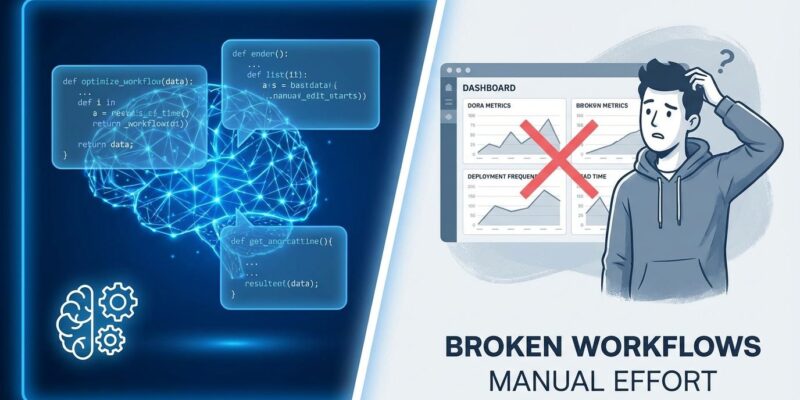
Now for the tension: if AI is saving developers 8+ hours per week, why do 66% say current metrics don’t reflect their real contributions? Because we’re measuring the wrong things.
DORA metrics—deployment frequency, lead time, mean time to recovery, change failure rate—measure software delivery performance, not developer value. They focus on a narrow window (code commit to release) and ignore the work that happens before and after: architecture decisions, code reviews, mentoring, collaboration, and yes, debugging that “almost-right” AI-generated code.
Furthermore, the JetBrains data reveals a critical shift: non-technical factors are now MORE important than technical ones. 62% of developers say collaboration, communication, and clarity matter most to their productivity. Only 51% prioritize technical factors like CI/CD speed or IDE performance. Translation: “ship faster” has been replaced by “work better together.”
This isn’t just developer sentiment—it’s a trend reshaping how engineering teams measure success. Alternative frameworks like SPACE (Satisfaction, Performance, Activity, Communication, Efficiency) and DevEx (Google’s human-centered approach) are gaining traction. GitHub introduced ESSP (Engineering System Success Playbook), and DX unveiled Core 4 in 2025. What do they have in common? All prioritize human factors alongside technical metrics. Consequently, DORA isn’t dead, but it’s no longer enough.
TypeScript, Rust, Go Dominate Language Trends
Meanwhile, the language landscape is evolving in predictable yet revealing ways. TypeScript has seen “the most dramatic rise in real-world usage over the past five years,” now used by 22% of developers as a primary language. Rust set a new usage record this year—the only language to do so—and Go doubled its user base to 2.2 million professional developers in five years.
What developers want to learn next tells the real story: Go (11%), Rust (10%), Python (7%), Kotlin (6%), and TypeScript (6%). This is pragmatism meets aspiration. TypeScript is the pragmatic choice—add type safety to JavaScript, boost productivity immediately, and tap into massive job market demand. In contrast, Rust and Go are aspirational—learn them for performance, safety, modern language design, and future-proof your career.
Then there’s Scala, the language paradox: only 2% of developers use it as a primary language, yet 38% of top earners work with it. That’s the rare skill premium in action—low supply, high demand, top pay. Similarly, Rust, Go, and Kotlin also command premium salaries, reinforcing that learning emerging languages isn’t just about passion—it’s about economics.
The Productivity Paradox Explained
So why the disconnect? Developers save massive time with AI (85% adoption, 8+ hours/week for 20%), yet 66% say metrics don’t capture their value. And non-technical factors now outweigh technical ones (62% vs 51%). The answer: AI fundamentally changes HOW developers work, but companies are still measuring OUTPUT.
Traditional metrics track lines of code, commits, deployments—things that made sense when developers typed everything from scratch. However, AI shifts the job toward reviewing, refining, and guiding code generation. You save 8 hours, but you spend some of that fixing “almost-right” code. You ship features faster, but the value comes from architecture decisions and collaboration, not raw commit velocity.
Modern development values QUALITY: code reviews, mentoring, system design, knowledge sharing. These don’t show up in deployment frequency. Human factors—collaboration, communication, clear requirements—now drive productivity more than CI/CD pipelines. Yet most companies still rely on DORA metrics designed for a pre-AI world.
The fix? Human-centered frameworks like SPACE and DevEx that measure satisfaction, collaboration, and flow alongside technical performance. Engineering leaders who adopt these will outperform teams stuck on pure output metrics.
What This Means for 2025 and Beyond
The JetBrains Developer Ecosystem 2025 survey paints a clear picture: developers are AI-native, metrics-skeptical, and pragmatically aspirational.
AI tools aren’t just hype—they’re proven. 85% adoption and massive time savings validate the revolution. Developers have embraced AI at scale, delegating repetitive work to focus on creative problem-solving. Furthermore, the 68% who say AI proficiency will be a job requirement aren’t speculating—they’re observing reality.
However, productivity measurement needs urgent reform. 66% don’t trust current metrics because those metrics don’t capture what matters: collaboration, communication, architecture decisions, and the human work that turns code into value. DORA metrics measure delivery performance, not developer contributions. The rise of SPACE, DevEx, and DX Core 4 reflects industry recognition that technical benchmarks alone are insufficient.
Language trends reveal market pragmatism: TypeScript dominates for immediate productivity gains, while Rust and Go represent aspirational learning for performance and career future-proofing. Rare skills command premiums—Scala’s 2% usage but 38% top earner rate proves supply and demand still matter.
The bottom line: the 2025 developer ecosystem has moved beyond the “will AI replace developers?” debate. Developers are using AI to amplify their work, but companies haven’t figured out how to measure the value they create. The future belongs to teams that combine AI-augmented workflows with human-centered productivity frameworks—measuring not just how fast they ship, but how well they collaborate, communicate, and solve problems.
If your engineering organization is still relying solely on DORA metrics, you’re measuring the wrong things. And if you’re a developer worried AI will replace you, the data says otherwise: 85% of your peers are already using AI to get better at their jobs, not replace them. The question isn’t whether to adopt AI or rethink metrics—it’s how fast you can make the shift.