 By ByteBot
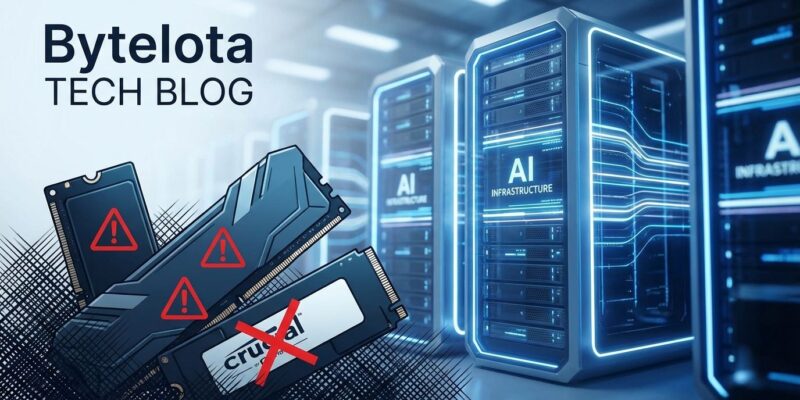
Micron Technology announced yesterday it’s killing the Crucial consumer brand after 29 years, exiting all consumer SSD and RAM sales by February 2026. The reason: AI data centers pay better. Micron’s High Bandwidth Memory (HBM) business hit $2 billion per quarter with an $8 billion annual run rate, making consumer memory’s thin margins obsolete. This isn’t just one brand dying—it’s a signal that AI economics are reshaping the entire hardware market, with consumers losing priority to enterprise profits.
AI Data Centers Pay 10x More Than Consumers
The economics are brutal. A single HBM chip for Nvidia H200 GPUs costs around $2,000, while a Crucial 32GB consumer RAM kit sold for $69 before the shortage. Moreover, Micron’s HBM revenue reached $2 billion per quarter in Q3 FY2025, representing 50.7% year-over-year growth. CEO Sanjay Mehrotra projects HBM could hit $25-30 billion in annual revenue by 2030.
Consequently, Micron is reallocating 20% of global DRAM capacity away from consumers to chase these higher-margin AI sales. The company is spending “the overwhelming majority” of its $14 billion capex on HBM production, which is already sold out through 2025. Additionally, cloud providers like Microsoft, Amazon, and Google are booking multi-year allocations for 2026 and 2027.
Sumit Sadana, Micron’s EVP and Chief Business Officer, put it plainly in the official announcement: “The AI-driven growth in the data center has led to a surge in demand for memory and storage. Micron has made the difficult decision to exit the Crucial consumer business in order to improve supply and support for our larger, strategic customers in faster-growing segments.” Translation: consumers can’t compete with AI data center economics.
RAM Prices Up 500%, SSDs Doubled—And It’s Getting Worse
Consumer prices are already surging. Furthermore, CyberPowerPC claims RAM prices are up 500% since October 2025, with overall DRAM pricing up 171.8% year-over-year. SSDs have doubled in cost. A Crucial 32GB DDR5 kit that cost $69 in spring 2025 now sells for $186. Premium kits hit absurd levels: Corsair 48GB kits went from $200 to $900.
Retailers are responding to the crisis. CyberPowerPC announced price hikes starting December 7. Meanwhile, Micro Center is removing price tags from memory kits, moving to “spot pricing” like gas stations. Framework stopped selling standalone RAM to prevent scalpers. The message is clear: buy now or pay more later.
The worst impact is expected in H1 2026 when distributor inventories deplete. In fact, industry experts warn the shortage could last into late 2026 or 2027, with some saying it could take “up to a decade to resolve” as AI infrastructure buildout continues. A 64GB DDR5 kit now costs around $500—the same as a PS5 Pro.
Related: Marvell Bets $3.25B on Photonics to Solve AI’s Memory Wall
20% of DRAM Capacity Leaves Consumer Market
Micron controls approximately 20% of global DRAM manufacturing capacity, and its exit permanently removes this supply from consumers. Only three major DRAM manufacturers exist: Micron, Samsung, and SK Hynix. Notably, all consumer brands—Kingston, Corsair, G.Skill, ADATA—source chips from these “big three.”
Market consolidation is accelerating. About 25% of the world’s DRAM production is now dedicated to enterprise. HBM alone will account for 5% of DRAM shipments but 20% of revenue in 2024, according to TrendForce. The profit margins are too attractive to ignore.
Reduced competition means higher prices and less consumer choice. If other vendors see Micron’s AI profits, they may follow suit. Consequently, the consumer memory market is becoming an afterthought in the AI era.
Developer Backlash and AI Bubble Fears
Developer communities on Hacker News and Reddit are critical of Micron’s decision. However, common sentiment runs deeper: “Micron only cares about AI datacenter, which seems like a very short sighted decision if the AI bubble pops. This is quintessential short term thinking on Micron’s part. Post-AI bubble, this will look very stupid.”
The community sees risk: if AI demand crashes like crypto mining did, Micron will have abandoned a stable consumer market for a potentially temporary boom. Moreover, one developer summed it up: “Losing Crucial as a brand is sad, their products and prices were very competitive, and less competition in the market means higher prices for everyone.”
Reddit’s r/pcgaming and r/hardware are filled with concerns about building affordable PCs in 2026. The tension between quarterly profits and long-term strategy is obvious.
What’s Next: February 2026 Cutoff and Long Shortage Ahead
Crucial will continue shipping consumer products until the end of fiscal Q2 (February 2026), then stop all retail distribution. Warranty and support continues for existing products. Therefore, consumers have roughly 2-3 months to buy Crucial products before they disappear forever.
After that, prices likely rise further as supply tightens and remaining brands adjust to reduced competition. This isn’t a temporary blip—it’s a multi-year reordering of hardware priorities driven by AI economics.
Key Takeaways
- Micron is killing Crucial after 29 years to prioritize AI data center customers paying 10-30x more per chip than consumers
- RAM prices already up 500% since October 2025, SSDs doubled, with H1 2026 expected to be worse when distributor inventory depletes
- 20% of global DRAM capacity permanently leaving consumer market as Micron reallocates production to HBM for AI chips
- Developer communities criticize the move as “short-sighted” if AI bubble pops, but enterprise economics are too attractive to ignore
- Buy Crucial products before February 2026 cutoff or expect significantly higher prices from remaining brands (Kingston, Corsair, G.Skill)
The message from Micron is clear: in the AI era, consumer tech is a low-priority market. Developers, PC builders, and gamers are paying the price—literally.