 By ByteBot
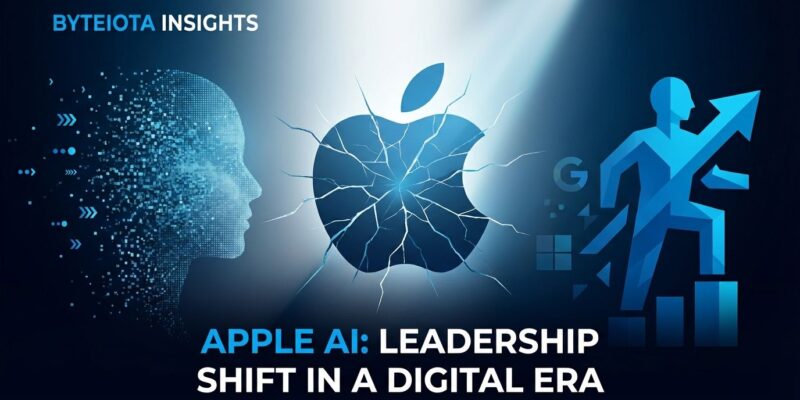
Apple announced on December 1 that AI chief John Giannandrea is stepping down after seven years, replaced by Google Gemini veteran Amar Subramanya. The leadership change comes after repeated Siri delays, a 20% AI team exodus, and Tim Cook stripping Siri from Giannandrea’s control in March. This isn’t a retirement—it’s an admission that Apple’s AI strategy failed.
The Siri Disaster Timeline
At WWDC 2024, Apple teased a smarter Siri powered by Apple Intelligence. Eighteen months later, those promised features still don’t exist. App Intents, Personal Context, and Onscreen Awareness were delayed from iOS 18 to iOS 18.4, then to spring 2026. The delays got so bad that Cook removed Siri from Giannandrea’s oversight entirely in March 2025, handing it to Vision Pro creator Mike Rockwell.
The technical problems run deep. Apple never built a unified backend for Siri—instead, they ran two parallel systems, one for legacy commands and another for advanced AI features. Mid-development, leadership pivoted from dual on-device and cloud models to a single cloud-based approach. Engineers frustrated by the constant direction changes left for competitors. Apple’s internal data shows their chatbot is 25% less accurate than ChatGPT.
Former employees paint a picture of organizational dysfunction: poor leadership, lack of urgency, and no clear vision. When ChatGPT launched in 2022, Giannandrea reportedly told his team it “didn’t add much value.” That complacency cost Apple two years while OpenAI, Google, and Anthropic raced ahead.
Enter Amar Subramanya: The Gemini Fix
Subramanya, 46, spent 16 years at Google, ending as Head of Engineering for Gemini Assistant. Before joining Apple, he was Microsoft’s Corporate VP of AI, working on the foundation models powering Copilot. He has a PhD in machine learning from the University of Washington and deep experience with DeepMind’s advanced model training.
This hire signals a strategic pivot. Giannandrea championed on-device AI, calling cloud processing “technically wrong.” Subramanya built Gemini and Copilot—both cloud-first AI systems. You don’t hire Google’s Gemini lead to continue the same strategy that failed. Expect more cloud AI, deeper partnerships (Bloomberg reports Apple is nearing a $1 billion annual deal for custom Gemini servers), and less ideological purity about on-device processing.
The question isn’t whether Subramanya knows how to build great AI—he does. The question is whether Apple’s organizational problems are fixable. One executive can’t undo years of cultural issues overnight.
The Talent Exodus Nobody Talks About
While Apple focused on damage control for Siri delays, 20% of their AI team quietly left for competitors. The Foundation Models team, already small at 50-60 people, lost roughly 10 members including team lead Ruoming Pang, who joined Meta for a reported $200 million package from Mark Zuckerberg.
Other key departures: Jian Zhang (lead AI researcher for robotics) went to Meta’s Robotics Studio. John Peebles and Nan Du joined OpenAI. Zhao Meng went to Anthropic. Industry recruiters describe the exodus as “a crisis of confidence” around Apple’s AI future. When your best researchers flee to build products at competitors, it’s not about compensation alone—it’s about momentum and belief.
With such a small core team, every departure is catastrophic. You can’t compete in the AI race when talent is abandoning ship.
What Giannandrea Got Right (and Wrong)
Giannandrea deserves credit for building Apple’s privacy-first AI foundation. Private Cloud Compute, on-device Apple Foundation Models, and the architectural emphasis on local processing created genuine differentiation. His philosophy that cloud processing is “technically wrong” aligned perfectly with Apple’s privacy brand.
But philosophy doesn’t ship products. Siri became a punchline. Promised features never materialized. Former employees cite “poor leadership,” an “overly relaxed culture,” and a “lack of ambition” in Siri’s design. Giannandrea’s ideological commitment to on-device AI may have constrained what was possible, leaving Apple stuck while competitors shipped cloud-powered assistants that actually worked.
The privacy foundation he built remains valuable—that’s Giannandrea’s lasting contribution. But the execution failure is equally his legacy.
What Developers Should Expect
Don’t hold your breath for Siri improvements before late 2026. The spring 2026 deadline for App Intents and Personal Context is optimistic given Apple’s track record. Internal sources suggest engineers don’t expect meaningful improvements even with iOS 19.4.
Subramanya’s first public test will be WWDC 2026, where he’ll need to outline a credible AI strategy. Expect announcements about expanded partnerships—ChatGPT integration exists, but deeper Gemini collaboration seems inevitable. The shift from Giannandrea’s on-device purity to Subramanya’s cloud-first pragmatism will reshape Apple Intelligence.
For iOS and macOS developers waiting on promised AI features: don’t wait. Integrate ChatGPT or Gemini directly into your apps now. Apple’s AI strategy is in flux, timelines are unreliable, and betting your product roadmap on Apple Intelligence is risky. The privacy features—on-device processing and Private Cloud Compute—remain strong differentiators, but assume advanced AI capabilities won’t arrive on schedule.
Apple brought in a Gemini veteran because their current approach failed. Whether Subramanya can rebuild confidence, stem the talent exodus, and ship working AI products remains to be seen. One thing is certain: the on-device idealism is over. Apple’s AI future looks a lot more like Google’s than Giannandrea ever imagined.