 By ByteBot
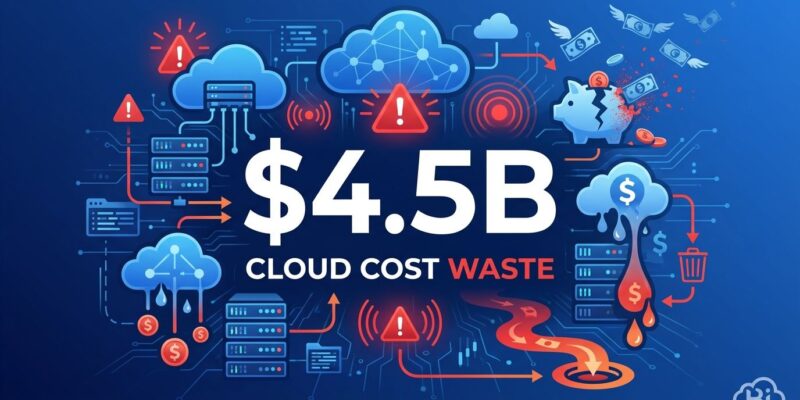
Developers are sitting on $44.5 billion in cloud waste for 2025—21% of enterprise cloud spend—and most don’t even know it exists. A new Harness FinOps report surveying 700 developers and engineering leaders reveals the root cause isn’t technical incompetence: it’s organizational disconnect. While 62% of developers want control over cloud costs, only 43% have access to real-time data on idle resources. The result? Purchasing decisions based on guesswork (55%), fundamental optimizations ignored (71% skip spot instances), and waste identification cycles averaging 31 days—far too slow to matter.
This isn’t a FinOps problem. It’s a developer empowerment problem waiting to be solved.
Developers Are Flying Blind on Cloud Costs
The visibility gap is staggering. Only 43% of developers have real-time data on idle resources. Just 39% can see orphaned storage and detached volumes. A mere 33% can monitor whether workloads are over or under-provisioned. The rest are operating in the dark.
Without visibility, optimization becomes impossible. By the time FinOps teams identify waste—31 days on average—new inefficiencies have already piled up elsewhere. It’s like fixing a leak while the pipes keep breaking upstream. Meanwhile, 55% of developers admit their purchasing commitments are based on guesswork rather than data. Reserved Instances bought without usage analysis. Savings Plans purchased on hunches. Over-provisioning “to be safe” because no one knows what’s actually needed.
John Bonney, CFO at Harness, frames the stakes clearly: “Cloud infrastructure spend is one of the biggest line items for modern enterprises, right behind salary.” When cloud costs rival payroll, flying blind isn’t acceptable.
Basic Cloud Cost Optimizations Left on the Table
Here’s what makes the $44.5 billion figure even more painful: the waste is preventable with existing, well-understood tactics. Spot instances save up to 90% compared to on-demand pricing for fault-tolerant workloads. Reserved instances offer 75% discounts for steady-state production. Rightsizing overprovisioned instances cuts costs by 20-30%. These aren’t bleeding-edge techniques—they’re table stakes.
Yet 71% of developers don’t use spot orchestration. 61% skip rightsizing. 58% avoid reserved instances or savings plans entirely. 48% fail to track and shut down idle resources. Only 32% employ fully automated cost-saving practices. The gap isn’t knowledge—every developer knows spot instances exist. It’s tooling, visibility, and culture.
When developers lack real-time cost data and team-level accountability, the default behavior is over-provisioning. Better to waste budget than risk downtime. Better to guess high on Reserved Instance commitments than optimize with data. The result is billions left on the table annually.
FinOps vs Developers: The Disconnect That Costs Billions
52% of engineering leaders cite the disconnect between FinOps teams and developers as the root cause of cloud waste. It’s an organizational structure problem, not a competence issue. FinOps teams manage budgets and track spending but lack the technical context to rightsize workloads without breaking things. Developers provision resources and build applications but lack cost visibility and budget accountability. Neither has the complete picture needed for effective optimization.
Traditional centralized FinOps creates slow, frustrating feedback loops. Developers request resources. FinOps reviews bills weeks later. Waste gets identified 31 days after it started. By then, it’s old news—and new waste has accumulated. This model treats cost optimization as something done to developers rather than by them.
The alternative works better. Skyscanner decentralized cost accountability to individual engineering teams and found enough savings within two weeks to cover an entire year of licensing costs. Duolingo made cost efficiency a core engineering quality metric alongside reliability and performance—treating FinOps as a daily discipline rather than a quarterly exercise. The pattern is clear: when developers own their team’s costs and can see them in real-time, they optimize aggressively.
What Actually Works: Developer-Driven Cloud Cost Optimization
Organizations achieving 20-30% cost reductions share a common pattern: they give developers cost intelligence platforms, automated workflows, and team-level budgets. Then they get out of the way. Validity reduced time spent on cost management by 90% through real-time visibility integrated into developer tools. No separate dashboards no one checks. No monthly reports filed and forgotten. Cost data flows into Slack, Datadog, and Grafana—tools developers already use.
Automation removes friction. Tag enforcement embedded in CI/CD pipelines means every resource gets categorized automatically—no nagging developers about compliance. Cost alerts land in Slack with actionable context: “Your dev environment has been idle for 72 hours—shut it down to save $84/day [Shut Down Now].” Click once, waste eliminated. No tickets, no approvals, no bureaucracy.
AI-driven tools are delivering up to 30% savings by autonomously managing Reserved Instance commitments and rightsizing recommendations. 86% of developers surveyed expect AI to enhance cost optimization within a year. The technology isn’t the blocker anymore—the blocker is organizational structure and culture.
Three Cloud Cost Optimizations to Start Today
Don’t boil the ocean. Start with three high-impact, low-risk optimizations that deliver immediate ROI.
First, move CI/CD runners and batch processing jobs to spot instances. These workloads are fault-tolerant, stateless, and retryable—perfect candidates for 80-90% cost reduction with near-zero risk. Use AWS Auto Scaling Groups with mixed instance policies to automatically fall back to on-demand if spot capacity is unavailable.
Second, implement automated shutdown of dev and test environments during nights and weekends. Development environments running 24/7 but used 2 hours a day represent pure waste. AWS Instance Scheduler or equivalent tools can cut non-production costs 40-60% without any code changes.
Third, analyze 90-day usage patterns with Cost Explorer and purchase reserved instances for baseline production workloads. Don’t guess—look at actual utilization data. Identify workloads running consistently 24/7 for months. Commit to 1-year reserved instances for 75% savings on that baseline capacity. Leave variable traffic on on-demand or spot.
The industry standard isn’t picking one pricing model—it’s strategically using all three. Reserved instances for baseline production. Spot for batch jobs and fault-tolerant workloads. On-demand for everything else. Diversification maximizes savings without sacrificing reliability.
Key Takeaways
- $44.5 billion in cloud waste for 2025 stems from organizational disconnect, not technical ignorance—62% of developers want cost control but only 43% have real-time visibility
- Basic optimizations deliver massive savings yet remain unused: spot instances save 90%, reserved instances 75%, rightsizing 20-30%, but most developers lack the tools and culture to implement them
- Centralized FinOps creates 31-day feedback loops that can’t keep pace with cloud waste—decentralized ownership like Skyscanner’s model delivers savings in weeks, not months
- Real-time cost visibility integrated into developer workflows (Slack alerts, CI/CD tagging enforcement) drives behavior change better than quarterly reports and compliance nagging
- Quick wins exist today: move CI/CD to spot (90% savings), automate dev/test shutdown (40-60% savings), purchase reserved instances based on 90-day usage analysis (75% savings)
The path forward isn’t more FinOps policing—it’s developer empowerment with the visibility, tools, and accountability to optimize proactively. The technology exists. The playbooks are proven. What’s missing is the cultural shift to treat cost efficiency as an engineering quality metric, not a finance constraint.