 By ByteBot
Kubernetes has become the default infrastructure choice—put it on your resume, spin up clusters, prove you’re “cloud native.” However, here’s the uncomfortable truth: 78% of engineers waste 15+ hours per week troubleshooting Kubernetes, according to multiple 2025 industry surveys. That’s nearly two full workdays spent fighting YAML indentation errors, debugging DNS configurations, and maintaining infrastructure that three EC2 instances could replace.
The “Great Kubernetes Exodus” isn’t hyperbole—companies are actively migrating away from K8s back to simpler alternatives. Moreover, when 91% of Kubernetes users work at companies with 1,000+ employees, and 68% of all developers find it overly complex, we need to question the narrative. If you’re a small team running Kubernetes, you’re probably solving problems you don’t have while creating ones you didn’t need.
Why Kubernetes Overkill Happens: The Enterprise Tool Mismatch
The data doesn’t lie: 91% of Kubernetes users come from organizations with over 1,000 employees. Another 34% work at companies with 20,000+ employees. Furthermore, only 9% of K8s users are from companies with 500-1,000 employees. Startups and small companies adopt Kubernetes at a slower pace due to resource constraints and simpler infrastructure needs.
Kubernetes was designed to solve Google-scale problems: managing thousands of servers, millions of containers, complex multi-regional deployments. Google has those problems. You don’t. When you’re a 10-person team deploying a web app and a few microservices, you’re using a dump truck to haul groceries. Sure, it works, but you’ll spend more time maintaining the dump truck than delivering groceries.
When Kubernetes actually makes sense: 100+ microservices handling millions of requests daily, 20+ engineer teams with dedicated DevOps staff, genuine multi-cloud portability requirements (not theoretical ones), and measurable infrastructure pain that simpler tools can’t solve. The rule is simple: add Kubernetes only when the pain of not having it is clear and measurable. If you’re debating whether you need it, you don’t.
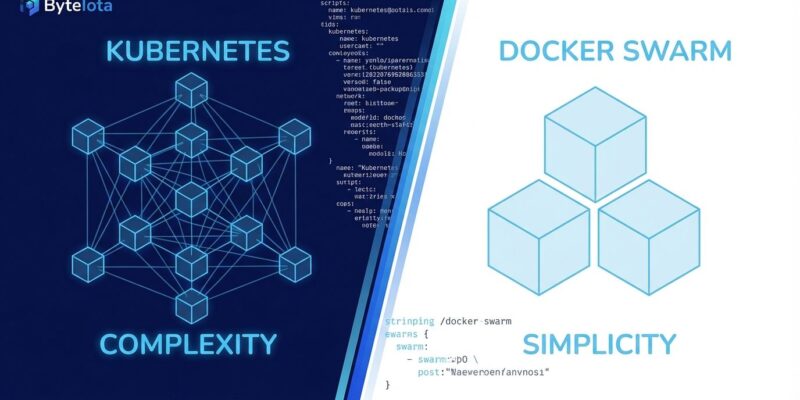
Docker Swarm vs Kubernetes: 5x Faster and Simpler
Let’s talk performance. Docker Swarm deploys containers 5x faster than Kubernetes under heavy load. Additionally, Swarm can spin up 100+ web server replicas in under 60 seconds on typical cloud infrastructure. It performs without degradation at up to 90% load, while Kubernetes starts degrading at only 50% load. Swarm responds to API calls much faster than Kubernetes.
The learning curve difference is stark: Docker Swarm requires hours to days to achieve productivity for teams already familiar with Docker. In contrast, Kubernetes takes weeks to months—and that timeline has doubled from 2-3 months in 2019 to 6-8 months in 2024. That’s half a year of reduced productivity for every new team member. Stack Overflow’s 2024 survey calls the Kubernetes learning experience a “learning cliff” rather than a learning curve.
Setup complexity? Docker Swarm initializes with a single command. That’s it. Meanwhile, Kubernetes requires multi-step configuration, deep expertise in container orchestration, networking, and distributed systems. Swarm is built into Docker—no extra software needed. If your team already uses Docker (and they do), Swarm is the natural next step.
Scalability concerns? Swarm handles up to 2,000 nodes. Kubernetes supports 5,000 nodes. Unless you’re planning to deploy applications across thousands of servers, Swarm’s limits are irrelevant. For teams under 25 engineers with straightforward deployment needs, Docker Swarm provides better productivity with lower operational overhead. That’s not opinion—it’s documented in multiple 2025 technical analyses.
The Hidden Cost Crisis: 30% Cloud Waste Plus Operational Overhead
BCG estimates that up to 30% of cloud spending is wasted due to Kubernetes over-provisioning. Kubernetes consumes significant CPU and RAM before workloads even start. Control plane controllers run constantly, reconciling state and creating a perpetual cost leak. Additionally, cloud providers charge for control planes, worker nodes, load balancers, and storage—costs that multiply when you spin up multiple environments.
However, the real cost isn’t infrastructure. It’s people. Kubernetes creates “black holes” for cloud cost management because multiple applications run on shared compute resources, and cloud provider bills don’t show which team’s workload runs in each cluster. Managing Kubernetes effectively requires expertise in cluster provisioning, networking configuration, storage management, security hardening, monitoring, observability, cost optimization, disaster recovery, and continuous maintenance.
The result? Companies hire specialized Kubernetes experts (expensive) or dedicate entire teams to keep clusters running (even more expensive). For many organizations, especially startups and small teams, this overhead simply isn’t justified by the benefits. Teams spend months spinning up clusters to deploy apps that three EC2 instances could handle. The time sink is measurable: one wrong space in YAML configuration breaks everything, PR diffs become 90% indentation changes, and new environments take 6 hours of copy-paste work.
The Great Kubernetes Exodus: Simpler Alternatives Winning
Multiple 2025 articles document a trend: companies ditching Kubernetes for simpler alternatives. The exodus is driven by cost consciousness, operational complexity, and the realization that “full power of Kubernetes isn’t always necessary.”
Docker Swarm leads for teams prioritizing simplicity and speed. It’s stable, easy to use, and integrates seamlessly with Docker tooling teams already know. HashiCorp Nomad handles multiple workload types (containers, VMs, Java apps, Windows services) in one lightweight platform. It’s suited for smaller teams wanting flexibility without Kubernetes complexity.
Fly.io dominates edge deployments with global infrastructure, zero-config deployments, and fast auto-scaling. It abstracts containers completely—you deploy code, Fly handles the rest. AWS App Runner provides fully managed container deployment for web apps and APIs, with direct GitHub and ECR integration. No clusters, no nodes, no YAML.
The unifying theme: these tools solve real deployment problems without demanding PhD-level distributed systems knowledge. They get out of your way so you can build product.
The 90% Rule: Calculate Your Kubernetes Tax
Calculate your Kubernetes tax: if 78% of your engineers spend 15 hours per week troubleshooting, that’s 40% of your engineering capacity maintaining infrastructure instead of building product. For a 10-person team, that’s 4 full-time engineers worth of productivity lost to YAML hell and DNS debugging.
Know the scale mismatch. Kubernetes is an enterprise tool designed for enterprise problems. If you’re not managing hundreds of microservices across thousands of nodes with dedicated DevOps teams, you’re overengineering. Docker Swarm is 5x faster, learns in hours instead of months, and handles more scale than 90% of teams will ever need.
The exodus is real. Companies are actively moving away from Kubernetes to simpler alternatives that deliver the same benefits without the operational nightmare. The decision framework is straightforward: use Docker Swarm for teams under 25 engineers with typical deployment needs. Use Nomad for multi-workload flexibility. Use Fly.io or managed platforms to avoid infrastructure entirely. Reserve Kubernetes for when you have clear, measurable pain that only K8s can solve.
And if you’re not sure whether you need Kubernetes? You don’t. Save your team months of frustration, tens of thousands in wasted cloud spend, and focus on shipping product instead of debugging YAML indentation.