 By ByteBot
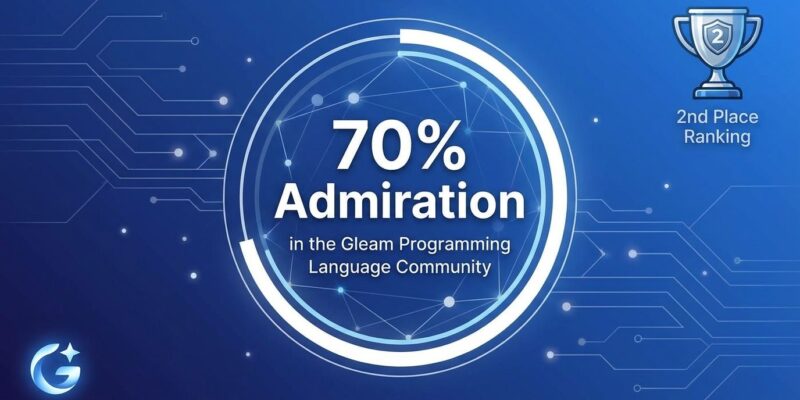
Seventy percent of developers who use Gleam want to keep using it. That’s the finding from the 2025 Stack Overflow Developer Survey, which ranked Gleam as the second most admired programming language—right behind Rust at 72 percent. The catch? Only 1.1 percent of developers reported doing extensive work with it.
For a language that hit version 1.0 in March 2024, this isn’t a contradiction. It’s a signal. When eight percent of early adopters already have Gleam running in production and seven out of ten want more of it, the gap between admiration and adoption isn’t a problem. It’s a countdown.
Static Typing Meets the BEAM
Gleam is a statically-typed functional programming language that runs on the BEAM virtual machine—the same Erlang runtime that powers WhatsApp and Ericsson’s telecommunications infrastructure. For decades, the BEAM ecosystem has been dominated by dynamically-typed languages like Erlang and Elixir. Gleam fills the gap for developers who want the battle-tested concurrency and fault tolerance of BEAM with the safety guarantees of static typing.
No null values, no exceptions, and no messages sent between processes that aren’t type-checked at compile time. The compiler catches errors before they ship.
The Numbers Tell Two Stories
The 2025 Stack Overflow survey marks Gleam’s first appearance in the rankings. Landing at 70 percent admiration places it ahead of Elixir (66 percent) and Zig (64 percent), and just shy of Rust’s industry-leading 72 percent. For a language ten months past its stable release, that’s extraordinary.
The 1.1 percent extensive development figure provides context. This is an early-stage language with high satisfaction among users who’ve tried it. A separate survey of 841 Gleam developers found that eight percent already have it running in production—a remarkable adoption rate for a tool that hasn’t celebrated its first birthday. Thoughtworks added Gleam to its Technology Radar in April 2025, signaling growing enterprise awareness.
Zero Crashes in Two Years
Strand, a company that bills itself as one of the first to run Gleam in production, offers the strongest validation of the admiration data. After two years of running Gleam code in live systems, the development team reports zero Gleam-related crashes. The team’s case study emphasizes maintainability—even after weeks away from the codebase, developers find it easy to return and make changes.
The team chose Gleam for its combination of modern language features and access to battle-tested BEAM libraries. The result: a system that “just works, reliably, day in and day out, without constant babysitting and maintenance.”
Production validation matters more than survey data. When a company runs unfamiliar technology in production for two years without crashes, that’s a stronger endorsement than any admiration percentage.
The Gap Is the Point
Developer admiration is a leading indicator. When seven in ten users of a year-old language say they want to keep using it, you’re not looking at hype. You’re looking at inevitability.
The gap between 70 percent admiration and 1.1 percent usage reflects the natural adoption curve for new programming languages. High satisfaction among early adopters, slow initial growth, then acceleration as the ecosystem matures. The eight percent production rate suggests confidence—developers aren’t just experimenting; they’re betting on it.
Gleam’s developer base comes overwhelmingly from outside the Erlang and Elixir ecosystems. Developers with backgrounds in Haskell, Scala, and F# are finding their way to the BEAM through Gleam’s static type system. This isn’t cannibalization of the existing BEAM community. It’s expansion.
What Comes Next
Admiration leads, adoption follows. The question isn’t whether Gleam will grow, but how fast. The combination of high developer satisfaction, production validation, and ecosystem expansion suggests the gap will narrow. Whether it narrows quickly enough to sustain momentum depends on framework development, tooling maturity, and continued community investment.
For now, the 70 percent tells you what developers who’ve tried Gleam think about it. The 1.1 percent tells you how many developers have tried it. Both numbers are rising.