 By ByteBot
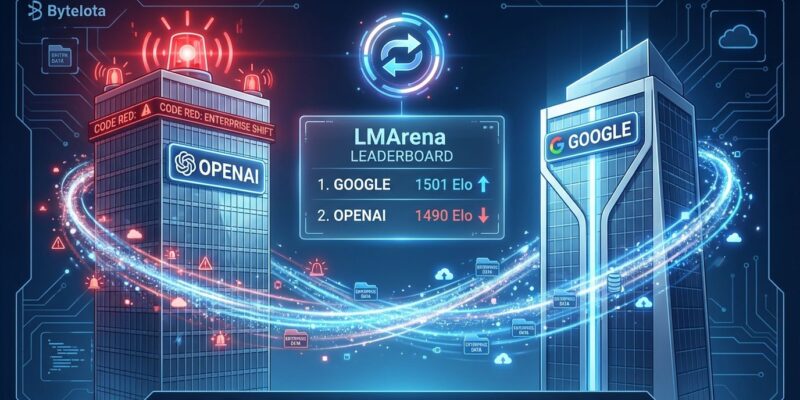
OpenAI CEO Sam Altman issued an emergency “Code Red” memo yesterday, redirecting all company resources to improve ChatGPT’s core quality as Google Gemini 3 surges past OpenAI in technical benchmarks and enterprise adoption. The internal directive, first reported by The Wall Street Journal, delays OpenAI’s advertising rollout indefinitely and cancels the recently-launched “Pulse” personal assistant. This marks a dramatic reversal from three years ago when Google declared its own “Code Red” over ChatGPT’s threat to Search.
For developers and enterprises, this signals that the AI platform wars are accelerating. Technical benchmarks now drive real business consequences—including platform switches, product delays, and strategic pivots at the industry’s largest players.
From Search Defender to ChatGPT Challenger: The Role Reversal
In December 2022, Google CEO Sundar Pichai declared a company-wide “Code Red” emergency over ChatGPT’s threat to Google Search, scrambling teams to build a competitive response. That three-year effort culminated in Google Gemini 3, which launched November 18 and immediately topped the LMArena leaderboard with a historic 1501 Elo score—the first model to breach 1500.
Now the roles have reversed. Altman’s memo acknowledges OpenAI is on the defensive, facing a competitor that captured 650 million monthly active users by October (a 44% surge from July’s 450 million) and demonstrated measurable technical superiority across industry benchmarks.
The irony isn’t lost on industry observers. Google’s 2022 panic over ChatGPT led to Gemini. OpenAI’s 2025 panic over Gemini may determine whether ChatGPT retains its market position—or becomes the next cautionary tale about tech dominance being temporary, not permanent.
Product Delays Expose Competitive Urgency
Altman’s memo directs OpenAI to delay its advertising rollout—a critical revenue stream for a company burning $8 billion annually on $13 billion revenue—and halt development on AI agents for health and shopping applications. Most strikingly, OpenAI canceled its “Pulse” personal assistant indefinitely, despite launching it to Pro users just months ago.
These aren’t cosmetic delays. Canceling Pulse just months after launch signals something worse than feature delays—it suggests OpenAI’s current quality gaps are severe enough to justify killing recently-shipped products and removing planned revenue streams.
The financial pressure amplifies the urgency. OpenAI’s 70% burn rate (spending $8 billion against $13 billion revenue) makes the delayed advertising rollout particularly painful. Meanwhile, Gemini 3’s 650 million MAU demonstrates Google’s distribution advantage through Android, Search, and Workspace integrations.
Enterprise Trust Erosion: The Benioff Switch
Salesforce CEO Marc Benioff used ChatGPT daily for three years. After spending two hours testing Gemini 3, he posted on X: “Holy shit… It feels like the world just changed, again. I’m not going back.” The post went viral, reaching over 1 million views and signaling a high-profile enterprise defection.
Benioff praised Gemini 3’s “reasoning, speed, images, video… everything is sharper and faster.” What makes this particularly damaging for OpenAI is the timing—Benioff switched just seven days after Gemini 3’s November 18 launch, despite Salesforce’s existing OpenAI partnership.
Enterprise trust is OpenAI’s moat. ChatGPT holds 78% Fortune 500 adoption compared to Gemini’s 34%. However, Benioff’s defection demonstrates that technical improvements can overcome years of platform loyalty. When a billionaire CEO publicly dumps your product after two hours with a competitor, that’s not a good signal for enterprise retention.
Related: Stack Overflow 2025 Survey: AI Trust Hits All-Time Low
The Benchmark Reality Behind the Panic
Gemini 3’s technical achievements justify OpenAI’s concern. Beyond the 1501 Elo LMArena score, Gemini 3 posted 76.2% on SWE-bench Verified (coding agent benchmark), 91.9% on GPQA Diamond (PhD-level science questions), and 23.4% on MathArena Apex (state-of-the-art mathematics).
More importantly, Gemini 3’s 1 million token context window dwarfs ChatGPT’s 128K, enabling analysis of massive codebases that ChatGPT can’t handle. Native multimodal support (text, images, video, audio in a single interface) addresses gaps where ChatGPT previously led.
Altman promises a new reasoning model “next week” that beats Gemini 3 in internal evaluations. The challenge: Google demonstrated that sustained R&D investment (their three-year response to ChatGPT’s threat) produces results. OpenAI’s emergency response may improve ChatGPT short-term, but Google’s integrated ecosystem (Search, Workspace, Android, Cloud) creates long-term distribution advantages that pure technical performance can’t overcome.
Platform Choice in the AI Arms Race
Developers face an ecosystem lock-in dilemma masquerading as an AI model choice. ChatGPT integrates with Microsoft 365 and Azure, serving 78% of Fortune 500 companies. Gemini 3 offers deeper Google Workspace and Google Cloud integration, combined with superior benchmarks and a 1 million token context window for massive codebase analysis.
This isn’t ChatGPT versus Gemini—it’s Microsoft versus Google. Choosing a platform means choosing infrastructure, compliance frameworks, and vendor dependencies. The smart money diversifies rather than switches. Maintain API integrations for both platforms to avoid single-vendor dependency as benchmark wars shift monthly.
OpenAI’s promised reasoning model release “next week” adds another variable. Google’s momentum is real (650M MAU, enterprise defections, benchmark leads), but the AI landscape changes fast enough that next week’s release could rebalance competitive dynamics. For now, the safest bet is platform-agnostic development that doesn’t hitch your entire stack to whichever model topped LMArena this month.
Key Takeaways
- OpenAI’s “Code Red” mirrors Google’s 2022 panic over ChatGPT—roles reversed in just three years, demonstrating that AI dominance is temporary, not permanent.
- Product delays (ads, Pulse assistant, AI agents) reveal real competitive pressure, not marketing theater—OpenAI is sacrificing revenue streams and recently-launched products to address quality gaps.
- Enterprise trust is shifting: Marc Benioff’s public switch to Gemini 3 after three years of ChatGPT use signals that technical improvements (1501 Elo, faster responses) can overcome platform loyalty.
- This is Microsoft versus Google, not just ChatGPT versus Gemini—platform choice determines ecosystem lock-in (Azure/Microsoft 365 vs Google Cloud/Workspace), not just AI model access.
- Developers should diversify AI platform dependencies rather than switching wholesale—benchmark wars change monthly, and platform-agnostic approaches avoid betting everything on temporary leaders.
The lesson: three-year head starts don’t guarantee dominance. Ask Google, who spent three years building Gemini to respond to ChatGPT’s threat. Now ask OpenAI, scrambling to respond to the competitor they created by threatening Google’s Search business in 2022.