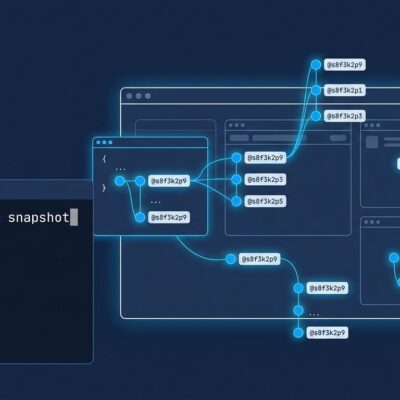
Render launched Sandboxes in public beta on November 4 — Firecracker microVM environments that give AI agents persistent compute with no runtime limits. The headline feature is not the lack of a timer. It is what happens when a sandbox suspends: Render snapshots memory state and running processes. When it wakes up, your agent continues exactly where it left off. Vercel persistent sandboxes save the filesystem. Processes restart from scratch.
The Persistence Gap
This distinction matters more than it might seem. Vercel caps individual sandbox sessions at 24 hours, and a resumed sandbox starts a new VM from filesystem state only. Running commands, in-memory state, and open connections are gone. If your agent was mid-task, it needs to checkpoint everything to disk or start over.
Render model works differently. Sandboxes auto-suspend after 15 minutes of idle time, taking a runtime snapshot that includes memory and processes — not just files. On the next command, the sandbox resumes from that snapshot. Firecracker snapshot-restore mechanism memory-maps the saved state and loads CPU context: in benchmarks, this takes under 30 milliseconds from snapshot versus 125 milliseconds cold boot.
The practical outcome: a codebase migration agent running 18 hours keeps its running app, its in-flight diffs, and its connection to a local database the entire time. On Vercel, that agent needs architectural workarounds before it hits the 24-hour wall. See the Render vs Vercel comparison for a full breakdown.
Who This Is Actually For
Render lists the agent types that benefit most: multi-day tasks, voice and WebSocket sessions where reconnecting drops context, software factories running parallel agents, and platforms letting customers execute custom code. Stuart Layton, Head of Technology at FinQore, describes their use case: “Sandboxes are the runtime for the agents in our software factory, and they let our customers securely run custom code on our platform.”
Vercel remains the right choice for plenty of agent work: short inference calls, streamed responses, chat interfaces, and anything tightly coupled to the Vercel AI SDK or Next.js frontend. The hybrid approach — Vercel for the frontend and CDN, Render for backend agent workers — is worth considering before migrating either way.
Credential Security in Long-Running Agents
The longer an agent runs, the more attack surface its credential store presents. Prompt injection attacks targeting long-context agents are a documented threat in 2026. Render answer is credential brokering: API keys never enter the sandbox. A broker intercepts outbound requests and injects credentials only for approved domains. Combined with per-sandbox outbound network policies — allow all, restrict to specific domains, or block entirely — this keeps key material outside agent-reachable memory.
Credential brokering is rolling out to limited customers first. Standard environment variables are available now for all plans.
Pricing: What You Actually Pay
Billing covers active CPU and allocated memory. While a sandbox is suspended, you pay only for snapshot storage — no CPU or memory charges. For AI agents that spend most of their runtime waiting on model responses or I/O, this means you are not paying for idle compute.
| Feature | Render Sandboxes | Vercel Sandboxes |
|---|---|---|
| Runtime limit | None | 24 hours per session |
| State on resume | Files + memory + processes | Files only (processes restart) |
| Pricing while idle | Snapshot storage only | No charge (active CPU model) |
| Credential security | Credential broker (rolling out) | Standard env vars |
| Availability | Public beta (Oregon) | GA |
Getting Started
Render Sandboxes are available in public beta on all workspace plans, currently in Oregon. TypeScript and Python SDKs are ready, with pre-built templates for Claude Managed Agents, Cursor Cloud Agents, OpenAI Agents API, LangGraph, and Mastra. Full documentation is at render.com/docs/sandboxes.
Beta means production reliability at scale is still being proven. Render is being deliberate about credential brokering rollout. Worth testing for new agent projects before committing migration work from an existing stack.