 By ByteBot
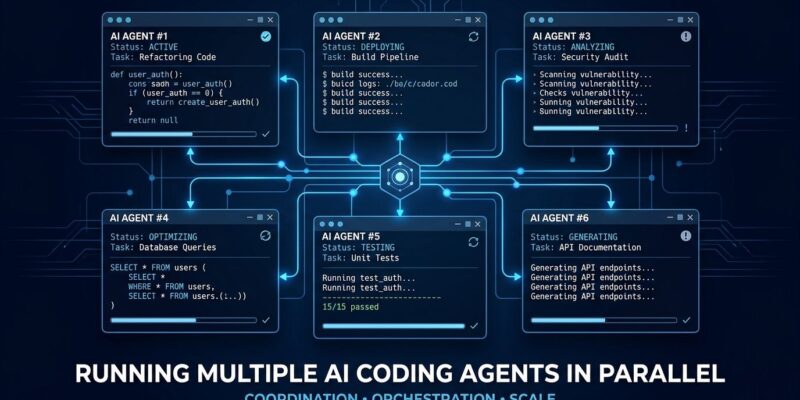
Most developers still treat coding agents like a single-threaded CPU: fire one off, wait, review, fire off the next. It works, but it turns a backlog of ten tasks into a ten-session marathon. Paradev — an agentic IDE that just crossed 15.8K GitHub stars this week — makes that serial queue unnecessary. It runs Claude Code, Codex, Gemini CLI, and any other CLI agent simultaneously, each in its own isolated Git worktree, all on your own machine.
One Worktree Per Agent, No Conflicts
The reason parallel agents have historically been dangerous is simple: two agents editing the same files at the same time produce chaos. Paradev solves this with Git worktrees — a native Git feature that creates separate checkouts of your repository on separate branches. Each Paradev workspace gets its own worktree, its own branch, its own terminal sessions, and its own port assignment so dev servers don’t collide.
What you get is a diff viewer across all active workspaces and the ability to review every agent’s output before anything touches your main branch. You’re not rubber-stamping a merge; you’re reviewing actual diffs the same way you’d review a pull request.
One important caveat: worktrees isolate files, not processes. Two runaway agents can still interact at the OS level. For most development work this is a non-issue, but it’s worth knowing before you run untrusted agent-generated scripts in parallel.
Bring Your Own Agent, Keep Your Own Subscription
Paradev is deliberately agent-agnostic. It supports Claude Code, OpenAI Codex, Gemini CLI, Cursor Agent, OpenCode, GitHub Copilot CLI, and Amp — and it never proxies your model calls. Your API keys stay yours. You pay Anthropic, OpenAI, or Google directly for what the agents consume. Paradev takes nothing from that transaction.
This matters because Claude Code’s built-in --worktree flag and Agent Teams feature only work within the Claude ecosystem, and Agent Teams use roughly 7x tokens compared to a single session. Paradev’s approach is cheaper for most use cases and works across any agent you’re already paying for.
The Free Tier Is Actually Free
The local free plan includes the desktop app, the CLI, and unlimited parallel workspaces for one user. No trial period, no feature-limited demo. The team has explicitly committed that running agents in parallel on your own machine will never require payment.
| Plan | Price | What You Get |
|---|---|---|
| Free | $0 | Local workspaces, desktop app, CLI, 1 user |
| Pro | $20/mo | Automations, remote access, mobile app |
| Team | $60/mo | Cloud workspaces, 150 hrs/seat (early access) |
| Ultra | $200/mo | Cloud workspaces, 500 hrs/seat |
MIT Licensed — The Story Behind That
Paradev shipped initially under Apache 2.0, then briefly switched to Elastic License 2.0 (ELv2) — source-available but not OSI-approved open source. The community objected. PR #9107 moved the project back to MIT. It’s a clean MIT license now, which means you can use it in production, fork it, and integrate it into commercial tooling without license review headaches.
Agents Running Agents: The MCP Angle
The feature most people miss in the announcement noise: Paradev ships an MCP server. That means Claude Code and other MCP-aware agents can create and manage Paradev workspaces themselves. Combine this with cron-based automations — recurring prompts that fire on a schedule without you — and the TypeScript SDK, and you have the foundation for a fully autonomous agent fleet: one agent orchestrating others, each working a task in its own worktree, results landing in your review queue.
The Honest Take
Paradev is a genuinely useful tool solving a real problem, but 15.8K stars in three days is a hype signal, not a quality rating. The project is young. Cloud workspaces are in early access. The MCP integrations and plugin system are early-stage. For local parallel agent orchestration, the free tier is low-risk enough to try immediately. For production team workflows, give it another quarter and watch the issue tracker.
Download the desktop app at paradev.com or browse the source at github.com/ParadevAI/Paradev. If you’re already running Claude Code in the terminal, the free tier takes about five minutes to set up and immediately changes how you think about your task queue.