 By ByteBot
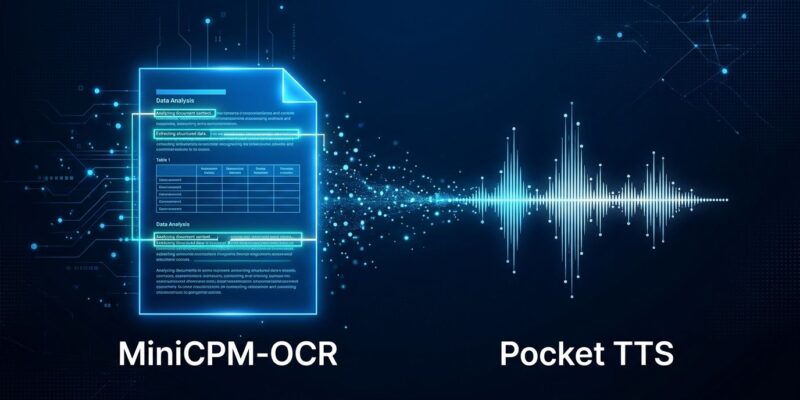
Hugging Face Transformers 5.21.0 shipped October 26 with two additions worth more than the usual changelog skimming: MiniCPM-OCR, a 1.3B document parser that outscores Google and AWS on real-world document benchmarks, and Pocket TTS, a 100M-parameter voice model from Kyutai that runs at 6x real time on your CPU. Both are open-source, both ship in the standard Transformers pipeline, and both make a credible case for replacing paid cloud APIs in most developer workloads.
MiniCPM-OCR: A 1.3B Document Parser That Beats Cloud OCR
OpenBMB’s MiniCPM-OCR 1.0 is the first OCR-specific model in the MiniCPM family. It pairs a SigLIP vision encoder with a Qwen3.5 language model to handle the content that trips up most OCR tools: scanned pages, curved documents, embedded tables, formulas, receipts, and dense PDFs. It scores 93.68 on Real5-OmniDocBench and holds the highest equal-weight average across four major OCR benchmarks — OmniDocBench v1.6, Real5-OmniDocBench, Wild-OmniDocBench, and olmOCR-Bench.
The release is a two-model suite. MiniCPM-OCR 1.0 (1.3B) does the parsing. MiniCPM-OCR Jev (2B) acts as a quality inspector — it scores the reliability of parsing results and flags anything that needs human review. For production document pipelines where wrong extractions cost real money, having a model that knows when it’s uncertain is more useful than raw accuracy alone.
Throughput is 1.2 pages per second by default, 55% faster with DSpark decoding acceleration. The weights are Apache 2.0. Quantized versions — AWQ, GPTQ, and GGUF — are already available, so it runs on llama.cpp, vLLM, SGLang, and Ollama in addition to the Transformers pipeline. The model ID is openbmb/MiniCPM-OCR-1.0.
For context: Google Document AI charges $1.50 per 1,000 pages for plain OCR and up to $30 for form parsing. AWS Textract starts at $1.50 and reaches $50 for key-value extraction. MiniCPM-OCR runs on your existing hardware and costs nothing per page. The trade-off is infrastructure ownership; the upside is that the benchmark numbers are now genuinely competitive.
Pocket TTS: Voice on CPU, No GPU Required
Pocket TTS from Kyutai (the team behind Moshi) is a 100M-parameter Continuous Audio Language Model that generates speech faster than real time using only two CPU cores. On a MacBook Air M4, it runs at about 6x real time with 200ms latency to first audio chunk. It also supports voice cloning from a few seconds of sample audio.
Getting started takes one install and ten lines of Python:
pip install pocket-tts --extra-index-url https://download.pytorch.org/whl/cpufrom pocket_tts import TTSModel
import scipy.io.wavfile
tts_model = TTSModel.load_model()
voice_state = tts_model.get_state_for_audio_prompt(
"hf://kyutai/tts-voices/alba-mackenna/casual.wav"
)
audio = tts_model.generate_audio(voice_state, "Hello world, this is a test.")
scipy.io.wavfile.write("output.wav", tts_model.sample_rate, audio.numpy())No GPU build of PyTorch required. It supports Python 3.10 through 3.14 and PyTorch 2.5+. The model had 6,700+ GitHub stars before Transformers integration — this release makes it a standard import rather than a separate installation path.
Also in 5.21: Gradium Phonon and Two More Models
Gradium’s Phonon TTS also lands in this release. At 31M parameters — smaller than Pocket TTS (100M) and the widely-used Kokoro (82M) — it wins blind human evaluations on naturalness against both, with notably stronger multilingual output. If you’re targeting languages beyond English, Phonon is worth a comparison test.
Flint MoE, Recursive’s hybrid-attention mixture-of-experts model, and UltraVBert, which combines ModernVBert with a SigLIP vision encoder for document retrieval, round out the new additions.
Technical Changes to Check Before Upgrading
Two changes require attention. The FP8 KV cache backend is new: 5.21 adds an “fp8” option to QuantizedCache that stores KV states in torch.float8_e4m3fn. Enable it with cache_implementation="quantized" and cache_config={"backend": "fp8"}. For long-context inference workloads, this can reduce memory pressure meaningfully.
Tensor parallelism has a breaking change. ColwiseParallel and RowwiseParallel now apply only to linear layers. If you have custom TP plans that applied them to embeddings, you need to switch to the new embedding-specific style before upgrading. Most users won’t hit this — but distributed inference setups with custom TP plans should check the release notes first.
Upgrade with pip install --upgrade transformers. Full release notes, including the complete model list and bug fixes, are in the Transformers 5.21 release on GitHub. The MiniCPM-OCR-1.0 model card on Hugging Face covers deployment options and quantization variants in detail.