 By ByteBot
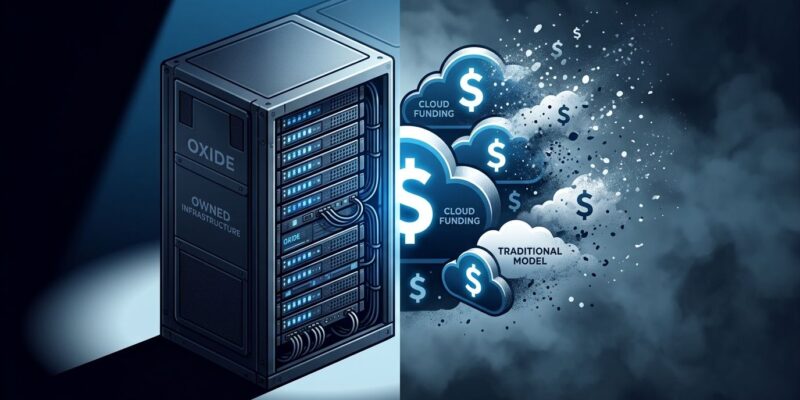
Oxide Computer announced a $445M Series D today, led by Eclipse Capital with AMD Ventures as a strategic investor. The size is notable. The real headline is not. Buried in the announcement is the detail that Oxide generated taxable income from ordinary operations in spring 2026 and paid income taxes. For a hardware startup that builds rack-scale servers starting around $500,000 each, that is the milestone most hardware companies spend a decade trying to reach — or never do.
The $445M is working capital, not oxygen. Oxide’s backlog already exceeds production capacity. This raise exists to buy components and expand manufacturing to fulfill orders already committed. That distinction matters more than the dollar amount.
The On-Premise Cloud Computer You Can Actually Own
Oxide sells one thing: an integrated rack of up to 64 AMD EPYC 9005 servers, pooled NVMe storage, custom networking, and a full software stack. It ships as a single unit, becomes operational within hours, and exposes the same API-first control plane paradigm developers already know from AWS — but running in your data center on hardware you own.
The software stack is Helios (Oxide’s illumos-based host OS) and Propolis (a Rust-written hypervisor built on bhyve, open source). Each sled packs a 64-core EPYC CPU, approximately 1TB DRAM, and 64TB of NVMe flash. The control plane handles provisioning, networking, and firewalling through an API with no per-core software fees — the hardware cost includes the entire stack.
The Hacker News community has a reasonable summary of what Oxide is actually selling: compute you buy rather than computers you assemble. It fills the gap between “negotiate a Dell contract and figure out Kubernetes yourself” and “pay Amazon for the next decade.” Kubernetes, standard Linux and Windows VMs, Spark, Airflow, and Ray all run on Oxide without modification.
Related: Cloudflare Basin Is GA: Serverless Analytics, Zero Egress Fees
Why Cloud Repatriation Is Real This Time
The cloud-vs-on-prem argument has been running for a decade, mostly as theology. In 2026, it finally has numbers. 86% of CIOs plan to move some workloads from public cloud back to private or on-premises infrastructure — the highest rate ever recorded in enterprise IT surveys. 37signals estimated roughly $1.3–1.5M in annual savings after repatriating from AWS, projecting $7M over five years.
The pattern that is emerging is not a full cloud exit — only 8–10% of organizations go that route. It is rebalancing: keep variable burst workloads and unpredictable demand on AWS, move the baseline predictable workloads to owned infrastructure. Data engineering pipelines running 24/7. Classical ML workloads with known resource requirements. Regulated data that cannot legally live in a public cloud. AI inference for smaller models where CPU-based EPYC delivers better cost per token than a shared GPU cluster.
Oxide’s backlog exceeding its manufacturing capacity is empirical evidence that the rebalancing is happening at enterprise scale, not just in blog posts. The AMD strategic investment adds a dimension: AMD is not betting on Oxide because of cloud repatriation sentiment — they are betting because EPYC demand through Oxide is real enough to warrant a direct stake.
Not a GPU Cluster, Not for Everyone
Oxide is direct about what it does not do. The system targets CPU-based workloads: data engineering, classical machine learning, RAG and embedding pipelines, CPU-based LLM inference. Training frontier models still goes to cloud or dedicated GPU infrastructure. Variable workloads with unpredictable demand still belong on AWS or Azure, where elasticity has genuine value that on-prem cannot match.
The entry point — approximately $500K per rack — puts Oxide firmly in enterprise territory. Startups and small engineering teams do not fit the customer profile. However, for an organization already spending $5M+ annually on AWS for workloads that run at consistent utilization, the five-year TCO calculation often shifts significantly toward ownership.
Key Takeaways
- Oxide reached profitability and paid income taxes in 2026 — the most important signal in the Series D announcement, more than the dollar amount
- The $445M is working capital to fulfill existing backlog, not survival funding — a meaningful distinction for evaluating market traction
- Cloud repatriation is accelerating: 86% of CIOs plan workload moves, driven by cost predictability and data sovereignty, not ideology
- Oxide fits a specific workload profile: consistent utilization, regulated data, CPU-based AI inference — not GPU training or variable demand
- AMD Ventures investing strategically signals the hardware roadmap will deepen, not just the software