 By ByteBot
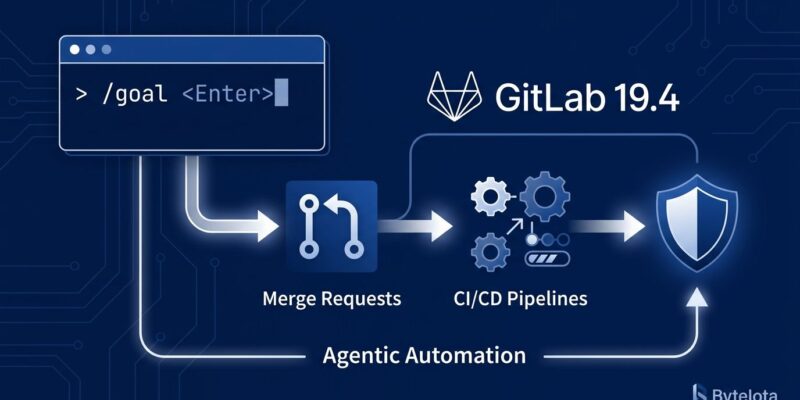
GitLab 19.4 ships the /goal command: describe what you want done, and GitLab Duo implements it, verifies its own work, and iterates until the task is finished. That’s the headline. Underneath it, MCP server tools now expose CI/CD pipelines, merge requests, and vulnerability triage to any compatible AI agent, and three new open-weight models cut per-task credit costs by up to 4x. GitLab is not adding a coding assistant on top of its platform. It is turning the platform itself into an agent loop.
The /goal Command
The /goal command is a new slash command in GitLab Duo CLI. You describe an objective — “fix the failing tests in spec/models/user_spec.rb until all pass and CI is green” — and a dual-model system takes it from there. The primary agent implements. A separate verification model checks the result against your stated goal after each turn and decides whether to continue or stop. You can view the verifier output, halt the run at any point, or redirect with a new goal.
The detail that matters for many teams: it runs locally. No code leaves the machine to a cloud sandbox. That makes it viable for air-gapped environments — banks, government systems, and anywhere your security policy blocks remote execution. Requirements are GitLab Duo CLI 9.17.0 or higher on a GitLab 19.3 or newer instance, with Duo Agent Platform enabled on Premium or Ultimate.
MCP Server Tools: Agents Can Now Touch Your Pipelines
GitLab 19.4 expands its Model Context Protocol server with five new tool categories: repository operations, merge request workflows, CI/CD pipeline control, work item management (issues, epics, tasks, OKRs), and vulnerability triage. Any MCP-compatible AI agent can now trigger a GitLab pipeline, inspect job logs, or triage a vulnerability finding without leaving the agent environment.
The governance model is worth noting. Read-only tools default to “Always Allow.” Write and delete tools default to “Always Ask.” Both are configurable at the group or project level from the same settings page that controls the Agent Platform’s internal tools. This is governance-first by design — not bolted on afterward.
Open-Weight Models: Pick the One That Fits the Budget
GitLab 19.4 adds three hosted open-weight models to Duo Agent Platform: Kimi K3 from Moonshot AI, GLM 5.3 from Z.ai, and MiniMax M3 from MiniMax. They offer different credit-to-call ratios suited to different workloads.
| Model | Calls per GitLab Credit | Best For |
|---|---|---|
| Kimi K3 | 1.82 | Large codebases, extended agent sessions |
| GLM 5.3 | 5 | Long-horizon coding tasks |
| MiniMax M3 | 8 | High-volume routine automation |
MiniMax M3 at 8 calls per credit is the case for running routine, high-volume agentic work — continuous integration support, comment summarization, or automated triage that would burn through frontier model credits fast. GLM 5.3 handles long-horizon tasks where context retention matters more than raw speed. Admins set defaults per feature and restrict model choices at the group level, which matters for compliance teams that need to control which models touch code. GitLab’s open-weight model guide covers configuration steps in detail.
Credits Visibility: Now You Can See What Your Agents Are Spending
GitLab Credits usage visibility reaches general availability in 19.4. Per-event exports show product, flow type, user, project, and token counts. Spend cap warnings fire at 50 and 80 percent thresholds. Caps are now configurable through the UI — no GraphQL required. Every credit links to a named user, which is the audit trail regulated environments need before approving agentic automation at scale.
Upgrade Note
If you run self-managed GitLab, the version to be on is 19.4.1, released September 23. It includes security and bug fixes. The upgrade to 19.4 enables Geo SSH proxying by default — review the full release notes before proceeding. Multi-node deployments can upgrade without downtime using standard zero-downtime procedures.
What 19.4 Is Building Toward
GitLab has been systematic about this progression. Version 19.0 embedded AI in secrets detection and merge request review. Version 19.4 adds autonomous goal execution and lets external agents drive the CI/CD layer. The direction is a platform where an AI agent takes a ticket, writes the code, opens a merge request, runs CI, addresses reviewer feedback, and closes out the vulnerability scan — without a developer supervising each step. The /goal command and the open-weight model economics are the pieces that make that loop financially viable for teams that are not operating at enterprise scale.