
 By
Every developer using GitHub Copilot has stared at the model picker: Do I use Claude Opus 5 for this, or will GPT-6.1 Sol be good enough? GitHub’s answer is to stop asking developers that question. Project HydraFusion, which just expanded from the Copilot CLI to VS Code and the GitHub Copilot app, routes each coding request through whichever execution pattern achieves the best quality-to-cost ratio — automatically, without any configuration. In benchmark testing against Claude Opus 5, HydraFusion cut estimated costs by up to 67% while matching or exceeding quality on most tasks.
Three Ways to Run a Task
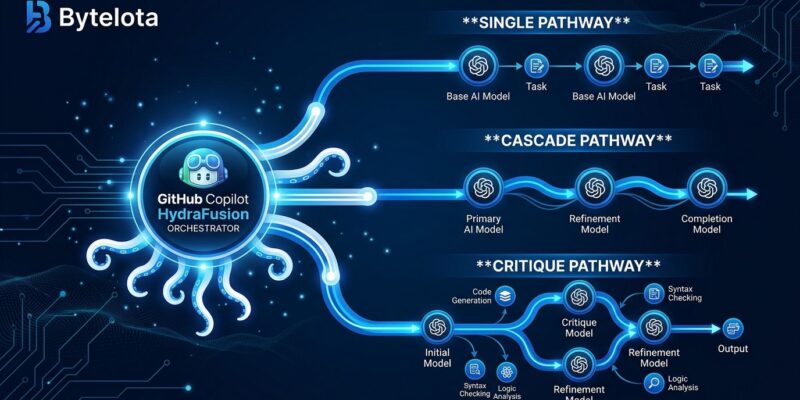
HydraFusion does not pick a model — it picks a workflow. For each coding request, it reads capability signals (multi-step reasoning, code generation, debugging, tool use) and routes through one of three execution patterns:
- Single: One model handles the task directly. Lowest cost, lowest latency. Used when HydraFusion estimates one model can hit the quality bar in a single pass.
- Cascade: A leaner model drafts first. If it fails an internal quality gate, the task escalates to a more capable model. Cost scales with task complexity rather than defaulting to frontier pricing on everything.
- Critique: One model drafts the solution. A second model reviews it in a read-only context — no tool calls, no side effects. The first model then revises. Designed for accuracy-sensitive work.
The routing decision happens at runtime, per task, with no developer involvement. That is the core of what HydraFusion does differently from everything else in this space.
What the Benchmarks Actually Say
GitHub ran offline evaluations across three benchmarks. The results are strong, with one honest caveat:
| Benchmark | Cost vs. Claude Opus 5 | Quality vs. Claude Opus 5 |
|---|---|---|
| TerminalBench 2.1 | -67% | +4.9 percentage points |
| CheckpointBench | -65% | -0.1 percentage points |
| DeepSWE | -36% | -1.5 percentage points |
Two out of three benchmarks show HydraFusion matching Opus 5 quality at roughly a third of the cost. InfoQ’s analysis notes DeepSWE — an agentic software engineering benchmark emphasizing long-horizon multi-step tasks — is where the quality dip appears. For complex, multi-step agentic work, HydraFusion’s Cascade pattern occasionally picks the wrong escalation threshold. GitHub is still calibrating this.
The Token Cost Reality
HydraFusion has no usage surcharge — you pay each model’s standard token rate for the legs it actually runs. But a Critique workflow runs two model calls. A Cascade that fails the quality gate runs two as well. If HydraFusion consistently routes complex tasks through Critique or a failing Cascade, total token spend can exceed what a single frontier model call would have cost.
For Copilot Pro users on token-limited plans: enable it, then monitor your first week’s usage. For Copilot Business and Enterprise with per-seat billing, the cost reduction math is more straightforward — fewer high-cost model calls, smarter routing.
How to Enable HydraFusion
As of September 30, HydraFusion is available in VS Code 1.140+ and the GitHub Copilot app on all plans (Pro, Pro+, Business, Enterprise). Select it from the Copilot Chat model picker. If it does not appear, enable it manually:
// VS Code settings.json
{
  "chat.copilot.hydraFusion.enabled": true
}
Or open Settings (Ctrl+, / Cmd+,), search for chat.copilot.hydraFusion.enabled, and check the box. Enterprise and organization accounts may need an admin to allow preview features first.
Why This Matters Beyond Copilot
What makes HydraFusion notable is not just the cost numbers — it is what it signals about where AI coding tooling is heading. Every other multi-model routing solution requires developers to design the routing logic: LangChain, LlamaIndex, and OpenAI’s Agents API all put that burden on you. HydraFusion makes it invisible.
Whether GitHub keeps calling it “multi-model orchestration” or rebrands it in a future Copilot release, this pattern — automated per-task model routing with transparent cost accounting — is where the entire IDE AI stack is heading. HydraFusion is a research preview today. It is the default behavior of coding assistants in two years.


