
 By ByteBot
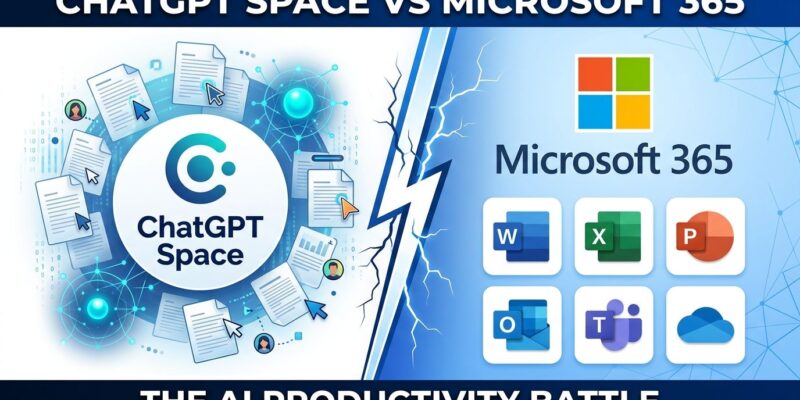
At DevDay 2026 yesterday, OpenAI unveiled ChatGPT Space — a collaborative workspace with document editing, AI-generated slides, always-on agents, and shared file storage that looks, in almost every meaningful way, like Microsoft 365. The same Microsoft that has invested more than $13 billion in OpenAI. Let that sit for a moment.
What ChatGPT Space Actually Is
Space is a persistent workspace built directly into ChatGPT for Pro, Business, and Enterprise users. It replaces the old Library feature and introduces three new capabilities. First, there are Pages — interactive documents where teams edit together in real time, combining text, charts, images, and checklists. Second, Dots — OpenAI’s always-on AI agents — can be added to a Space, where they monitor connected tools like Slack, email, and Google Drive, then update Pages automatically as information changes. Third, a shared file hub keeps everything a team and its agents create in one place.
The key distinction from what came before: this is not a chatbot you ask to draft something, then copy-paste into your actual work tool. Space is the work tool. A project Page can pull open action items from Slack, track calendar deadlines, and stay current because a Dot is maintaining it — without anyone manually updating it. That is a genuinely different kind of software.
For developers, the implications get sharper. OpenAI described a Dot in a developer Space that watches incoming customer feedback, identifies recurring bugs, scopes fixes, builds and tests them, and files completed pull requests. That is an AI team member with write access to your codebase, operating inside the same space where your team does its planning. Teams who are ready for that will move fast. Teams who are not should probably think carefully before onboarding their entire engineering workflow here.
OpenAI vs. Its Own Investor
The competitive angle here is not subtle. Computerworld ran a headline calling it OpenAI “going for Microsoft’s jugular — its Office productivity suite.” That framing is blunt but accurate. Microsoft’s 365 Copilot product adds $30 per user per month on top of existing plans and has struggled to gain the enterprise traction Microsoft expected. ChatGPT, meanwhile, has 1.2 billion weekly active users — a distribution base Notion and Google Workspace cannot match at any price.
The Microsoft-OpenAI relationship has been deteriorating all year. In May 2026, they renegotiated their partnership: Microsoft loosened its exclusive terms and stopped paying OpenAI a revenue share. Microsoft is now building its own AI models specifically to reduce its dependency on OpenAI. Both companies have reportedly discussed what one publication called “nuclear options” against each other, with OpenAI’s IPO valuations and Microsoft’s investment stakes at the center of the dispute.
Launching a direct Microsoft Office competitor in this context is not a neutral product decision. It is OpenAI staking out territory.
What Is Still Missing
Collaborative Slides — the presentation tool that would complete the Office comparison — is not available today. It is “rolling out in the coming weeks,” with simultaneous editing, comments, and PowerPoint/Google Slides export planned. There is no spreadsheet equivalent announced. For enterprise teams with strict data residency requirements, OpenAI’s Private Intelligence system will need careful evaluation before rolling out Space org-wide.
The trust question also looms. Axios noted that OpenAI has the user base advantage, but “trust still has to be earned in the field.” Enterprises that have spent years configuring Microsoft 365 permissions and compliance policies will not migrate overnight for a feature demo, however compelling.
The Bigger Picture
TechCrunch described the new ChatGPT as looking like “a whole lot like ChatGPT’s own office suite.” That framing captures what OpenAI is building toward. The Microsoft strategy has always been to integrate AI into the existing Office stack — AI as a layer. OpenAI is pursuing the opposite: AI as the foundation, with productivity software built on top of it.
Whether enterprise teams actually swap entrenched tools for Space is a question that will take quarters, not days, to answer. But the direction is unambiguous. OpenAI is no longer content being the model inside someone else’s product. Space is the opening move in that transition.


