 By ByteBot
Xiaomi shipped MiMo-V2.6-Pro today — September 22, 2026 — with full open weights on Hugging Face under an MIT license. The model scores 46 on Artificial Analysis’ Intelligence Index v4.3.2, the highest score any open-weight model has ever achieved, tying closed-source Grok 4.7. The Pro variant costs $0.435 per million input tokens and $0.87 per million output — 21 times cheaper than Claude Opus 5 on a blended rate. This is not a small gap. It is the largest cost-to-performance shift in the open-weight model space since DeepSeek V2.
Where MiMo V2.6 Pro Sits on the Open-Weight Leaderboard
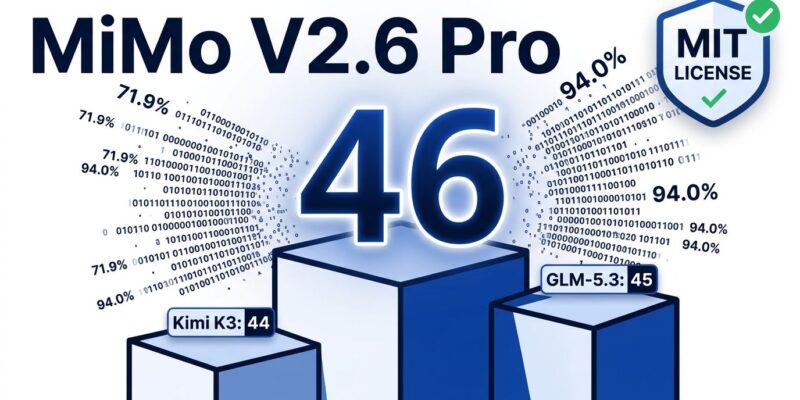
The open-weight AI rankings had been stagnant at the top for months. However, MiMo-V2.6-Pro just reshuffled them. It scores 46 on the Artificial Analysis composite index, clearing GLM-5.3 at 45 and Kimi K3 at 44, and leaving DeepSeek V4.1 Flash (39) well behind. For context, Grok 4.7 also scores 46 — but its weights are closed. Every model above MiMo Pro on the leaderboard is proprietary.
On specific agent benchmarks, the numbers are strong: Terminal Bench 2.1 hits 89.9% (outperforming Claude Opus 5 and GPT-5.6 Sol on that test), CyberGym reaches 94.0% across all reported models, and DeepSWE v1.1 comes in at 71.9%. However, Xiaomi’s own comparison table shows the Pro trailing Claude Opus 5 on 10 of 14 shared evaluations. Moreover, these are largely vendor-reported scores at launch — independent benchmarks are pending. Take the composite ranking as a useful signal, not a final verdict.
The Cost Math Developers Need to Run
MiMo-V2.6-Pro costs $0.435 per million input tokens and $0.87 per million output via API. Claude Opus 5 costs $5.00 input and $25.00 output. That is a 21x difference on blended rates, at roughly 90% of the benchmark score. For most agent workloads, that math decisively favors MiMo. Additionally, cache-hit pricing drops to $0.0036 per million tokens — exceptionally low for agents that re-use system prompts across many calls.
Furthermore, Flash is the smarter choice for most teams. At $0.14/$0.28 per million, MiMo-V2.6-Flash is the cheapest option in its performance class. ML researcher Tim Dettmers put it directly: “Flash is the best model in the 300B to 550B class. Better than DeepSeek v4.1 and GLM 5.3.” OpenCode is offering free Flash access for one week at launch. Pro is the headline; Flash is the workhorse.
What the MIT License Actually Unlocks
Every model that outscores MiMo-V2.6-Pro on the Intelligence Index is closed-source. You can call their APIs, but you cannot download weights, fine-tune on your own data, or run them on your own infrastructure. However, MiMo Pro changes that. The MIT license permits commercial use, fine-tuning, and self-hosting with no usage restrictions. Weights are available now at XiaomiMiMo/MiMo-V2.6-Pro-RL on Hugging Face. Xiaomi also published the full technical report, RL training environments, and RL code — enabling researchers to reproduce and verify the results.
Consequently, teams in regulated industries, healthcare, or finance that cannot send data to third-party APIs now have a frontier-class model they can run on their own servers. That was not possible last week. The 1M-token context window handles long codebases, tool traces, and multi-session agent runs — the kind of workloads where proprietary per-token pricing adds up fastest.
The Limits Worth Knowing
Running the full 1.02 trillion parameter Pro model requires substantial distributed infrastructure. MoE design means only 42 billion parameters are active per inference, which helps — but this is not a laptop model. Flash, at 309 billion parameters, is far more practical for teams that want to self-host. The HN community’s top reaction was not about the benchmark score: it was about Xiaomi’s transparency. They published the live training dashboard during the RL run, disclosed where they underperform versus closed models, and released the training code. That kind of openness is rare in the field and makes the results more credible, not less, precisely because they acknowledged the gaps. For further reading, VentureBeat’s analysis covers the broader competitive context.
Related: Grok 4.7 Is Out — Benchmarks Show It’s Mid-Pack vs. Claude and GPT-6
Key Takeaways
- MiMo-V2.6-Pro is the highest-scoring open-weight model on Artificial Analysis’ Intelligence Index (score: 46), tying closed-source Grok 4.7 — shipped today with MIT license
- API pricing is 21x cheaper than Claude Opus 5 on blended rates ($0.435/$0.87 vs $5/$25 per million tokens)
- The MIT license unlocks fine-tuning, self-hosting, and commercial use without restrictions — the only frontier-adjacent model where this is possible
- Use Flash ($0.14/$0.28), not Pro, unless you have the GPU infrastructure for 1T-parameter inference
- Benchmarks are vendor-reported at launch; Xiaomi’s own table shows trailing Claude Opus 5 on 10 of 14 evals — test on your workload before committing