 By
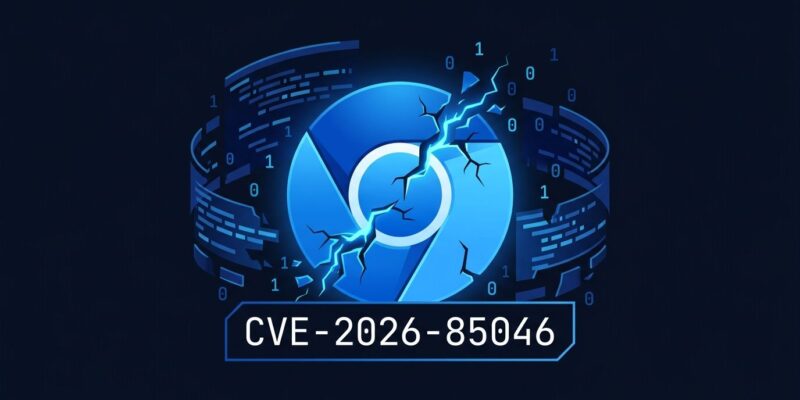
By Google patched a V8 type confusion zero-day on September 3. CISA added it to the Known Exploited Vulnerabilities catalog the next day and gave federal agencies until September 18 to fix it. That deadline is three days away. If you ship an Electron app, run Puppeteer in CI, or simply haven’t opened Chrome since August, you are still exposed.
What CVE-2026-85046 Actually Is
Type confusion is when a runtime misidentifies the type of an object in memory. In V8, Chrome’s JavaScript and WebAssembly engine, a crafted HTML page can trick the engine into treating one object as another. The resulting memory corruption gives an attacker a primitive for arbitrary code execution inside the Chrome sandbox — no download, no click-through, just navigation to a hostile page.
CVSS score is 8.8 (HIGH). Google confirmed an exploit existed in the wild before the patch shipped. The fix landed in Chrome 152.0.7977.82 for Windows and Linux, and 152.0.7977.82/.83 for macOS. Every Chromium-based browser inherits the same V8 flaw: Microsoft Edge, Brave, Opera, and Vivaldi all need updates too. Check yours now: navigate to chrome://version and confirm you are on 152.0.7977.82 or later.
Why Electron Developers Have a Separate Problem
Here is what most CVE roundups miss. Electron bundles its own Chromium binary. When Chrome auto-updates on a user’s machine, your Electron app does not benefit — it carries its own copy of V8 inside your packaged binary. Electron 44, the current stable release, ships with Chromium 152.0.7977.54, which is the pre-patch version. Your users are exposed whether or not they have updated Chrome on their own.
This means you, the developer, are effectively acting as your own browser vendor. Every Electron app maintainer needs to bump to a patched Electron version, rebuild, and push a new release to users. If your update pipeline is manual, that is a fire drill. If you have auto-update configured via Squirrel or Electron’s built-in updater, you still need to ship the new binary first — the updater only delivers what you’ve built.
Who Needs to Act and How
Your remediation depends on how you use Chromium:
- Chrome and Chromium-based browser users: Navigate to
chrome://version. If you are below 152.0.7977.82, restart Chrome to trigger the update or download fresh from google.com/chrome. Edge, Brave, and Opera users should check their own update channels — they all ship V8 and are equally affected. - Electron app developers: Run
npm outdated electron. Update to a release that bundles Chromium 152.0.7977.82 or later, rebuild your distributables, and push the update immediately. The Electron releases page maps each version to its bundled Chromium build. If Renovate or Dependabot is not already tracking your Electron dependency, enable it now so you catch the next one faster. - Puppeteer and Playwright users: Both tools bundle their own Chromium. Run
npm update puppeteerand invalidate CI caches so the next pipeline run pulls fresh binaries. For Playwright, runnpx playwright install chromium. Cached Docker layers are a common culprit for stale browsers lingering in CI. - Chromium Embedded Framework (CEF) apps: A full rebuild against patched Chromium source is required. Check your upstream CEF fork for the patched release and rebuild. There is no shortcut.
Six Zero-Days in Nine Months
CVE-2026-85046 is Chrome’s sixth zero-day of 2026. All six carry CVSS 8.8 scores, and three of them — including this one — are V8 type confusion bugs specifically. Security researchers have noted this reflects sustained, organized adversarial research against the world’s most-deployed JavaScript runtime, not random bug hunting. The implication for developers is direct: any runtime sharing V8 lineage — Node.js, Deno, Bun — is a long-term target surface even when a specific CVE names only Chrome.
Three Days Left
CISA’s 14-day mandate is calibrated to active exploitation, not theoretical risk. The September 18 deadline signals that adversaries are using this in real attacks right now. Non-federal teams should treat it with the same urgency as any production incident. If your Electron app has not shipped a patched update, your users are running a browser with a confirmed, exploited zero-day baked into your installer. That is a liability you can close this week.