 By ByteBot
The Kubernetes Dashboard was archived in January 2026, leaving a gap that kubectl never actually filled. Headlamp — the browser-based Kubernetes UI officially endorsed by SIG-UI — stepped into that gap. Now it has a Cluster API plugin that goes further than anything the old Dashboard offered: genuine fleet-level visibility across all your Cluster API-managed infrastructure, in a browser, without YAML archaeology.
The plugin landed June 25, 2026 and has been quietly maturing since. If you manage multi-cluster environments with Cluster API, this is worth your attention now — especially with Helm 3 reaching hard EOL in February 2027 and the entire operational stack pushing teams to modernize.
Why the Old Dashboard Left a Real Gap
The original Kubernetes Dashboard was a generic cluster inspector. It worked fine when most teams had one or two clusters and Kubernetes was still the new thing you were figuring out. At fleet scale — dozens of clusters managed declaratively through Cluster API — it was useless. You could not see replica status across clusters, you could not trace the relationship between a MachineDeployment and the machines it controlled, and there was no scaling interface that did not require dropping back to the CLI.
When the Dashboard was archived due to lack of maintainers, the gap it left was not “we lost a nice dashboard.” It was “we have no endorsed browser-based tool for the operational layer between kubectl and a full platform product like Rancher.” Headlamp was already filling that role as a general-purpose cluster UI. The Cluster API plugin closes it completely for fleet operators.
What the Cluster API Plugin Gives You
The plugin was developed by Chayan Das through the CNCF LFX Mentorship program and supports both CAPI v1beta1 and v1beta2. It adds a dedicated Cluster API section to Headlamp with views for every major CAPI resource:
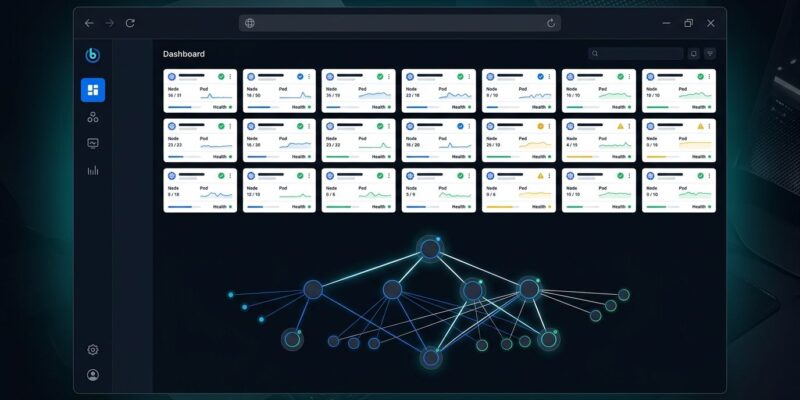
- Fleet overview — all clusters with live control-plane replica and worker status in a single view
- Machine hierarchy — drill from Cluster into MachineDeployments, MachineSets, and individual Machines with condition detail and remediation guidance
- One-click scaling — scale MachineDeployments and MachineSets directly from the UI, no kubectl required
- Map view — a visual topology diagram of Cluster to Control Plane to Worker relationships
- ClusterClass detection — auto-labels class-managed resources so topology-aware clusters are immediately identifiable
- KubeadmControlPlane visibility — replica counts, version tracking, machine association
- Prometheus integration — inline metrics on Cluster, MachineDeployment, MachineSet, and Machine detail pages when the Headlamp Prometheus plugin is installed
Provider support covers Docker, AWS, Azure, GCP, and vSphere. Current status is Alpha — pin specific versions rather than running the latest automatically.
Deploying Headlamp With the Cluster API Plugin
Headlamp installs into your management cluster via Helm. Add the repo and install:
helm repo add headlamp https://kubernetes-sigs.github.io/headlamp/
helm install my-headlamp headlamp/headlamp --namespace kube-system
Once Headlamp is running, install the Cluster API plugin from the plugin catalog inside the Headlamp UI. For Prometheus metrics, add the Headlamp Prometheus plugin separately and configure the source under Settings. The in-cluster installation docs cover OIDC configuration and ingress setup for production environments.
One practical note from early adopters: restrict Headlamp access to platform operators. This is infrastructure-layer tooling — the scaling and visibility it provides should not be exposed to tenants.
Headlamp as the Endorsed Default
Headlamp is Apache 2.0, no commercial tier, no per-seat licensing, no account requirement. It was created by Kinvolk (now part of Microsoft) and is currently a CNCF project living under kubernetes-sigs as the official SIG-UI project. The former Kubernetes Dashboard maintainers explicitly point here.
The plugin development pipeline matters too. CNCF LFX Mentorship runs on a quarterly cycle, and Headlamp is actively using it — Prometheus integration, Volcano support, and Knative visibility are already in or near the pipeline. The old Dashboard had no such backing. Headlamp’s extensibility model means the dashboard grows with the ecosystem rather than falling behind it.
If you have been putting off replacing the Kubernetes Dashboard, or if you are still running kubectl get clusters --all-namespaces to get a picture of your fleet, the Cluster API plugin gives you a reason to change that today. Deploy it against your management cluster, get eyes on the fleet, and pair it with the Prometheus plugin for metrics. The operational clarity it provides is not subtle.