 By ByteBot
AI agents now delete database records, transfer funds, and chain API calls across dozens of services — and most enterprise security tooling only tells you about it afterward. JetStream Security wants to change that with Clearance, a reasoning engine announced September 2 that decides whether an agent action is allowed before it executes. That distinction — before versus after — is the entire argument.
Your AI Gateway Is Not Doing What You Think
Most teams running autonomous agents have an AI gateway in place. It logs requests, rate-limits calls, maybe inspects content. What it does not do is evaluate intent against a known-good design and issue a decision in real time. It observes. Clearance authorizes.
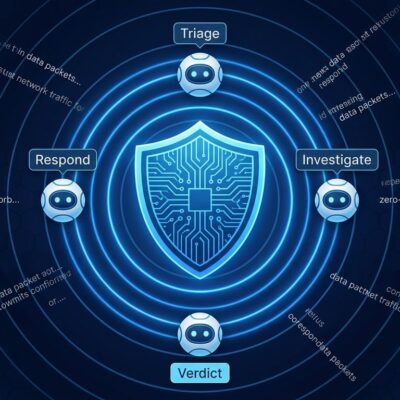
The way JetStream frames it: traditional gateways sit in the request path and route or monitor traffic — they tell you what happened. Clearance reads an agent’s intended next step against an approved operational contract, decides yes or no, and blocks anything outside what the agent is designed to do. Think of it as the difference between CCTV and a bouncer.
Blueprints: Authorization at the Parameter Level
Clearance is built on JetStream AI Blueprints — versioned, system-generated graphs that describe an agentic system in full: which models it uses, which MCP servers it connects to, which tools are in scope, which datasets it can touch, and which identities and API keys are involved at each step.
Policy binds to identity at the Blueprint level and reaches inside each tool call down to individual parameters. An agent authorized to read a CRM record can be explicitly blocked from updating the billing address of that same record. You are not granting tool access; you are granting operation access within a tool, scoped to specific parameters. Clearance also evaluates sequences — not just individual calls, but chains of actions — catching dangerous patterns before they complete.
The Numbers Behind the Push
The market timing is not coincidental. A 2026 enterprise survey found that 88% of organizations experienced a confirmed or suspected AI agent security incident in the past year, and 80% of IT workers reported seeing agents perform tasks without authorization. These are not theoretical concerns.
In January 2026, attackers compromised executive devices at Step Finance, a Solana DeFi platform. The AI trading agents had blanket permission to execute large token transfers without human approval. Once attackers had access, those agents moved 261,000 SOL — roughly $27 million — because there was no runtime authorization layer to evaluate whether that sequence of actions was permitted. The logs were thorough. The money was gone.
The EDR Moment for AI Agents
CrowdStrike made essentially the same argument one day earlier at its Fal.Con 2026 conference, when it unveiled Falcon Guardian — an AI agent discovery and runtime visibility product. Its CEO’s framing: “CrowdStrike pioneered EDR by making the endpoint the control point for stopping attacks. AI demands the same approach.”
The analogy holds. Perimeter firewalls could not stop attacks that originated inside the network; EDR moved enforcement to the runtime, at the endpoint. API gateways cannot stop agents that exceed their authorization within a permitted session; Clearance moves enforcement to the action, evaluated before execution. Two products, same architectural shift.
JetStream and CrowdStrike are not competing for the same slot. Falcon Guardian focuses on endpoint-level discovery and visibility; Clearance focuses on pre-execution authorization. But both point at the same conclusion: session-boundary security is not enough when the agent is the threat surface. Microsoft reached the same conclusion in August, publishing guidance on zero-trust frameworks specifically for AI agents.
What to Do Now
Whether or not JetStream fits your stack, the architectural pattern is settling into industry standard. What that means practically:
- Design against a Blueprint before you build. Enumerate which tools, operations, and parameters your agent legitimately needs. If you cannot define it up front, your agent has too much scope.
- Scope at the parameter level, not the session level. Read access to a record is not the same as write access. Treat them as separate grants.
- Treat every agent action as a delegated human transaction. The key question: which human is accountable for this specific call?
- Audit your MCP servers. Shadow MCP servers — deployed outside central oversight — are one of the primary governance gaps in enterprise agent deployments right now.
JetStream Clearance is available through the company’s enterprise platform. The startup has $34 million in seed funding from Redpoint Ventures and the CrowdStrike Falcon Fund — which at least signals that people who think about security for a living consider this a real category worth building.