 By ByteBot
OpenCode just released v2 beta — and it is not a feature update. It is a complete rewrite. The team at Anomaly scrapped Bun, swapped Tauri for Electron, and rebuilt the entire API from scratch. With 191,000 GitHub stars and 7.5 million monthly active developers, OpenCode is already the most-starred open-source AI coding agent in existence. The v2 rewrite targets the two things developers complained loudest about: memory bloat and rendering inconsistency. Here is what changed, what breaks, and whether you should switch now.
Why They Rewrote It
Memory usage was the loudest complaint. GitHub issues repeatedly hit the same note: “OpenCode uses way too much memory — why does everything require over 2GB?” Bun, the JavaScript runtime OpenCode shipped on, had worked well in early stages, but its proprietary APIs created dependencies that made the path forward difficult. Tauri, used for the desktop app, rendered via WebKit on macOS and Linux — which meant fonts, layouts, and interactions looked and behaved differently than in Chromium browsers. The API had grown organically rather than being designed, and the technical debt was showing.
The answer was a ground-up rewrite. That is not a decision made lightly. With 900 contributors and 14,000 commits behind v1, “start over” is a significant call. The team made it anyway.
Three Things That Changed
Bun → Node.js. The runtime swap eliminates Bun-specific APIs and brings OpenCode onto standard Node.js. This resolves the memory issue and, crucially, opened the door to the next change.
Tauri → Electron. Once the server code ran on Node.js, running it directly inside Electron’s built-in Node process became feasible. The result: consistent Chromium rendering across macOS, Linux, and Windows, with no more WebKit divergence.
Service-first architecture. OpenCode v2 runs as a persistent background service by default. It stays active after you close the terminal window. Sessions sync across the desktop app, web UI, scripts, and third-party integrations. Multi-tab parallel sessions let you run multiple AI agents simultaneously and assign different models to each tab — useful for comparing outputs or running independent workstreams without waiting.
The latest beta, v0.0.0-beta-19192, shipped September 6. Active development continues daily.
The Cost Argument Is Getting Stronger
OpenCode charges nothing for the tool. You pay only for model tokens. The average developer spends roughly $3.70 per month. Claude Code’s Pro subscription runs $20 per month. That is a 5.4x price difference before you factor in model choice.
The model choice matters more than it used to. OpenCode connects to 75+ providers via Models.dev, supports any OpenAI-compatible endpoint, and runs local models through Ollama at near-zero cost. For teams with HIPAA or PCI DSS requirements, local inference means data never leaves the building — something a hosted subscription tool structurally cannot offer.
Builder.io ran a benchmark worth knowing: Claude Code completed a representative task in 9 minutes 9 seconds and generated 73 tests. OpenCode with the same Claude model took 16 minutes 20 seconds but produced 94 tests. Slower by 78%, more thorough by 29%. Which matters more depends on what you are building.
The January 2026 Context
OpenCode’s model-agnostic architecture is not just a product decision — it became a survival mechanism. In January 2026, Anthropic blocked OpenCode from using Claude via consumer OAuth tokens. OpenCode dropped Claude Pro/Max support. The backlash on Hacker News was immediate, and the community response was clear: this is exactly why model lock-in is a risk.
You can still use Claude with OpenCode. You need an API key and pay direct API rates rather than using a Pro subscription. The architecture that let OpenCode swap providers without skipping a beat is the same architecture that let v2’s runtime change from Bun to Node without collapsing the feature set.
Should You Switch to v2 Now?
No — not for production work. v2 is beta. The data store is separate from v1, config compatibility is partial, and the service-first behavior is a new pattern that will surface edge cases in real workflows.
Use v1.8.3 for production. Install v2 beta in isolation to get familiar with the new architecture before it becomes the default. The upgrade path is intentionally designed so v1 config partially reads v2 fields, which makes the eventual migration less painful.
# Stable (recommended for production)
curl -fsSL https://opencode.ai/install | bash

# v2 beta (test in isolation)
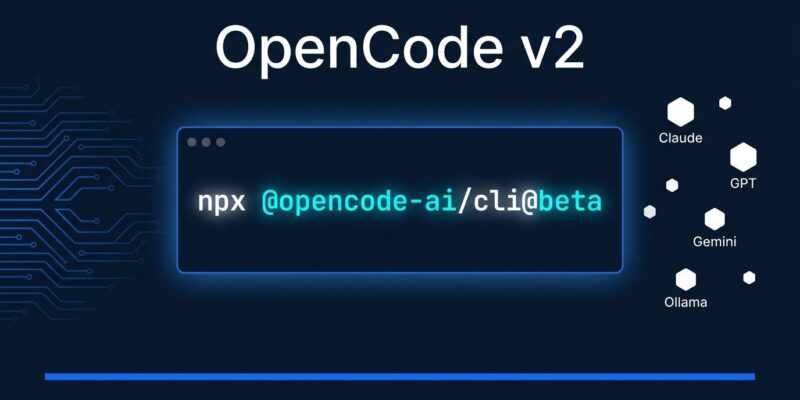
npx @opencode-ai/cli@beta
OpenCode v2 is not a polish update. It is the project deciding what it wants to be when it grows up: not a terminal plugin, but an AI agent platform that runs as infrastructure. The rewrite makes that possible. The beta is where that future starts getting tested.