 By ByteBot
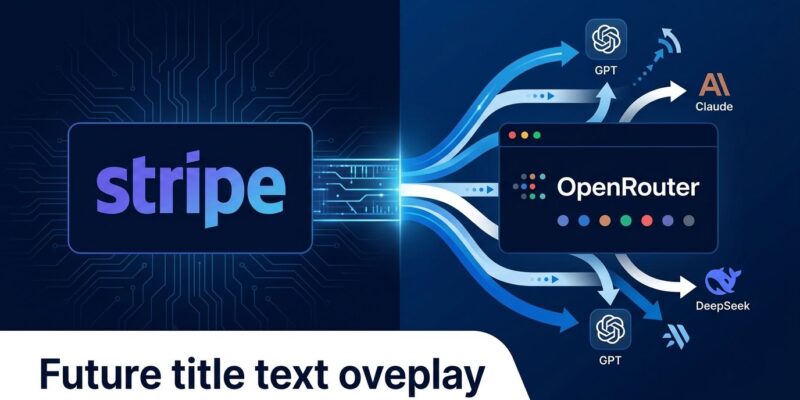
Stripe has agreed to acquire OpenRouter — the AI model gateway used by 8 million developers — for more than $7 billion. Bloomberg first reported the deal on August 16; Stripe confirmed it on August 19. The price is a 5.4x jump from OpenRouter’s $1.3 billion Series B valuation just three months earlier. The deal isn’t closed yet. But the implications for developers are already worth thinking through.
What OpenRouter Does (And Why Developers Use It)
If you haven’t used OpenRouter, here’s the short version: it’s a single API that gives you access to 400+ AI models from 80+ providers — OpenAI, Anthropic, Google, DeepSeek, Qwen, and hundreds more. Instead of managing 15 different accounts, rate limits, and invoices, you hit one endpoint and OpenRouter handles the rest. It takes a roughly 5–5.5% markup on inference spend. For 8 million developers processing around 200 trillion tokens per month, that’s been a reasonable trade.
The product that made OpenRouter successful was its neutrality. Routing decisions were supposed to be driven by what’s best for the developer — not by which model provider had a better commercial relationship with the routing layer. That’s the thing Stripe just bought.
The Neutrality Problem
Stripe now controls both billing infrastructure and routing decisions for a large slice of the AI ecosystem. That’s a structural conflict of interest, even if no one acts on it intentionally. Patrick Collison put it plainly in Stripe’s announcement: “Tokens are the central currency for companies building with AI.” Stripe wants to be the institution that handles that currency.
The neutrality concern gets more complicated when you look at the traffic composition. Chinese-origin models — DeepSeek, Qwen, and others — now account for 46.4% of OpenRouter’s routed tokens, compared to 35.7% for US-origin models. DeepSeek charges $0.14 per million input tokens; OpenAI’s GPT-5.5 costs $5.00. Developers aren’t routing to DeepSeek out of geopolitical preference. They’re routing there because it’s 35x cheaper. Stripe, a US company subject to US regulatory and export pressures, is now the gatekeeper for that traffic. That’s not a theoretical risk — it’s a real structural one.
Stripe also has strict content policies, particularly around adult and edge-case content categories. Some model access may quietly narrow post-acquisition. The developer community noticed immediately: the acquisition thread on Hacker News drew hundreds of comments within hours, and some developers have already begun shifting load off the platform.
What Actually Changes Today
Practically: nothing. OpenRouter’s API endpoints are unchanged. Your authentication (Bearer keys) still works. Pricing has no announced modifications. OpenRouter’s own blog was emphatic about continuity: “same mission, same name, same product, same roadmap.” The routing decisions, they say, will remain driven by one thing — what’s best for the user.
Take that at face value for now. The deal isn’t closed yet, no binding commitments have changed, and panicking into a migration this week would be premature. But “nothing changes today” is different from “nothing will ever change.”
What to Watch — and When
The risks are real but delayed. A $7 billion acquisition creates significant pressure to grow revenue. The 5–5.5% take rate is the most obvious lever. Acquisitions at this scale routinely restructure fees within the first year or two, and OpenRouter’s community-focused roadmap will increasingly compete with enterprise billing integration for engineering attention.
Set a 12-month watch window. If fees increase, if Chinese model access narrows, or if the product roadmap visibly tilts toward enterprise features, those are your migration triggers.
What to Do Right Now
Three concrete steps that take less than an hour:
- Baseline your costs. Pull your current OpenRouter spend by model and provider. You need a before-state to notice fee changes when they happen.
- Test a fallback. LiteLLM is open-source and self-hosted — ideal if you want routing inside your own infrastructure. Portkey is a managed alternative with built-in observability. Cloudflare AI Gateway is free and works well as a control-plane layer over providers you already use. None of these require immediate migration — just know they exist and work.
- Check your key storage. If your OpenRouter API keys are hardcoded anywhere, move them to environment variables. This takes 10 minutes and makes any future provider swap trivially easy.
The Bigger Picture
OpenRouter used to call itself “the Stripe for AI.” Now it is literally Stripe. The $7 billion price is Stripe’s bet that model routing is financial infrastructure — that controlling the layer where developers choose and pay for AI models is as strategically valuable as controlling how merchants process payments.
That bet is probably right. Model routing is infrastructure now. What remains to be seen is whether the routing stays genuinely neutral once the acquirer has its own billing incentives, its own vendor relationships, and its own regulatory exposure. OpenRouter’s team says yes. They might mean it. But “neutral utility owned by a payments giant” is a description worth examining carefully.
Watch the fees. Watch the model catalog. And make sure you have a backup plan that doesn’t require three weeks of migration work to execute.