 By
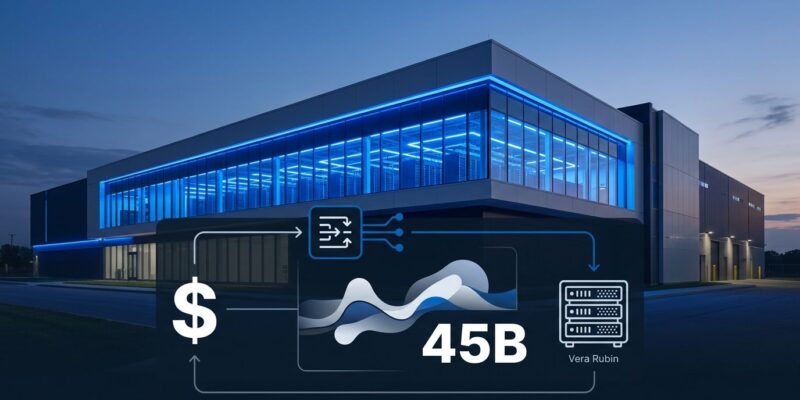
By Anthropic just committed $45 billion to compute — and it won’t be ready until 2027. The deal, signed August 26 with U.K.-based AI infrastructure company Nscale, locks in 460 megawatts of Nvidia Vera Rubin capacity in a West Virginia data center. It is the second massive compute contract Anthropic has signed this month: three weeks earlier, the company inked a $10 billion deal with Volta for 133 megawatts in Norway. Combined, that is $55 billion in new compute commitments in 22 days, all before an October IPO targeting a $2 trillion valuation.
What the Nscale Deal Is
Nscale is a London-based AI infrastructure company founded in 2024, built on compute infrastructure spun out of a Norwegian crypto-mining operation. Since then it has raised $2 billion at a $14.6 billion valuation, with backers including Nvidia and Microsoft. Under the Anthropic agreement, Nscale will lease 460 megawatts — enough power for 345,000 U.S. homes — from its flagship West Virginia data center, running Nvidia’s Vera Rubin chip architecture. The facility comes online at the end of 2027. The agreement runs six years, or roughly $7.5 billion per year in compute spend.
The $55B Compute Sprint Before October
This is not a standalone procurement decision. Anthropic is in a pre-IPO infrastructure blitz.
On August 4, the company signed with Volta — a cloud startup founded months earlier by ex-Brookfield Asset Management managers — for $10 billion of Vera Rubin capacity in Norway, backed by a J.P. Morgan credit facility. The Norwegian site should come online in phases by Q1 2027. Then came the Nscale deal on August 26, nearly five times larger. Investors expect Anthropic to go public in October at a $2 trillion valuation, which would make it the largest IPO in history, surpassing SpaceX’s $1.77 trillion debut in June. Annualized revenue was $47 billion in May; investors project $100 to $120 billion by year-end.
At that scale, the story Anthropic needs to tell Wall Street is that it can meet demand. Locking in $55 billion in multi-year compute contracts before the roadshow is how you prove that without actually having the hardware yet. The compute commitment is, in part, a financial statement.
Why Vera Rubin Matters to Your API Bill
Both deals specify Nvidia’s Vera Rubin chips, which matter for reasons beyond the hardware press release. Nvidia claims Vera Rubin delivers 5x the inference performance and 10x lower cost per token versus Blackwell at the rack level. Each GPU carries 288 GB of HBM4 memory at roughly 22 TB/s bandwidth, rated at 50 PFLOPS NVFP4.
That is a meaningful leap. If inference cost falls 10x at the hardware layer, Anthropic has room to cut API prices further while improving margins — or to absorb significantly higher request volume without raising prices. The company already cancelled a planned September 1 price increase for Sonnet 5; it signalled that competitive pressure on pricing is real and they intend to stay aggressive.
The Developer Timeline: Honest Version
Here is where the optimism should be calibrated. Nothing in either compute deal changes today’s rate limits, API latency, or pricing. The West Virginia facility is not online until end of 2027. The Norwegian Volta facility arrives first, in phases, starting Q4 2026 and completing Q1 2027. That is when the first wave of Vera Rubin capacity might start showing up in Anthropic’s infrastructure.
The practical developer timeline looks like this: Q4 2026, watch for any rate limit expansions tied to Volta coming online. Q1–Q2 2027, first Vera Rubin performance improvements may reach the API. End of 2027, when Nscale’s West Virginia facility opens, the 460 MW is added on top of existing capacity. If Anthropic’s pricing philosophy holds, that headroom should translate into either higher rate limits or lower costs — not both at once, but progress.
The IPO Tension Developers Should Watch
Anthropic going public at a $2 trillion valuation in October will change how the company operates. Public companies answer to quarterly earnings. The question developers should track: does IPO pressure push Anthropic toward high-margin enterprise contracts at the expense of the developer API tier?
The early signals are mixed. TechCrunch noted that the Nscale deal continues Anthropic’s pattern of locking in compute ahead of the IPO. Fortune reported that the $2T valuation depends on projections of $100–$120B in annualized revenue by year-end. Hitting those numbers requires broad API adoption, not just enterprise contracts. Developers are part of the growth story.
Still, post-IPO Anthropic will prioritize revenue per compute hour. Watch whether rate limit tiers shift, whether free or low-tier access narrows, and whether enterprise features get compute priority over the API. Those signals will arrive before 2027.
What to Do Now
The $45 billion Nscale deal is a 2027 story dressed up as August 2026 news. The near-term implications are limited. But the pattern matters: Anthropic is betting that demand for Claude will continue compounding faster than any single infrastructure partnership can serve. Bloomberg reported the full deal terms; the broader investment thesis is that compute scarcity — not model quality — will be the primary constraint on AI businesses through 2028.
For developers building on Claude API today: budget your rate limits conservatively through Q3 2027. Monitor Anthropic’s communications around the IPO for any tier restructuring. And if you are currently hitting rate ceilings regularly, request a limit increase now — the process exists and gets easier as capacity scales.