 By ByteBot
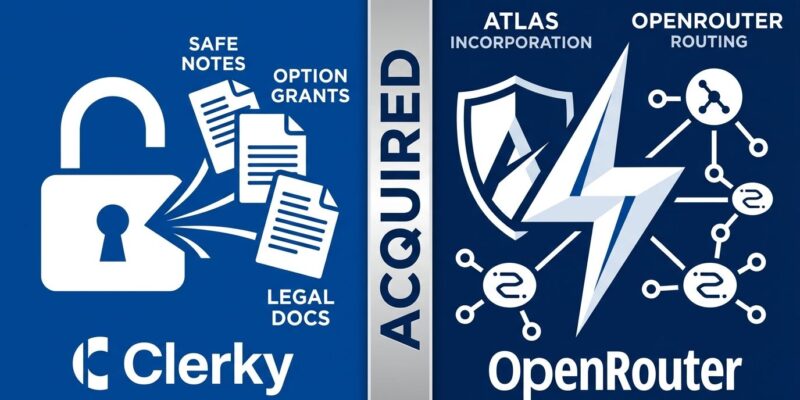
Stripe acquired Clerky today — the legal document platform used by 23% of all Silicon Valley seed and pre-seed startups. The deal follows Stripe’s $7B+ OpenRouter acquisition by roughly ten days. In August 2026 alone, Stripe bought AI model routing infrastructure and startup legal infrastructure. That is not a coincidence. It is a strategy.
What Clerky Is (And Why This Acquisition Has Weight)
Clerky is not a generic legal tool. It handles the legal paperwork that matters most at the earliest, most legally risky moments of a startup’s life: SAFE notes, option grants, advisor agreements, and priced funding rounds. Its templates are drafted by Orrick — a law firm that works with top-tier venture-backed companies — and startups using Clerky have collectively raised over $140 billion in VC funding. That 23% figure is not a rounding error. Nearly one in four Silicon Valley seed deals runs through this platform.
Until today, Clerky and Stripe Atlas were complementary products serving different moments in a startup’s lifecycle. Atlas handles day one: incorporate a Delaware C-corp, get an EIN, open a bank account, and start accepting payments. Clerky handles everything after that — issue equity to founders, create SAFE notes for investors, grant options to employees, set up advisor agreements. One gets you legal, the other gets you funded.
What Stripe Now Controls
Put the August acquisitions together and Stripe now owns a remarkable slice of startup infrastructure. It controls payments (the original product), startup incorporation (Atlas), legal documents for the entire funding lifecycle (Clerky), and AI model routing for developers building on LLMs (OpenRouter, 400+ models). A startup can now incorporate, handle all its legal paperwork, process payments, and route AI requests — without ever leaving Stripe’s ecosystem.
Patrick Collison framed the OpenRouter deal as “building the economic infrastructure for AI.” The Clerky acquisition extends that framing into the physical startup lifecycle. Stripe is not just building payment rails. It is building the plumbing every new company touches on its first day of existence.
Related: Stripe Buys OpenRouter for $7B+: What Devs Must Know
The Convenience Case — and the Concern
The optimistic read on this acquisition is real. Atlas and Clerky integration could genuinely simplify life for founders. Today, you incorporate via Atlas, figure out Clerky separately, then set up Stripe payments — three vendors, three dashboards, three sets of credentials. A unified flow handling incorporation, legal documents, and payments in one experience would be legitimately useful. Over 100,000 founders from 169 countries already use Atlas. Adding Orrick-quality legal templates to that product is an upgrade, not a downgrade.
The skeptical read is also real. A startup that incorporates via Stripe, issues all its equity through Clerky’s templates, raises SAFEs through Clerky, and processes payments through Stripe core is deeply embedded before it has a single employee. Stripe vendor lock-in is already a documented concern: rolling reserves on accounts flagged as elevated risk are non-negotiable, and payout schedules are set by Stripe, not by you. Adding legal document dependency to payments dependency means the cost of switching is not just technical — it is legal and financial.
Hacker News surfaced the tension immediately. One commenter called it “deeply problematic” that “Stripe now controls all of the early incorporation infrastructure.” Others pushed back, noting that alternatives — Firstbase, Gust, Capbase — still exist. Both reactions are correct. The alternatives exist. However, the gravitational pull of a unified Stripe experience will make them harder to choose. See the full discussion in the Hacker News thread on the acquisition.
The Irony Worth Noting
Stripe was founded specifically to make it easier for developers to start and build companies. The Collison brothers wanted to reduce the friction between a developer’s idea and their first transaction. That mission attracted an entire generation of developer-founders who made Stripe their default. Now, a company built to serve the startup ecosystem is systematically acquiring the infrastructure startups cannot avoid — before they have written a single line of product code.
That is not necessarily wrong. Infrastructure consolidation has real benefits for users when the consolidator maintains quality. Nevertheless, it is worth watching. The question is not whether Stripe will maintain Clerky’s quality — the team is staying, and Clerky’s document quality is Orrick-backed, not Stripe-dependent. According to the Atlas vs Clerky comparison, Clerky’s lifetime plan remains the better option for most venture-track founders precisely because of document depth. The real question is what Stripe does with the data, the defaults, and the routing once every new startup passes through its ecosystem on day one.
Key Takeaways
- Stripe acquired Clerky on August 27, 2026 — its second significant acquisition in under two weeks, following OpenRouter ($7B+) on August 19
- Clerky handles legal docs (SAFEs, option grants, advisor agreements) for 23% of Silicon Valley seed/pre-seed startups; $140B+ collectively raised by Clerky companies
- Stripe now controls incorporation (Atlas), legal docs (Clerky), payments (core), and AI model routing (OpenRouter) — the full startup stack from day one
- The convenience case is legitimate: Atlas + Clerky integration could simplify multi-vendor startup setup into a single flow
- The lock-in concern is also legitimate: startups embedded across Stripe’s legal and financial infrastructure face high switching costs before they have scaled enough to negotiate alternatives