 By
By Cursor rolled out Origin — its own Git hosting platform — on August 17. Roughly three hours later, GitHub went down. The timing was coincidental. The strategy was not. Origin is Cursor’s clearest signal yet that when AI agents do the coding, the editor and the forge need to be the same product. For paid Cursor users, it is already live — whether they opted in or not.
What Cursor Origin Is
Origin is a Git host that lives natively inside the Cursor editor, under a new Codebase tab. Repositories are hosted at origin.cursor.com remotes, with standard push and pull, branch protections, and permissions. It is a real forge, not a UI layered over GitHub.
The day-one beta ships four core pieces: repositories, pull requests with inline review, code browsing and search, and two-way GitHub sync. Three integrations arrived with launch: Vercel, Depot, and Buildkite. Cursor is not asking teams to abandon GitHub immediately — connected GitHub repositories remain on GitHub as the source of truth, with pull request conversations syncing both ways within seconds.
The Agent Loop That Makes This Different
Here is the architectural advantage worth paying attention to. Cursor’s cloud agents can clone Origin repositories natively, branch, commit, push, and open pull requests — without the API round-trips, auth handshakes, and context reloading that slow down any agent connected to an external forge through an app integration.
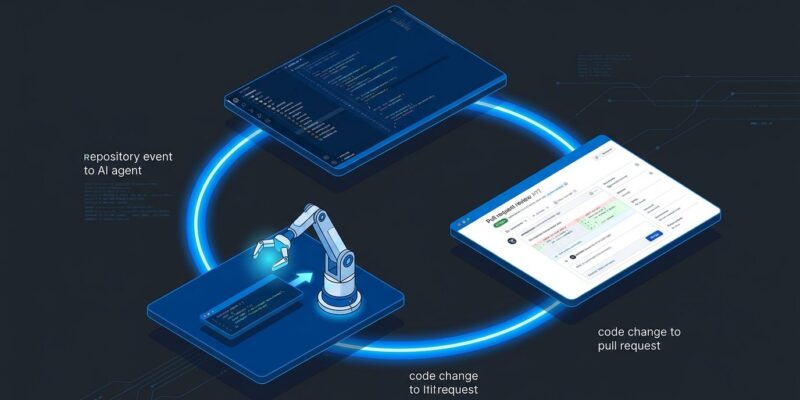
Since August 19, agents can also subscribe to their own pull requests. They wake up autonomously when a PR event fires — a failed check, a review comment, a push — and keep working until the PR is clean. The loop looks like this: repository event, agent runs in an isolated VM, code change, PR update, CI result, agent wakes again. No developer in the IDE required.
Subagents run on separate isolated VMs, each starting from a fresh sandbox cloned from the repo at trigger time. Changes are staged for review rather than applied directly. This containment model lets agents experiment aggressively without corrupting working code. The cost: running five subagents in parallel is roughly five times the cloud compute usage of one.
The Problem: No Data Terms
Here is where things get uncomfortable. Origin rolled out opt-out-by-default to all paid Cursor users. Enterprise admins can disable it. Individual paid users cannot. And Cursor has published no Origin-specific data terms — no data retention policy, no subprocessor disclosures, no statement on training use, no code migration or export tooling.
SpaceX closed its $60 billion acquisition of Cursor three days before Origin launched. Cursor’s standard Privacy Mode was reportedly changed in June 2026 to allow developer code data to flow into Grok 4.5 training at SpaceX and Tesla. The NextWeb reported it directly: Cursor Origin is on by default for paid users, and its data terms are unpublished. For enterprise teams with IP protections, auditors, or legal obligations, this is a blocker. Publishing terms should have come before the opt-out rollout, not after.
What It Does Not Do Yet
Origin is a weeks-old beta. There are no public repositories, no native CI (Depot and Buildkite integrations fill this gap for now), no Issues, and no free tier. It competes on agent-native workflow, not feature breadth. Teams evaluating it as a full GitHub replacement today will be disappointed. Teams evaluating it as an agent workflow layer on top of their existing GitHub repos have a more interesting case.
The Bigger Picture
For most of software history, where code lives and where code gets written were separate companies. GitHub owned hosting; editors owned the writing experience. Cursor is the first serious attempt to collapse these into one product built for the agentic era. GitHub responded with its own analysis covered by VentureBeat noting GitHub’s Copilot Desktop App, which went GA in June 2026 as a supervised agent workspace tied to GitHub issues and PRs. The models are different: GitHub starts from the issue and PR, Cursor starts from the agent session. Neither has won.
Vercel CEO Guillermo Rauch captured the moment: “You can now host your repos in Cursor Origin and deploy to Vercel via Cursor Origin which is itself hosted on Vercel.” The recursion is neat. The data terms are not.