 By ByteBot
Waymo opened its next-generation Ojai robotaxi to all riders in San Francisco, Los Angeles, and Phoenix this week — their cheapest, fastest-scaling vehicle yet. The catch: it rolls out of a factory in Ningbo, China. And a bipartisan Senate bill that cleared committee last month would ban every vehicle like it.
The Best Robotaxi Waymo Has Ever Shipped
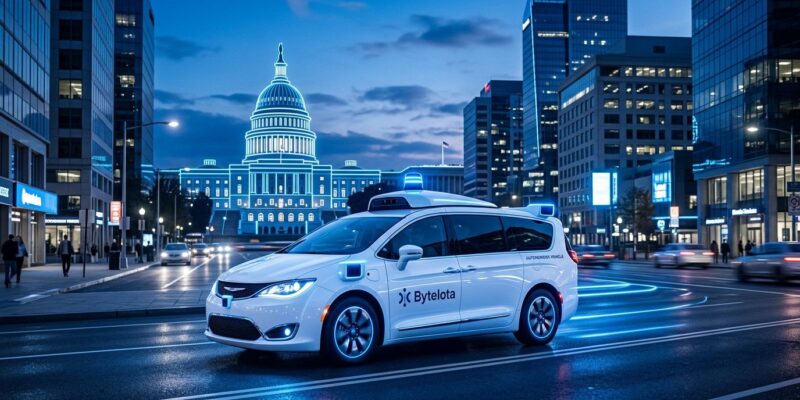
The Ojai is a purpose-built autonomous minivan manufactured by Zeekr, the EV brand owned by China’s Geely Holding Group. After a free early-access run beginning in late May, Waymo opened it to paid rides on August 19–20 across its three largest markets. Expansion to Denver, Las Vegas, and San Diego is slated for later this year, with research firm MoffettNathanson projecting 5,000 Ojai vehicles in the U.S. by year-end.
The vehicle is a significant step up in economics. Waymo’s previous platform, the Jaguar I-Pace, cost roughly $200,000 per unit. The Ojai lands at approximately $103,000 after tariffs and Waymo’s own autonomous hardware integration — nearly half the price. That cost reduction is what makes Waymo’s goal of one million paid weekly rides by end-of-year even remotely achievable. The company is already at 500,000 rides per week, generating around $355 million in annualized revenue.
The 102.5% Tariff That Didn’t Stop Anything
Waymo imported more than 3,200 Ojai vehicles through the Port of Los Angeles — 2,600 of them in 2026 alone — despite a 102.5% tariff on Chinese-manufactured EVs. That tariff inflates the $38,000 base chassis to roughly $78,000 landed. Add Waymo’s sixth-generation autonomous hardware at approximately $25,000 per vehicle, and you’re still at roughly half the cost of a Jaguar I-Pace.
To comply with the Commerce Department’s Connected Vehicle Rule, Waymo strips the Ojai of all Chinese connectivity hardware before it enters service. At the company’s Mesa, Arizona facility (operated with Magna International), Waymo installs its own sensor suite and U.S.-compliant hardware. That’s Waymo’s legal argument: the imported chassis has “no smarts, no connectivity,” in the words of Waymo Chief Safety Officer Mauricio Peña at a Senate hearing in February.
Polestar Got Banned for Less
The argument might not hold up much longer. In June 2026, the Commerce Department banned Polestar from selling its 2027 model-year vehicles in the United States. Polestar’s offense: majority ownership by Geely — the same Chinese conglomerate that owns Zeekr. The Polestar 3 was assembled in South Carolina. It didn’t matter. Ownership structure was the determining factor, not where the car was built or what hardware it ran.
Zeekr is Geely. The Ojai is a Zeekr vehicle. The regulatory logic that killed Polestar’s U.S. business applies directly to the chassis Waymo is staking its expansion on.
Congress Is Moving Fast
The Connected Vehicle Security Act of 2026 (S.4429) goes further than the existing rule. Introduced by Senator Bernie Moreno (R-OH) and Senator Elissa Slotkin (D-MI), with matching House legislation from Representatives Dingell and Moolenaar, it would ban any vehicle “designed or made by a company tied to China” from import, sale, or interstate commerce. The Senate Commerce Committee advanced it unanimously on July 22. It has 32 cosponsors.
Under S.4429, Waymo’s Mesa integration work would be irrelevant. The bill bans vehicles by manufacturer origin, not by which components cross the border. Zeekr ships the car. Zeekr is Geely. That’s the test — and the Ojai fails it.
The Problem No One Has an Answer To
At the February Senate hearing, Moreno told Waymo executives: “You said in your testimony that we’re locked in a race with China, but it seems like you’re getting in bed with China.” He’s not wrong to notice the tension. He’s also not wrong that Geely’s ownership creates a real governance question.
But the counterargument is just as uncomfortable: there is no American-made purpose-built autonomous minivan available at scale. The Ojai exists because no domestic alternative does. If Congress bans it, Waymo doesn’t automatically find a replacement — it slows down, loses cost advantage, and cedes ground in the commercial AV market it currently leads — the same market Tesla has barely begun to challenge.
Waymo’s expansion to a million rides per week depends on Ojai economics. S.4429 would end that math. Whether the bill passes or gets amended to carve out autonomous platforms like Waymo’s is the question that will determine whether U.S. regulators are serious about winning the AV race — or just serious about looking like it.