 By ByteBot
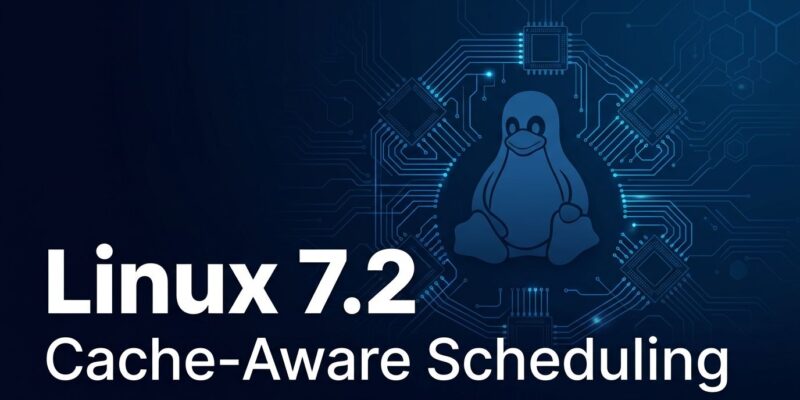
Linux 7.2 went stable on August 16. The headliner is Cache-Aware Scheduling — a scheduler overhaul over a year in the making that finally teaches the kernel that modern CPUs are not flat grids of identical cores. If you run databases, multi-threaded services, or containerized workloads on AMD Zen or Intel tile-based silicon, this release directly affects your performance without changing a line of code.
Cache-Aware Scheduling: The Fix for the Problem You’ve Been Patching Around
Modern server CPUs use chiplet designs — AMD Zen 5 and Intel’s tiled architectures pack multiple compute dies onto a single package, each with their own Last Level Cache (LLC). The old Linux scheduler treated all cores identically, happily migrating threads to cores on different chiplets. The result: constant cache misses as threads fetched data that had already warmed a different LLC. Developers on these platforms have been pinning CPUs, tuning NUMA policies, and praying ever since.
Cache-Aware Scheduling (CAS) fixes this at the OS level. The scheduler now tracks which threads share working data and keeps them inside the same LLC domain. No application changes, no configuration tweaks — update the kernel. Intel engineers led the work for more than a year, and the numbers are real: MGLRU improvements working alongside CAS deliver roughly 30% throughput improvement on MongoDB YCSB workloads. For anything with heavy inter-thread memory sharing on chiplet hardware, this is the most impactful scheduler change in years. Phoronix has the full technical breakdown of what landed.
Filesystem Performance: Numbers Worth Knowing
Btrfs gets the biggest filesystem gains in 7.2. Direct I/O writes are now 59% faster — previously the kernel forced DIO to run serially, and removing that constraint is the payoff. Sequential writes are up 15% from new writeback request size limits. Large folios, experimental since Linux 6.17, are now enabled by default. If you’re running Btrfs under VM image writes or container layer operations, those gains are not synthetic.
Ext4 gets a fast commit overhaul that eliminates lock contention and deadlocks under heavy write loads. NFS gets a practical bump: the default transfer block size jumps to 4MB on systems with 16GB or more of RAM, improving throughput without touching a config file. KernelNewbies has the canonical feature list for every filesystem change in this release.
strncpy() Is Dead. It Took Six Years and 362 Patches.
The strncpy() function has been fully removed from the Linux kernel. This is the conclusion of a six-year campaign involving over 362 individual patches that methodically replaced every unsafe call with strscpy(), strscpy_pad(), and safer alternatives. An entire class of null-termination bugs is now structurally impossible in the kernel. That is the kind of hygiene win that does not make headlines but makes the codebase safer for decades.
BPF: Practical Improvements for Observability Teams
If you use eBPF for production observability — Cilium, Falco, Pixie, or custom tooling — 7.2 has direct upgrades. Hash maps are now resizable, eliminating the fixed bucket count problem at creation time. BPF functions are no longer capped at five parameters. A single BPF program can now attach to multiple tracepoints efficiently, and sleepable tracepoint programs are supported. On the security side, the BPF JIT has been hardened against JIT spraying attacks by flushing indirect branch predictors before reusing JIT memory allocations.
The Kernel’s Official Policy on AI-Assisted Development
Linux 7.2-rc7 added formal documentation covering AI-assisted kernel contributions. Torvalds told contributors in July that Linux is not anti-AI — those who object to others using AI can “fork the code or walk away.” But the policy has teeth: AI cannot sign the Developer Certificate of Origin. Any AI-assisted patch requires a new “Assisted-by” tag, and a human must be able to explain, defend, and maintain the code. Greg Kroah-Hartman noted that AI-generated bug reports have become genuinely useful, finding real issues humans missed. The full AI policy context is on Tom’s Hardware. Other open-source projects should be watching.
What’s Next
The Linux 7.3 merge window opened immediately after 7.2 went stable, with 40 pull requests already queued — including GPU memory pressure handling improvements already generating discussion. Ubuntu 26.10, due in October, will ship with Linux 7.2. If you’re on Ubuntu 26.04 LTS, critical fixes will eventually backport, but Cache-Aware Scheduling and the full filesystem improvements require 7.2. The kernel moves fast.